Dietary Patterns as Determinants of Ferritin Status in Adolescent Girls

Downloads
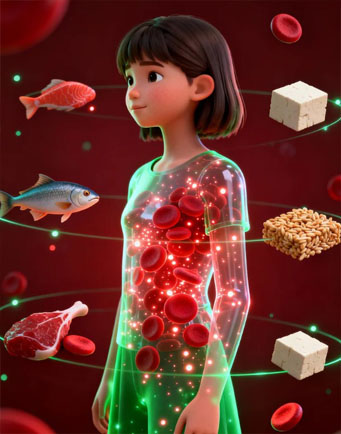
Iron deficiency, commonly indicated by low ferritin concentrations, remains a major nutritional problem among adolescent girls and poses risks to growth, cognitive development, and long-term health. While previous studies have largely focused on single nutrients or iron intake, evidence on the relationship between overall dietary patterns and ferritin status among Indonesian adolescents is limited. This study aimed to examine the association between dietary patterns and ferritin status among adolescent girls in Pekalongan, Indonesia. A cross-sectional study was conducted among 80 adolescent girls aged 15–19 years. Serum ferritin levels were measured using ELISA, and dietary patterns were derived using pattern-based dietary assessment. Age, nutrition knowledge, body mass index, physical activity, and hemoglobin concentration were also examined as potential correlates. Dietary pattern was significantly associated with ferritin status, with poorer dietary patterns linked to lower ferritin concentrations. In contrast, no significant associations were observed for body mass index, physical activity, hemoglobin levels, or other individual characteristics, suggesting that overall dietary quality may play a more prominent role in iron stores than single anthropometric or behavioral factors. Given the cross-sectional design and modest sample size, causal inference and generalizability are limited. Nevertheless, the findings highlight the potential value of improving dietary quality through adolescent-focused nutrition education and school-based nutrition strategies to support iron status and reduce the risk of iron deficiency in this population.
Abu-Baker, N. N., Eyadat, A. M., & Khamaiseh, A. M. (2021). The impact of nutrition education on knowledge, attitude, and practice regarding iron deficiency anemia among female adolescent students in Jordan. Heliyon, 7(2), e06348. https://doi.org/10.1016/j.heliyon.2021.e06348
Agarvas, A. R., Sparla, R., Atkins, J. L., Altamura, C., Anderson, T., Asicioglu, E., ... & Muckenthaler, M. U. (2025). Ferritin and transferrin predict common carotid intima-media thickness in females: a machine-learning informed individual participant data meta-analysis. MedRxiv. https://doi.org/10.1101/2025.04.30.25326720
Ajetunmobi, O. A., & Laobangdisa, S. (2024). The Effect of Cultural and Socio-economics Factors on Consumer Perception. In Consumer Perceptions and Food (pp. 23–44). Springer Nature Singapore. https://doi.org/10.1007/978-981-97-7870-6_2
Ayal, B. G., Demilew, Y. M., Derseh, H. A., & Kidie, A. A. (2022). Micronutrient intake and associated factors among school adolescent girls in Meshenti Town, Bahir Dar City Administration, Northwest Ethiopia, 2020. Plos One, 17(11), e0277263. https://doi.org/10.1371/journal.pone.0277263
Bennett, G., Bardon, L. A., & Gibney, E. R. (2022). A Comparison of Dietary Patterns and Factors Influencing Food Choice among Ethnic Groups Living in One Locality: A Systematic Review. Nutrients, 14(5), 941. https://doi.org/10.3390/nu14050941
Cohen, C. T., & Powers, J. M. (2024). Nutritional Strategies for Managing Iron Deficiency in Adolescents: Approaches to a Challenging but Common Problem. Advances in Nutrition, 15(5), 100215. https://doi.org/10.1016/j.advnut.2024.100215
Conrad, A., Burns, J., Sherburne, L., Kaled, M. D., Souley, H., & Nielsen, J. (2024). Understanding behavioural drivers of iron and folic acid supplementation and vitamin A- and iron-rich food consumption among women and adolescent girls in Niger. Public Health Nutrition, 27, e249. https://doi.org/10.1017/S1368980024002192
DePalma, R. G., Hayes, V. W., & O’Leary, T. J. (2021). Optimal serum ferritin level range: iron status measure and inflammatory biomarker. Metallomics, 13(6). https://doi.org/10.1093/mtomcs/mfab030
English, L. K., Ard, J. D., Bailey, R. L., Bates, M., Bazzano, L. A., Boushey, C. J., ... & Heymsfield, S. B. (2021). Evaluation of dietary patterns and all-cause mortality: a systematic review. JAMA network open, 4(8), e2122277. https://doi.org/10.1001/jamanetworkopen.2021.22277
Fite, M. B., Bikila, D., Habtu, W., Tura, A. K., Yadeta, T. A., Oljira, L., & Roba, K. T. (2022). Beyond hemoglobin: uncovering iron deficiency and iron deficiency anemia using serum ferritin concentration among pregnant women in eastern Ethiopia: a community-based study. BMC Nutrition, 8(1), 82. https://doi.org/10.1186/s40795-022-00579-8
Fu, J., Zeng, C., Huang, J., Guo, J., Su, Z., Luo, S., ... & Li, Y. (2024). Dietary patterns and association with Iron deficiency among children and adolescents aged 9–17 years in rural Guangzhou, China: a cross-sectional study. Frontiers in Nutrition, 11, 1443849. https://doi.org/10.3389/fnut.2024.1443849
Ge, S., Ali, S., Haldane, V., Bekdache, C., Tang, G. H., & Sholzberg, M. (2025). An approach to Hemequity: Identifying the barriers and facilitators of iron deficiency reduction strategies in low‐ to middle‐income countries. British Journal of Haematology, 206(2), 428–442. https://doi.org/10.1111/bjh.19984
Gherasim, A., Arhire, L. I., Niță, O., Popa, A. D., Graur, M., & Mihalache, L. (2020). The relationship between lifestyle components and dietary patterns. Proceedings of the Nutrition Society, 79(3), 311–323. https://doi.org/10.1017/S0029665120006898
Hallström, E., Löfvenborg, J. E., Moreaus, L., Sjöberg, A., Winkvist, A., & Lindroos, A. K. (2025). Iron intake and iron status of Swedish adolescents with diets of varying climate impact. European Journal of Nutrition, 64(2), 93. https://doi.org/10.1007/s00394-024-03572-y
Hassan, F., Kalsoom, S., Sheikh, N. H., & Humayun, A. (2020). Factors affecting food consumption patterns and dietary practices of adolescent girls: an explanatory sequential mixed method study. Annals of King Edward Medical University, 26(1), 9–18.
Islam, M., Trenholm, J., Rahman, A., Pervin, J., Ekström, E.-C., & Rahman, S. (2019). Sociocultural Influences on Dietary Practices and Physical Activity Behaviors of Rural Adolescents—A Qualitative Exploration. Nutrients, 11(12), 2916. https://doi.org/10.3390/nu11122916
Khani Jeihooni, A., Hoshyar, S., Afzali Harsini, P., & Rakhshani, T. (2021). The effect of nutrition education based on PRECEDE model on iron deficiency anemia among female students. BMC Women’s Health, 21(1), 256. https://doi.org/10.1186/s12905-021-01394-2
Knijff, M., Roshita, A., Suryantan, J., Izwardy, D., & Rah, J. H. (2021). Frequent Consumption of Micronutrient-Rich Foods Is Associated With Reduced Risk of Anemia Among Adolescent Girls and Boys in Indonesia: A Cross-Sectional Study. Food and Nutrition Bulletin, 42(1_suppl), S59–S71. https://doi.org/10.1177/0379572120977455
Kolarš, B., Mijatović Jovin, V., Živanović, N., Minaković, I., Gvozdenović, N., Dickov Kokeza, I., & Lesjak, M. (2025). Iron Deficiency and Iron Deficiency Anemia: A Comprehensive Overview of Established and Emerging Concepts. Pharmaceuticals, 18(8), 1104. https://doi.org/10.3390/ph18081104
Ma, J., Huang, J., Zeng, C., Zhong, X., Zhang, W., Zhang, B., & Li, Y. (2023). Dietary Patterns and Association with Anemia in Children Aged 9–16 Years in Guangzhou, China: A Cross-Sectional Study. Nutrients, 15(19), 4133. https://doi.org/10.3390/nu15194133
Mama Chabi, S., Fanou-Fogny, N., Nago Koukoubou, E., Deforche, B., & Van Lippevelde, W. (2022). Factors Explaining Adolescent Girls’ Eating Habits in Urban Benin: A Qualitative Study. Adolescents, 2(2), 205–219. https://doi.org/10.3390/adolescents2020017
Mei, Z., Addo, O. Y., Jefferds, M. E., Sharma, A. J., Flores-Ayala, R. C., & Brittenham, G. M. (2021). Physiologically based serum ferritin thresholds for iron deficiency in children and non-pregnant women: a US National Health and Nutrition Examination Surveys (NHANES) serial cross-sectional study. The Lancet Haematology, 8(8), e572–e582. https://doi.org/10.1016/S2352-3026(21)00168-X
Obeagu, E. I. (2025). Iron homeostasis and health: understanding its role beyond blood health – a narrative review. Annals of Medicine & Surgery, 87(6), 3362–3371. https://doi.org/10.1097/MS9.0000000000003100
Putri, F., Suyanto, S., Restila, R., Laksono, A. D., & Sundjaya, T. (2025). Exploring the role of nutritional status and anthropometric factors in anemia among adolescent girls in Pekanbaru, Indonesia. SAGE Open Medicine, 13, 1-10. https://doi.org/10.1177/20503121251355406
Samson, K. L. I., Fischer, J. A. J., & Roche, M. L. (2022). Iron Status, Anemia, and Iron Interventions and Their Associations with Cognitive and Academic Performance in Adolescents: A Systematic Review. Nutrients, 14(1), 224. https://doi.org/10.3390/nu14010224
Soans, J. S., Noronha, J. A., Mundkur, S. C., Nayak, B. S., Garg, M., Jathanna, R. D., & Mathias, E. G. (2025). Mapping evidence on the impact of junk food on anaemia among adolescent and adult population: a scoping review. BMC Nutrition, 11(1), 96. https://doi.org/10.1186/s40795-025-01079-1
Soliman, A. T., Alaaraj, N., Noor Hamed, Alyafei, F., Ahmed, S., Shaat, M., Itani, M., Elalaily, R., & Soliman, N. (2022). Review Nutritional interventions during adolescence and their possible effects. Acta Bio-Medica : Atenei Parmensis, 93(1), e2022087. https://doi.org/10.23750/abm.v93i1.12789
Stubbendorff, A., Borgström Bolmsjö, B., Bejersten, T., Warensjö Lemming, E., Calling, S., & Wolff, M. (2025). Iron insight: exploring dietary patterns and iron deficiency among teenage girls in Sweden. European Journal of Nutrition, 64(3), 107. https://doi.org/10.1007/s00394-025-03630-z
Vajdi, M., & Farhangi, M. A. (2020). A systematic review of the association between dietary patterns and health-related quality of life. Health and Quality of Life Outcomes, 18(1), 337. https://doi.org/10.1186/s12955-020-01581-z
Wiafe, M. A., Apprey, C., & Annan, R. A. (2023). Nutrition Education Improves Knowledge of Iron and Iron-Rich Food Intake Practices among Young Adolescents: A Nonrandomized Controlled Trial. International Journal of Food Science, 2023, 1–10. https://doi.org/10.1155/2023/1804763
World Health Organization. (2020). WHO guideline on use of ferritin concentrations to assess iron status in populations. World Health Organization.
Yunanci, S., Risma, R., Masrif, M., & Mulianingsih, M. (2023). A literature review of the relation between iron deficiency anaemia, physical activity and cognitive function in adolescent girls. Scripta Medica, 54(4), 405–412. https://doi.org/10.5937/scriptamed54-46534
Copyright (c) 2026 JURNAL INFO KESEHATAN

This work is licensed under a Creative Commons Attribution-NonCommercial-ShareAlike 4.0 International License.
Copyright notice
Ownership of copyright
The copyright in this website and the material on this website (including without limitation the text, computer code, artwork, photographs, images, music, audio material, video material and audio-visual material on this website) is owned by JURNAL INFO KESEHATAN and its licensors.
Copyright license
JURNAL INFO KESEHATAN grants to you a worldwide non-exclusive royalty-free revocable license to:
- view this website and the material on this website on a computer or mobile device via a web browser;
- copy and store this website and the material on this website in your web browser cache memory; and
- print pages from this website for your use.
- All articles published by JURNAL INFO KESEHATAN are licensed under the Creative Commons Attribution 4.0 International License. This permits anyone to copy, redistribute, remix, transmit and adapt the work provided the original work and source is appropriately cited.
JURNAL INFO KESEHATAN does not grant you any other rights in relation to this website or the material on this website. In other words, all other rights are reserved.
For the avoidance of doubt, you must not adapt, edit, change, transform, publish, republish, distribute, redistribute, broadcast, rebroadcast or show or play in public this website or the material on this website (in any form or media) without appropriately and conspicuously citing the original work and source or JURNAL INFO KESEHATAN prior written permission.
Permissions
You may request permission to use the copyright materials on this website by writing to [email protected].
Enforcement of copyright
JURNAL INFO KESEHATAN takes the protection of its copyright very seriously.
If JURNAL INFO KESEHATAN discovers that you have used its copyright materials in contravention of the license above, JURNAL INFO KESEHATAN may bring legal proceedings against you seeking monetary damages and an injunction to stop you using those materials. You could also be ordered to pay legal costs.
If you become aware of any use of JURNAL INFO KESEHATAN copyright materials that contravenes or may contravene the license above, please report this by email to [email protected]
Infringing material
If you become aware of any material on the website that you believe infringes your or any other person's copyright, please report this by email to [email protected].