Hypertension and Salt Consumption: A Story from A Coastal Area

Downloads
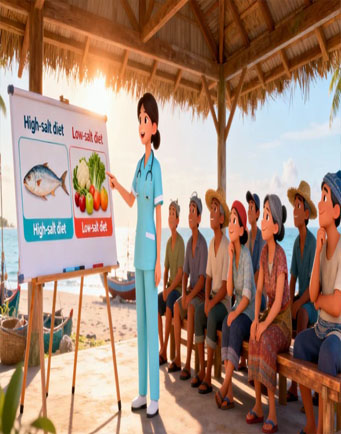
Indonesia has a high prevalence of hypertension accompanied by relatively high salt consumption, posing a significant public health concern, particularly in coastal areas where salty foods and saline water are commonly available. This study aimed to analyze the relationship between salt consumption and hypertension grade among residents in a coastal area. A cross-sectional study was conducted involving 174 hypertensive patients in Pangandaran District who had recorded blood pressure measurements at the local health center. Data on respondents’ characteristics, including age, sex, education level, occupation, and income, were collected. Salt intake was assessed using a Semi-Quantitative Food Frequency Questionnaire (SQ-FFQ). Multiple logistic regression analysis was performed to examine the association between salt consumption and hypertension grade while controlling for potential confounding variables. The mean sodium intake among respondents was 1312.11 ± 596.27 mg/day. Salt consumption was significantly associated with hypertension grade (β = 0.001; p = 0.004) after adjustment for education level and type of occupation. In conclusion, higher salt consumption is significantly associated with increased severity of hypertension in coastal populations, highlighting the need for targeted dietary interventions to reduce salt intake in these areas.
Adrian, S. J. (2019). Pengobatan Tradisional Akupresur di Era Moderen Pada Masyarakat. Jurnal Cermin Dunia Kedokteran (CDK), 46(3), 172–178.
Aristi, D. L. A., Rasni, H., Susumaningrum, L. A., Susanto, T., & Siswoyo, S. (2020). Hubungan Konsumsi Makanan Tinggi Natrium dengan Kejadian Hipertensi pada Buruh Tani di Wilayah Kerja Puskesmas Panti Kabupaten Jember. Buletin Penelitian Sistem Kesehatan, 23(1), 53-60. https://doi.org/10.22435/hsr.v23i1.2741
Badan Penelitian dan Pengembangan Kesehatan. (2013). Riset Kesehatan Dasar 2013. Jakarta: Badan Penelitian dan Pengembangan Kesehatan.
Badan Penelitian dan Pengembangan Kesehatan. (2019). Laporan Nasional Riskesdas 2018. Jakarta: Badan Penelitian dan Pengembangan Kesehatan.
Choi, H. M., Kim, H. C., & Kang, D. R. (2017). Sex differences in hypertension prevalence and control: Analysis of the 2010-2014 Korea national health and nutrition examination survey. PLoS ONE, 12(5), 1–12. https://doi.org/10.1371/journal.pone.0178334
Defianna, S. R., Santosa, A., Probandari, A., & Dewi, F. S. T. (2021). Gender differences in prevalence and risk factors for hypertension among adult populations: a cross-sectional study in Indonesia. International journal of environmental research and public health, 18(12), 6259. https://doi.org/10.3390/ijerph18126259
Farapti, F., Fatimah, A. D., Astutik, E., Hidajah, A. C., & Rochmah, T. N. (2020). Awareness of Salt Intake among Community‐Dwelling Elderly at Coastal Area: The Role of Public Health Access Program. Journal of nutrition and metabolism, 2020(1), 8793869. https://doi.org/10.1155/2020/8793869
Hussain, M. A., Mamun, A. A., Reid, C., & Huxley, R. R. (2016). Prevalence, awareness, treatment and control of hypertension in Indonesian adults aged≥ 40 years: findings from the Indonesia Family Life Survey (IFLS). PloS one, 11(8), e0160922. https://doi.org/10.1371/journal.pone.0160922
Joshi, V., Joshi, N. K., Suthar, P., & Jain, Y. K. (2021). Non-communicable diseases risk factors among government school teachers in Jodhpur, Rajasthan. International Journal of Public Health Science, 10(4), 920-926. https://doi.org/10.11591/ijphs.v10i4.20895
Kario, K., Okura, A., Hoshide, S., & Mogi, M. (2024). The WHO Global report 2023 on hypertension warning the emerging hypertension burden in globe and its treatment strategy. Hypertension Research, 47(5), 1099–1102. https://doi.org/10.1038/s41440-024-01622-w
Kassie, S. A., Michael Beyene, K. G., & Tiruneh, M. A. (2020). Determinants of hypertension among adults living in bole sub-city, Addis Ababa. International Journal of Public Health Science, 9(2), 121–128. https://doi.org/10.11591/ijphs.v9i2.20427
Kementerian Kesehatan Republik Indonesia. (2023). Peraturan Menteri Kesehatan Nomor 30 Tahun 2013 tentang Pencantuman Informasi Kandungan Gula, Garam, dan Lemak Serta Pesan Kesehatan untuk Pangan Olahan dan Pangan Siap Saji. Jakarta: Kementerian Kesehatan Republik Indonesia. Retrieved from: https://peraturan.bpk.go.id/Details/172111/permenkes-no-30-tahun-2013
Khan, J. R., Awan, N., Archie, R. J., Sultana, N., & Muurlink, O. (2020). The association between drinking water salinity and hypertension in coastal Bangladesh. Global Health Journal, 4(4), 153-158. https://doi.org/10.1016/j.glohj.2020.11.001
Kurnianto, A., Kurniadi Sunjaya, D., Ruluwedrata Rinawan, F., & Hilmanto, D. (2020). Prevalence of hypertension and its associated factors among Indonesian adolescents. International Journal of Hypertension, 2020(1), 4262034. https://doi.org/10.1155/2020/4262034
Nuraili, M. P., Respati, T., & Sopian, E. (2020). Gambaran BMI dan Tekanan Darah pada Penderita Tuberkulosis dan Non Tuberkulosis di Desa Pangalengan. Jurnal Integrasi Kesehatan dan Sains, 2(2), 150-153.
Nurmayanti, H. (2022). Efektivitas Pemberian Konseling Tentang Diet Dash terhadap Asupan Natrium, Kalium, Kalsium, Magnesium, Aktivitas Fisik, dan Tekanan Darah Pasien Hipertensi. Nutriture Journal, 1(1), 49–61. https://doi.org/10.31290/nj.v1i1.3531
Ramdhani, R., Respati, T., & Irasanti, S. N. (2013). Karakteristik dan gaya hidup pasien hipertensi di Rumah Sakit Al-Islam Bandung. Global Medical & Health Communication (GMHC), 1(2), 63-68. Retrieved from: https://ejournal.unisba.ac.id/index.php/gmhc/article/view/1521
Rossier, B. C., Bochud, M., & Devuyst, O. (2017). The hypertension pandemic: An evolutionary perspective. Physiology, 32(2), 112–125. https://doi.org/10.1152/physiol.00026.2016
Shaikh, M. M., Alkhayari, A. H. Z., Alabdulsalam, Q. A. K., Alhashmi, K., & Nadar, S. K. (2022). Estimation of Salt Intake and its Relation to Knowledge and Attitude Regarding the Dangers of High Salt Intake among an Urban Omani Population A pilot study. Sultan Qaboos University Medical Journal, 22(4), 486–492. https://doi.org/10.18295/squmj.9.2021.134
Siregar, P. A., Simanjuntak, S. F. S., Ginting, F. H. B., Tarigan, S., Hanum, S., & Utami, F. S. (2020). Aktivitas Fisik, Konsumsi Makanan Asin dan Kejadian Hipertensi Masyarakat Pesisir Kota Medan. Jurnal Ilmiah Kesehatan (JIKA), 2(1), 1-8.
Sugiharto, A. (2007). Faktor-faktor risiko hipertensi grade II pada masyarakat (studi kasus di kabupaten Karanganyar). Master Thesis. Universitas Diponegoro.
Syifadhiya, Q., & Farapti, F. (2023). Hubungan Ambang Rasa Asin dengan Kejadian Hipertensi pada Remaja di Surabaya. Amerta Nutrition, 7(4), 487-493. https://doi.org/10.20473/amnt.v7i4.2023.487-493
Thow, A. M., Farrell, P., Helble, M., & Rachmi, C. N. (2020). Eating in developing Asia: trends, consequences and policies. Asian Development Bank.
Unger, T., Borghi, C., Charchar, F., Khan, N. A., Poulter, N. R., Prabhakaran, D., ... & Schutte, A. E. (2020). 2020 International Society of Hypertension global hypertension practice guidelines. Hypertension, 75(6), 1334-1357. https://doi.org/10.1161/HYPERTENSIONAHA.120.15026
Williams, B., Mancia, G., Spiering, W., Agabiti Rosei, E., Azizi, M., Burnier, M., ... & Desormais, I. (2018). 2018 ESC/ESH Guidelines for the management of arterial hypertension: The Task Force for the management of arterial hypertension of the European Society of Cardiology (ESC) and the European Society of Hypertension (ESH). European heart journal, 39(33), 3021-3104. https://doi.org/10.1093/eurheartj/ehy339
World Health Organization (WHO). (2021). Guideline for the pharmacological treatment of hypertension in adults. Geneva: World Health Organization. Retrieved from: https://www.who.int/publications/i/item/9789240033986
Yulianto, F. A., Romadhona, N., Rosarianto, F., Rahmanda, V., Barlian, S., Tania, T. A., ... & Nugroho, H. (2020). Probability of Hypertension in Advancing Ages of Women. GMHC, 8(2), 148-154. https://doi.org/10.29313/gmhc.v8i2.6340
Zhou, B., Carrillo-Larco, R. M., Danaei, G., Riley, L. M., Paciorek, C. J., Stevens, G. A., ... & Breckenkamp, J. (2021). Worldwide trends in hypertension prevalence and progress in treatment and control from 1990 to 2019: a pooled analysis of 1201 population-representative studies with 104 million participants. The lancet, 398(10304), 957-980. https://doi.org/10.1016/S0140-6736(21)01330-1
Copyright (c) 2025 JURNAL INFO KESEHATAN

This work is licensed under a Creative Commons Attribution-NonCommercial-ShareAlike 4.0 International License.
Copyright notice
Ownership of copyright
The copyright in this website and the material on this website (including without limitation the text, computer code, artwork, photographs, images, music, audio material, video material and audio-visual material on this website) is owned by JURNAL INFO KESEHATAN and its licensors.
Copyright license
JURNAL INFO KESEHATAN grants to you a worldwide non-exclusive royalty-free revocable license to:
- view this website and the material on this website on a computer or mobile device via a web browser;
- copy and store this website and the material on this website in your web browser cache memory; and
- print pages from this website for your use.
- All articles published by JURNAL INFO KESEHATAN are licensed under the Creative Commons Attribution 4.0 International License. This permits anyone to copy, redistribute, remix, transmit and adapt the work provided the original work and source is appropriately cited.
JURNAL INFO KESEHATAN does not grant you any other rights in relation to this website or the material on this website. In other words, all other rights are reserved.
For the avoidance of doubt, you must not adapt, edit, change, transform, publish, republish, distribute, redistribute, broadcast, rebroadcast or show or play in public this website or the material on this website (in any form or media) without appropriately and conspicuously citing the original work and source or JURNAL INFO KESEHATAN prior written permission.
Permissions
You may request permission to use the copyright materials on this website by writing to [email protected].
Enforcement of copyright
JURNAL INFO KESEHATAN takes the protection of its copyright very seriously.
If JURNAL INFO KESEHATAN discovers that you have used its copyright materials in contravention of the license above, JURNAL INFO KESEHATAN may bring legal proceedings against you seeking monetary damages and an injunction to stop you using those materials. You could also be ordered to pay legal costs.
If you become aware of any use of JURNAL INFO KESEHATAN copyright materials that contravenes or may contravene the license above, please report this by email to [email protected]
Infringing material
If you become aware of any material on the website that you believe infringes your or any other person's copyright, please report this by email to [email protected].