Web-Based Electrocardiography Learning Application Development for Basic Trauma and Cardiac Life Support Training

Downloads
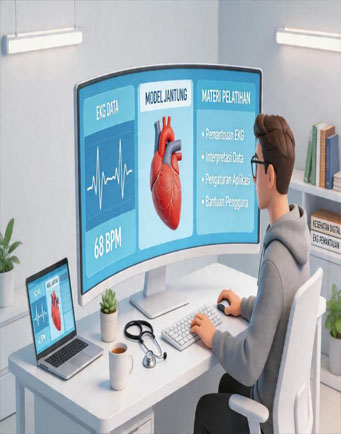
Electrocardiography (ECG) interpretation is an essential competency for healthcare providers, particularly nurses, in managing cardiac emergencies during Basic Trauma and Cardiac Life Support (BT&CLS). However, ECG learning in BT&CLS training is still predominantly delivered through conventional, paper-based methods, which may limit learners’ ability to rapidly and accurately interpret cardiac rhythms. Advances in web-based learning offer opportunities to enhance flexibility, interactivity, and learner engagement in emergency care education. This study aimed to develop and evaluate a web-based ECG learning application for BT&CLS training, focusing on its usability and technology acceptance. This study employed a mixed-method Research and Development (R&D) design combined with a quantitative approach. The web-based application was designed to include ECG theory modules, rhythm interpretation exercises, interactive quizzes with immediate feedback, and progress tracking features. Usability was assessed using an adapted System Usability Scale (SUS), while technology acceptance was measured using a modified Technology Acceptance Model (TAM) questionnaire. A total of 31 participants involved in BT&CLS training were recruited. Instrument reliability testing demonstrated excellent internal consistency. The results indicated high levels of user agreement across all usability dimensions, including functionality, reliability, ease of use, and portability of the application. Furthermore, all TAM components perceived usefulness, perceived ease of use, user attitude, behavioral intention, and user trust were rated in the high category. Participants reported that the application was intuitive, supportive of self-paced learning, and relevant to the competencies required in BT&CLS training. Overall usability and technology acceptance findings indicate that the web-based application effectively addresses key limitations of traditional paper-based ECG learning by enhancing flexibility, interactivity, and learner engagement in BT&CLS training. These findings suggest that digital learning tools can support self-paced practice and reinforce ECG interpretation competencies required in emergency care contexts. The developed web-based ECG learning application demonstrated strong usability and high technology acceptance among BT&CLS trainees. The application shows substantial potential to be integrated into BT&CLS training programs as a complementary learning tool, supporting flexible, interactive, and learner-centered acquisition of ECG interpretation skills. Further studies are recommended to evaluate its effectiveness in improving learning outcomes and clinical performance in emergency settings.
Agustini, N. L. P. I. B., Dewi, N. P. A. R., Putra, K. A. N., & Sanjana, W. E. (2025). Usability and functionality of M-DFEET application for the independence of foot care in diabetes mellitus patients. The Medical Journal of Malaysia, 80(2), 178–182. https://mail.e-mjm.org/2025/v80n2/v80-no-2-2025.pdf
Agustini, N. L. P. I. B., Ni Wayan Suniyadewi, I Dewa Ayu Rismayanti, Virgianti Nur Faridah, Resti Utami, Arifal Aris, & Nursalam Nursalam. (2022). Development and Validation of Android Based Mobile App For Diabetic Foot Early Self-Assessment. Malaysian Journal of Public Health Medicine, 22(2 SE-Articles), 95–102. Retrieved from ttps://www.mjphm.org/index.php/mjphm/article/view/1571/534
Byrne, R. A., Rossello, X., Coughlan, J. J., Barbato, E., Berry, C., Chieffo, A., Claeys, M. J., Dan, G.-A., Dweck, M. R., Galbraith, M., Gilard, M., Hinterbuchner, L., Jankowska, E. A., Jüni, P., Kimura, T., Kunadian, V., Leosdottir, M., Lorusso, R., Pedretti, R. F. E., … Ibanez, B. (2023). 2023 ESC Guidelines for the management of acute coronary syndromes. European Heart Journal, 44(38), 3720–3826. https://doi.org/10.1093/eurheartj/ehad191
Car, L. T., Poon, S., Kyaw, B. M., Cook, D. A., Ward, V., Atun, R., Majeed, A., Johnston, J., van der Kleij, R. M. J. J., Molokhia, M., V Wangenheim, F., Lupton, M., Chavannes, N., Ajuebor, O., Prober, C. G., & Car, J. (2022). Digital Education for Health Professionals: An Evidence Map, Conceptual Framework, and Research Agenda. Journal of Medical Internet Research, 24(3). https://doi.org/https://doi.org/10.2196/31977.
Cheah, W.-H., Mat Jusoh, N., Aung, M. M. T., Ab Ghani, A., & Mohd Amin Rebuan, H. (2023). Mobile Technology in Medicine: Development and Validation of an Adapted System Usability Scale (SUS) Questionnaire and Modified Technology Acceptance Model (TAM) to Evaluate User Experience and Acceptability of a Mobile Application in MRI Safety Screenin. The Indian Journal of Radiology & Imaging, 33(1), 36–45. https://doi.org/10.1055/s-0042-1758198.
Chen, Y., Ferguson, C., Cartledge, S., Colgan, J., Hendriks, J. M., Keller, K., & Lin, F. F. (2025). Nurse educators’ expectations, training, and assessments of electrocardiogram interpretation among Australian acute care nurses: a national survey. European Journal of Cardiovascular Nursing, 24(7), 1077–1086. https://doi.org/10.1093/eurjcn/zvaf088.
Dahbi, A., Breboneria, B. J. L., Ali, S. M. A., Mejia, P. C. G., Cordero, R. P., & Rosita, A. (2025). Effectiveness of Basic Trauma Nursing Management Course (BTNMC) in the level of knowledge among staff nurses. International Journal of Africa Nursing Sciences, 22, 100839. https://doi.org/https://doi.org/10.1016/j.ijans.2025.100839
Flores-Martin, D., Díaz-Barrancas, F., Pardo, P. J., Berrocal, J., & Murillo, J. M. (2025). ECG Twin Mentor: A digital twin-based system for personalized ECG learning and support. SoftwareX, 32, 102398. https://doi.org/https://doi.org/10.1016/j.softx.2025.102398.
Giebel, G. D., Speckemeier, C., Abels, C., Plescher, F., Börchers, K., Wasem, J., Blase, N., & Neusser, S. (2023). Problems and Barriers Related to the Use of Digital Health Applications: Scoping Review. J Med Internet Res, 25, e43808. https://doi.org/10.2196/43808.
Johnson, S. G., Potrebny, T., Larun, L., Ciliska, D., & Olsen, N. R. (2022). Usability Methods and Attributes Reported in Usability Studies of Mobile Apps for Health Care Education: Scoping Review. JMIR Med Educ, 8(2), e38259. https://doi.org/10.2196/38259
Kashou, A. H., Noseworthy, P. A., Beckman, T. J., Anavekar, N. S., Cullen, M. W., Angstman, K. B., Sandefur, B. J., Shapiro, B. P., Wiley, B. W., Kates, A. M., Sadhu, J., Thakker, P., Huneycutt, D., Braisted, A., Smith, S. W., Baranchuk, A., Grauer, K., O’Brien, K., Kaul, V., … May, A. M. (2024). EDUCATE: An international, randomized controlled trial for teaching electrocardiography. Current Problems in Cardiology, 49(3), 102409. https://doi.org/10.1016/j.cpcardiol.2024.102409
Köhler, S. M., Holtz, S., Neff, M. C., Schaaf, J., von Wagner, M., Müller, B. S., & Schütze, D. (2025). Evaluating the Prototype of a Clinical Decision Support System in Primary Care: Qualitative Study. JMIR Formative Research, 9, e69875–e69875. https://doi.org/10.2196/69875.
Krasne, S., Stevens, C. D., Kellman, P. J., & Niemann, J. T. (2021). Mastering Electrocardiogram Interpretation Skills Through a Perceptual and Adaptive Learning Module. AEM Education and Training, 5(2), e10454. https://doi.org/10.1002/aet2.10454.
Lee, J. W. Y., Tan, J. Y., & Bello, F. (2025). Technology Acceptance Model in Medical Education: Systematic Review. JMIR Medical Education, 11, e67873. https://doi.org/10.2196/67873
Lee, S., Kim, H. J., Choi, Y., Kim, J. Y., & Sun Shin, J. (2024). Effectiveness of electrocardiogram interpretation education program using mixed learning methods and webpage. BMC Medical Education, 24(1), 1039. https://doi.org/10.1186/s12909-024-05960-8
Lewis, J. R. (2018). The System Usability Scale: Past, Present, and Future. International Journal of Human–Computer Interaction, 34(7), 577–590. https://doi.org/10.1080/10447318.2018.1455307.
Lin, Y.-T., Chen, H.-A., Wu, H.-Y., Fan, C.-M., Hsu, J.-C., & Chen, K.-C. (2023). Influence of the Door-to-ECG Time on the Prognosis of Patients with Acute Coronary Syndrome. Acta Cardiologica Sinica, 39(1), 127–134. https://doi.org/10.6515/ACS.202301_39(1).20220602B.
Mahdavi Ardestani, S. F., Adibi, S., Golshan, A., & Sadeghian, P. (2023). Factors Influencing the Effectiveness of E-Learning in Healthcare: A Fuzzy ANP Study. Healthcare, 11(14), 2035. https://doi.org/10.3390/healthcare11142035
Mastour, H., Yousefi, R., & Niroumand, S. (2025). Exploring the acceptance of e-learning in health professions education in Iran based on the technology acceptance model (TAM). Scientific Reports, 15(1), 8178. https://doi.org/10.1038/s41598-025-90742-5.
McGee, R. G., Wark, S., Mwangi, F., Drovandi, A., Alele, F., & Malau-Aduli, B. S. (2024). Digital learning of clinical skills and its impact on medical students’ academic performance: a systematic review. BMC Medical Education, 24(1), 1477. https://doi.org/10.1186/s12909-024-06471-2.
Rahimpour, M., Shahbazi, S., Ghafourifard, M., Gilani, N., & Breen, C. (2021). Electrocardiogram interpretation competency among emergency nurses and emergency medical service (EMS) personnel: A cross-sectional and comparative descriptive study. Nursing Open, 8(4), 1712–1719. https://doi.org/10.1002/nop2.809
Ryan, A. T., Judd, T., Wilson, C., Larsen, D. P., Elliott, S., Kulasegaram, K., & Swanson, D. (2024). Timing’s not everything: Immediate and delayed feedback are equally beneficial for performance in formative multiple-choice testing. Medical Education, 58(7), 838–847. https://doi.org/https://doi.org/10.1111/medu.15287
Sanjana, I. W. E., & Pertama, P. P. G. P. (2025). Testing the Validity and Reliability of the "SICEPAT Anak" Application Prototype Using the System Usability Scale (SUS) and Technology Acceptance Model (TAM). Jurnal Gema Keperawatan, 18(2), 102-112. (in Indonesian). https://ejournal.poltekkes-denpasar.ac.id/index.php/JGK/article/view/4938
Siebert, J. N., Bloudeau, L., Combescure, C., Haddad, K., Hugon, F., Suppan, L., Rodieux, F., Lovis, C., Gervaix, A., Ehrler, F., & Manzano, S. (2021). Effect of a Mobile App on Prehospital Medication Errors During Simulated Pediatric Resuscitation A Randomized Clinical Trial. JAMA Network Open, 4(8), 1–13. https://doi.org/10.1001/jamanetworkopen.2021.23007
Siebert, J. N., Gosetto, L., Sauvage, M., Bloudeau, L., Suppan, L., Rodieux, F., Haddad, K., Hugon, F., Gervaix, A., Lovis, C., Combescure, C., Manzano, S., & Ehrler, F. (2022). Usability Testing and Technology Acceptance of an mHealth App at the Point of Care During Simulated Pediatric In- and Out-of-Hospital Cardiopulmonary Resuscitations: Study Nested Within 2 Multicenter Randomized Controlled Trials. JMIR Human Factors, 9(1), e35399. https://doi.org/10.2196/35399
Soar, J., Böttiger, B. W., Carli, P., Couper, K., Deakin, C. D., Djärv, T., Lott, C., Olasveengen, T., Paal, P., Pellis, T., Perkins, G. D., Sandroni, C., & Nolan, J. P. (2021). European Resuscitation Council Guidelines 2021: Adult advanced life support. Resuscitation, 161, 115–151. https://doi.org/10.1016/j.resuscitation.2021.02.010
Urstad, K. H., Navarro-Illana, E., Oftedal, B., Whittingham, K., Alamar, S., Windle, R., Løkken, A., Taylor, M., Larsen, M. H., Narayasanamy, M., Sancho-Pelluz, J., Navarro-Illana, P., & Wharrad, H. (2021). Usability and value of a digital learning resource in nursing education across European countries: a cross-sectional exploration. BMC Nursing, 20(1), 161. https://doi.org/10.1186/s12912-021-00681-5
Viberg, O., Kizilcec, R. F., Jivet, I., Martínez Monés, A., Oh, A., Mutimukwe, C., Hrastinski, S., & Scheffel, M. (2024). Cultural differences in students’ privacy concerns in learning analytics across Germany, South Korea, Spain, Sweden, and the United States. Computers in Human Behavior Reports, 14, 100416. https://doi.org/https://doi.org/10.1016/j.chbr.2024.100416.
Viljoen, C. A., Millar, R. S., Manning, K., & Burch, V. C. (2020). Effectiveness of blended learning versus lectures alone on ECG analysis and interpretation by medical students. BMC Medical Education, 20(1), 488. https://doi.org/10.1186/s12909-020-02403-y
Wang, W., Choi, D., & Yu, C. H. (2023). Effective web-based clinical practice guidelines resources: recommendations from a mixed methods usability study. BMC Primary Care, 24(1), 29. https://doi.org/10.1186/s12875-023-01974-1
Copyright (c) 2026 JURNAL INFO KESEHATAN

This work is licensed under a Creative Commons Attribution-NonCommercial-ShareAlike 4.0 International License.
Copyright notice
Ownership of copyright
The copyright in this website and the material on this website (including without limitation the text, computer code, artwork, photographs, images, music, audio material, video material and audio-visual material on this website) is owned by JURNAL INFO KESEHATAN and its licensors.
Copyright license
JURNAL INFO KESEHATAN grants to you a worldwide non-exclusive royalty-free revocable license to:
- view this website and the material on this website on a computer or mobile device via a web browser;
- copy and store this website and the material on this website in your web browser cache memory; and
- print pages from this website for your use.
- All articles published by JURNAL INFO KESEHATAN are licensed under the Creative Commons Attribution 4.0 International License. This permits anyone to copy, redistribute, remix, transmit and adapt the work provided the original work and source is appropriately cited.
JURNAL INFO KESEHATAN does not grant you any other rights in relation to this website or the material on this website. In other words, all other rights are reserved.
For the avoidance of doubt, you must not adapt, edit, change, transform, publish, republish, distribute, redistribute, broadcast, rebroadcast or show or play in public this website or the material on this website (in any form or media) without appropriately and conspicuously citing the original work and source or JURNAL INFO KESEHATAN prior written permission.
Permissions
You may request permission to use the copyright materials on this website by writing to [email protected].
Enforcement of copyright
JURNAL INFO KESEHATAN takes the protection of its copyright very seriously.
If JURNAL INFO KESEHATAN discovers that you have used its copyright materials in contravention of the license above, JURNAL INFO KESEHATAN may bring legal proceedings against you seeking monetary damages and an injunction to stop you using those materials. You could also be ordered to pay legal costs.
If you become aware of any use of JURNAL INFO KESEHATAN copyright materials that contravenes or may contravene the license above, please report this by email to [email protected]
Infringing material
If you become aware of any material on the website that you believe infringes your or any other person's copyright, please report this by email to [email protected].