Dose-Dependent Effect of Ethanol Extract of Red Ginger (Zingiber officinale var. rubrum) on Total Cholesterol Levels in Hypercholesterolemic Mice: An Experimental Study

Downloads
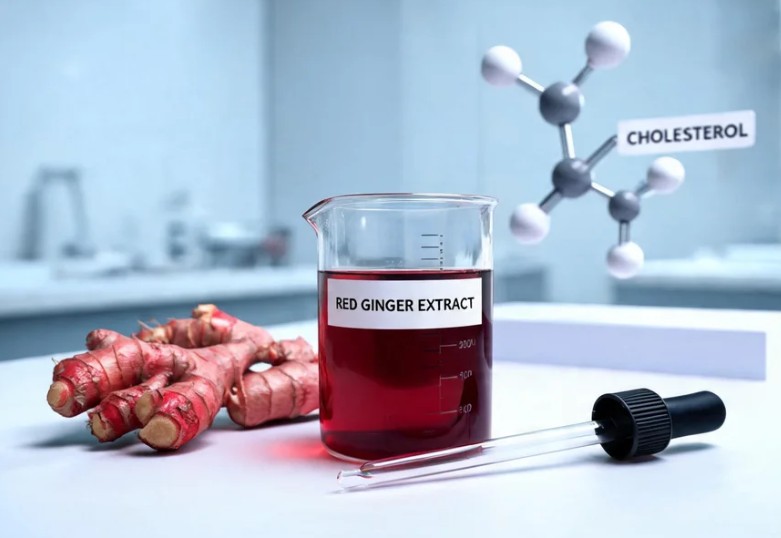
Cholesterol is an essential lipid in the body; however, excessive levels may lead to hypercholesterolemia and increase the risk of coronary heart disease. Natural alternatives such as red ginger extract (Zingiber officinale var. rubrum) have potential due to their antioxidant and anti-inflammatory properties. This study aimed to evaluate the effect and determine the optimal dose of red ginger extract in reducing total cholesterol levels. A laboratory experimental study with a pre-test and post-test control group design was conducted using 30 male mice (Mus musculus), which were randomly divided into five groups (three treatment groups and two control groups). The treatment groups received different doses of red ginger ethanol extract. The results showed that administration of red ginger extract reduced total cholesterol levels in mice, with mean total cholesterol level decreased from 163.57 mg/dL to 131.87 mg/dL. Statistical analysis indicated a significant reduction in cholesterol levels, and differences were observed among treatment groups. The highest dose (18 mg/kg body weight) demonstrated the most optimal effect. In conclusion, red ginger ethanol extract effectively reduces total cholesterol levels in mice, with higher doses showing greater efficacy.
Abdelhamid, M. S., Sherif, M. H., Abaza, H. R., El-Maghraby, L. M. M., Watad, S. H., & Awad, A. E. (2024). Zingiber officinale extract maximizes the efficacy of simvastatin as a hypolipidemic drug in obese male rats. Food Science & Nutrition, 12(3), 1940–1954. https://doi.org/10.1002/fsn3.3889
Anand, A., Srivastava, S., Sharma, D., Sridhar, S. B., Tariq, M., Rao, G. S. N. K., Mruthunjaya, K., Manjula, S. N., Sahu, R., & Hamida, M. B. Ben. (2026). Healing the Heart Naturally: The Role of Bioactive Phytocompounds in Cardiovascular Therapeutics. Phytomedicine, 158084. https://doi.org/https://doi.org/10.1016/j.phymed.2026.158084
Ayustaningwarno, F., Anjani, G., Ayu, A. M., & Fogliano, V. (2024). A critical review of Ginger’s (Zingiber officinale) antioxidant, anti-inflammatory, and immunomodulatory activities. Frontiers in Nutrition, 11, 1364836. https://doi.org/https://doi.org/10.3389/fnut.2024.1364836
Azizidoost, S., Nazeri, Z., Mohammadi, A., Mohammadzadeh, G., Cheraghzadeh, M., Jafari, A., & Kheirollah, A. (2019). Effect of Hydroalcoholic Ginger Extract on Brain HMG-CoA Reductase and CYP46A1 Levels in Streptozotocin-induced Diabetic Rats. Avicenna Journal of Medical Biotechnology, 11(3), 234–238. https://pubmed.ncbi.nlm.nih.gov/31379996/
Canbay, E., Canda, E., Yazıcı, H., Kasıkcı, G. K., Durmaz, B., Copur, O., & Tahhan, B. (2024). Determination of selected oxysterol levels , oxidative stress , and macrophage activation indicators in children and adolescents with familial hypercholesterolemia. https://link.springer.com/article/10.1186/s12944-024-02371-y
Christina, T. Y., Andika, I. P. J., Safaruddin, S., Yulianti, T. S., Sriwiyati, L., Oktiva, Y. D., & Fatimah, K. (2025). Peningkatan Kesehatan Masyarakat: Upaya Pencegahan Dan Pengendalian Penyakit Kardiovaskuler Melalui Deteksi Dini Kadar Kolesterol. GLOBAL ABDIMAS: Jurnal Pengabdian Masyarakat, 5(1), 36–42. https://doi.org/https://doi.org/10.51577/globalabdimas.v5i1.664
Cifuentes, M., Verdejo, H. E., Castro, P. F., Corvalan, A. H., Ferreccio, C., Quest, A. F. G., Kogan, M. J., & Lavandero, S. (2024). Low-grade chronic inflammation: a shared mechanism for chronic diseases. Physiology. https://doi.org/https://doi.org/10.1152/physiol.00021.2024
Crichton, M., Marshall, S., Marx, W., Isenring, E., & Lohning, A. (2023). Therapeutic health effects of ginger (Zingiber officinale): updated narrative review exploring the mechanisms of action. Nutrition Reviews, 81(9), 1213–1224. https://doi.org/https://doi.org/10.1093/nutrit/nuac115
Erlinawati, N. A. (2025). The Effect Of The Mediterranean Diet Pattern On Cholesterol Levels And Cardiovascular Health In Urban Adults. INJOSEDU: International Journal of Social and Education, 2(6), 1889–2002. https://languar.net/index.php/INJOSEDU/article/view/225
Garza-Cadena, C., Ortega-Rivera, D. M., Machorro-García, G., Gonzalez-Zermeño, E. M., Homma-Dueñas, D., Plata-Gryl, M., & Castro-Muñoz, R. (2023). A comprehensive review on Ginger (Zingiber officinale) as a potential source of nutraceuticals for food formulations: Towards the polishing of gingerol and other present biomolecules. Food Chemistry, 413, 135629. https://doi.org/10.1016/j.foodchem.2023.135629
Ghodeshwar, G. K., Dube, A., Khobragade, D., & Dube, A. H. (2023). Impact of lifestyle modifications on cardiovascular health: a narrative review. Cureus, 15(7). https://doi.org/https://doi.org/10.7759/cureus.42616
Gianazza, E., Brioschi, M., Martinez Fernandez, A., Casalnuovo, F., Altomare, A., Aldini, G., & Banfi, C. (2021). Lipid peroxidation in atherosclerotic cardiovascular diseases. Antioxidants & Redox Signaling, 34(1), 49–98. https://doi.org/https://doi.org/10.1089/ars.2019.7955
Gumbarewicz, E., Jarząb, A., Stepulak, A., & Kukula-Koch, W. (2022). Zingiber officinale Rosc. in the treatment of metabolic syndrome disorders—a review of in vivo studies. International Journal of Molecular Sciences, 23(24), 15545. https://doi.org/https://doi.org/10.3390/ijms232415545
Hannah, O., Mofoluwaso, B., Peter, O., & Eigbibhalu, G. (2023). Heliyon Ameliorative effect of ethanolic extract of Carica papaya leaves on hyper-cholesterolemic rats : The egg yolk induced model. Heliyon, 9(6), e17379. https://doi.org/10.1016/j.heliyon.2023.e17379
Herlina, N., Handayani, M. T. R., Al Aziz, N. M., Safitri, A., & Pamungkas, R. R. (2025). Cardioprotective Effects of Red Ginger Extracted Using Natural Deep Eutectic Solvent on Lipid Profile in Atherosclerotic Rats. Jurnal Jamu Indonesia, 10(3), 158–163. https://jamu-journal.ipb.ac.id/index.php/JJI/article/view/410
Ibrahim, A. D. (2025). Metabolic Disorders Worldwide: Prevalence, Contributing Factors, And Management Approaches. International Journal of Sport, Physical Education, and Public Health, 1(1), 20–29. https://wspublishing.org/index.php/ws18/article/view/95
Indonesia, S. K. (2023). Dalam angka. https://www.kemkes.go.id/id/survei-kesehatan-indonesia-ski-2023
Koppula, S., Shaik, B., & Maddi, S. (2025). Phytosomes as a new frontier and emerging nanotechnology platform for phytopharmaceuticals: therapeutic and clinical applications. Phytotherapy Research, 39(5), 2217–2249. https://doi.org/https://doi.org/10.1002/ptr.8465
Kurniawan, A. (2025). Bridging tradition and science: the health-promoting potentials of Indonesian local spices in ethnic foods. Journal of Ethnic Foods, 12(1), 39. https://link.springer.com/article/10.1186/s42779-025-00299-x
Lei, L., Liu, Y., Wang, X., Jiao, R., Ma, K. Y., Li, Y. M., Wang, L., Man, S. W., Sang, S., & Huang, Y. (2014). Plasma cholesterol-lowering activity of gingerol-and shogaol-enriched extract is mediated by increasing sterol excretion. Journal of Agricultural and Food Chemistry, 62(43), 10515–10521. https://doi.org/https://doi.org/10.1021/jf5043344
Nasution, S. A., Ginanjar, E., Lydia, A., Sukrisman, L., Alwi, I., Wijaya, I. P., Limantoro, C., Rasyid, H., Nugroho, P., Putranto, W., Suastika, K., Soelistijo, S. A., Tarigan, T. J. E., & Faratisha, I. F. D. (2026). Cardiovascular-kidney-metabolic syndrome in Indonesia: a commentary on the need for integrated management and policy action. Frontiers in Public Health, Volume 13-2025. https://doi.org/10.3389/fpubh.2025.1707551
Nsabimana, P., Sombié, O. O., & Pauwels, N. S. (2024). Nutrition , Metabolism & Cardiovascular Diseases Association between urbanization and metabolic syndrome in low- and middle-income countries : A systematic review and meta- analysis. Nutrition, Metabolism and Cardiovascular Diseases, 34(2), 235–250. https://doi.org/10.1016/j.numecd.2023.07.040
Puspitasari, P., Aliviameita, A., Puspita, A., & Ramadhan, S. I. M. (2025). Herbal combination therapy of coriander and red ginger extracts to improve hematological profiles in hyperlipidemia: in vivo study. MEDISAINS: Jurnal Ilmiah Ilmu-Ilmu Kesehatan, 23(3), 138–143. https://doi.org/https://doi.org/10.30595/medisains.v23i3.26399
Rampengan, D. D. C. H., Syahputra, R. A., Halim, P., Kumalawati, D. A., Ramadhan, R. N., Surya, R., Wiyarta, E., Permatasari, H. K., Tjandrawinata, R. R., & Taslim, N. A. (2024). Red ginger confers antioxidant activity, inhibits lipid and sugar metabolic enzymes, and downregulates miR-21/132 expression. Journal of Agriculture and Food Research, 18, 101526. https://doi.org/https://doi.org/10.1016/j.jafr.2024.101526
Salih, A. K., Alwan, A. H., Khadim, M., Al‐qaim, Z. H., Mardanov, B., El‐Sehrwy, A. A., Ahmed, Y. I., & Amerizadeh, A. (2023). Effect of ginger (Zingiber officinale) intake on human serum lipid profile: systematic review and meta‐analysis. Phytotherapy Research, 37(6), 2472–2483. https://doi.org/https://doi.org/10.1002/ptr.7769
Sethi, P., Saini, R., Rastogi, S., Panwar, N., Kumar, R., Verma, A., Dave, U., & Madan, A. (2025). Dose Dependent Studies of Medicinal Extracts. In Pharmacology of Plants and Plant Derived Biologically Active Molecules (pp. 345–387). CRC Press. https://www.taylorfrancis.com/chapters/edit/10.1201/9781003559887-19/dose-dependent-studies-medicinal-extracts-pranshul-sethi-ramandeep-saini-sonali-rastogi-neetu-panwar-ram-kumar-abhinav-verma-urvee-dave-ayush-madan
Sigit, F. S., Trompet, S., Tahapary, D. L., Harbuwono, D. S., le Cessie, S., Rosendaal, F. R., & de Mutsert, R. (2022). Adherence to the healthy lifestyle guideline in relation to the metabolic syndrome: Analyses from the 2013 and 2018 Indonesian national health surveys. Preventive Medicine Reports, 27, 101806. https://doi.org/https://doi.org/10.1016/j.pmedr.2022.101806
Song, B., Bie, Y., Feng, H., Xie, B., Liu, M., & Zhao, F. (2022). Inflammatory factors driving atherosclerotic plaque progression new insights. Journal of Translational Internal Medicine, 10(1), 36–47. https://doi.org/10.2478/jtim-2022-0012
Supu, R. D., Diantini, A., Levita, J., & others. (2018). Red ginger (Zingiber officinale var. rubrum): Its chemical constituents, pharmacological activities and safety. Fitofarmaka Jurnal Ilmiah Farmasi, 8(1), 25–31. https://doi.org/https://doi.org/10.33751/jf.v8i1.1168
Tsioufis, P., Theofilis, P., Tsioufis, K., & Tousoulis, D. (2022). The impact of cytokines in coronary atherosclerotic plaque: current therapeutic approaches. International Journal of Molecular Sciences, 23(24), 15937. https://doi.org/https://doi.org/10.3390/ijms232415937
Van Bennekum, A. M., Nguyen, D. V, Schulthess, G., Hauser, H., & Phillips, M. C. (2005). Mechanisms of cholesterol-lowering effects of dietary insoluble fibres: relationships with intestinal and hepatic cholesterol parameters. British Journal of Nutrition, 94(3), 331–337. https://doi.org/https://doi.org/10.1079/BJN20051498
Xuan, X., Zhang, J., Fan, J., & Zhang, S. (2023). Research progress of Traditional Chinese Medicine (TCM) in targeting inflammation and lipid metabolism disorder for arteriosclerosis intervention: A review. Medicine, 102(18), e33748. https://doi.org/https://doi.org/10.1097/md.0000000000033748
Copyright (c) 2026 JURNAL INFO KESEHATAN

This work is licensed under a Creative Commons Attribution-NonCommercial-ShareAlike 4.0 International License.
Copyright notice
Ownership of copyright
The copyright in this website and the material on this website (including without limitation the text, computer code, artwork, photographs, images, music, audio material, video material and audio-visual material on this website) is owned by JURNAL INFO KESEHATAN and its licensors.
Copyright license
JURNAL INFO KESEHATAN grants to you a worldwide non-exclusive royalty-free revocable license to:
- view this website and the material on this website on a computer or mobile device via a web browser;
- copy and store this website and the material on this website in your web browser cache memory; and
- print pages from this website for your use.
- All articles published by JURNAL INFO KESEHATAN are licensed under the Creative Commons Attribution 4.0 International License. This permits anyone to copy, redistribute, remix, transmit and adapt the work provided the original work and source is appropriately cited.
JURNAL INFO KESEHATAN does not grant you any other rights in relation to this website or the material on this website. In other words, all other rights are reserved.
For the avoidance of doubt, you must not adapt, edit, change, transform, publish, republish, distribute, redistribute, broadcast, rebroadcast or show or play in public this website or the material on this website (in any form or media) without appropriately and conspicuously citing the original work and source or JURNAL INFO KESEHATAN prior written permission.
Permissions
You may request permission to use the copyright materials on this website by writing to [email protected].
Enforcement of copyright
JURNAL INFO KESEHATAN takes the protection of its copyright very seriously.
If JURNAL INFO KESEHATAN discovers that you have used its copyright materials in contravention of the license above, JURNAL INFO KESEHATAN may bring legal proceedings against you seeking monetary damages and an injunction to stop you using those materials. You could also be ordered to pay legal costs.
If you become aware of any use of JURNAL INFO KESEHATAN copyright materials that contravenes or may contravene the license above, please report this by email to [email protected]
Infringing material
If you become aware of any material on the website that you believe infringes your or any other person's copyright, please report this by email to [email protected].