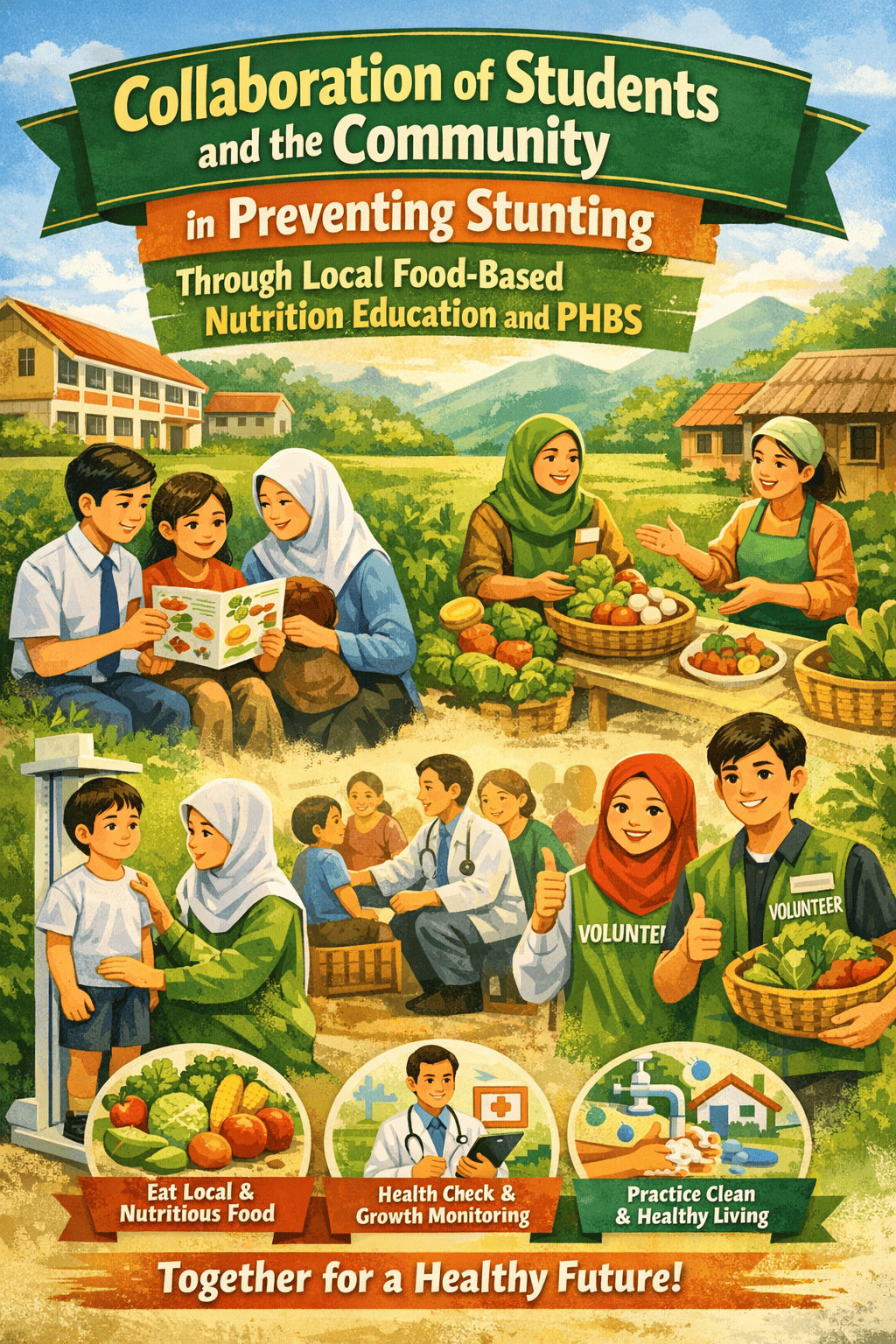
Collaboration of Students and the Community in Preventing Stunting Through Local Food-Based Nutrition Education and PHBS
Keywords:
stunting, edukasi, kolaborasi, pencegahanAbstract
Stunting is one of the main problems in Indonesian human development. Stunting is a multi-sectoral problem that includes maternal and child malnutrition, poor sanitation, and poor feeding practices. This can have a long-term impact on cognitive capacity, education, and economic productivity. Community-based prevention is important. The method used in this community service activity is the participation action research method, with an emphasis on collaboration between student/lecturer facilitators, the community, and the village government throughout the program cycle: from problem identification to evaluation. This community service activity is carried out with the target of stunted children, parents of stunted toddlers, pregnant women, breastfeeding mothers, school children and adolescent girls gaining increased knowledge about stunting, nutrition, PHBS and other health-related matters. Results: The activity was carried out effectively for 1 month with PMT running for 3 months. There was the formation of education groups and small group discussions as well as home visits during the activity. The target of the activity was 21 stunted children and their parents, 8 pregnant women, 16 breastfeeding mothers, 33 junior high school children, 29 adolescent girls. There is an increase in knowledge on all education targets, an increase in community participation in stunting prevention, especially after receiving assistance from the village government, an increase in nutritional status after the 90-day PMT intervention in stunted children, Conclusion: collaboration in conducting interactive small group education through lectures and demonstrations is effective in Increasing Community Knowledge and Participation in stunting prevention. Suggestions: Increasing cross-sector involvement in stunting prevention, increasing maternal knowledge, increasing community participation, mapping stunting problems in more detail
References
Aguilera Vasquez, N., & Daher, J. (2019). Do nutrition and cash-based interventions and policies aimed at reducing stunting have an impact on economic development of low-and-middle-income countries? A systematic review. BMC Public Health, 19(1), 1419. https://doi.org/10.1186/s12889-019-7677-1
Awaludin. (2019). [ Tract : Public Health Nutrition ] [ Analisis Bagaimana Mengatasi Permasalahan Stunting Di Indonesia. Jurnal Kedokteran, 35(4), 60.
Barat, J., Marlina, T., Maulida, I., Ulfah, S. M., & Putri, D. I. (2025). Pemberdayaan Perempuan untuk Pencegahan Stunting melalui Optimalisasi Kelompok Masyarakat di RW 17 , Kelurahan Pegambiran , Kota. 3(1), 87–96.
Erick, H. H. (2022). Associations between Parenting Style and Nutritional Knowledge on Stunting in Children Aged 24-60 Months in Ketang Health Center, East Nusa Tenggara, Indonesia. Journal of Epidemiology and Public Health, 8(4), 533–543. https://doi.org/10.26911/jepublichealth.2023.08.04.12
Holistik, P., & Anak, P. (2024). PENDAMPINGAN PARENTING HOLISTIK INTEGRATIF DENGAN METODE PARTICIPATORY ACTION RESEARCH. 485–503.
Kurniawan, Y. S., Priyangga, K. T. A., Krisbiantoro, P. A., & Imawan, A. C. (2021). Open access Open access. Journal of Multidiciplinary Applied Natural Science, 1(1), 1–12.
Lestari, W., Margawati, A., & Rahfiludin, Z. (2014). Risk factors for stunting in children aged 6-24 months in the sub-district of Penanggalan, Subulussalam, Aceh Province. Jurnal Gizi Indonesia (The Indonesian Journal of Nutrition), 3(1), 37–45.
Mahasiswa, J. I., Keperawatan, P., Fauzia, L., & Kadir, A. (2023). STUNTING. 3, 99–105.
Mazida, Z., Noveyani, A. E., & Prasetyowati, I. (2024). Mother’S Health Literacy With Stunting Incidence of Toddlers in Jember. Indonesian Journal of Public Health, 19(2), 381–389. https://doi.org/10.20473/ijph.v19i2.2024.381-389
Nursa’iidah, S., & Rokhaidah. (2022). Pendidikan, Pekerjaan Dan Usia Dengan Pengetahuan Ibu Balita Tentang Stunting. Indonesian Jurnal of Health Development, 4(1), 9–18.
Rahmadiyah, D., Sahar, J., & Widyatuti, W. (2022). Public Health Interventions to Reduce Stunting in Toddlers: A Systematic Review. Open Access Macedonian Journal of Medical Sciences, 10(F), 158–167. https://doi.org/10.3889/oamjms.2022.8610
Silitonga, A. M. P., Andariani, D., Idris, H., & Anggreini, R. (2023). Faktor Yang Bersangkutan Dengan Kejadian Stunting Pada Balita. Jurnal Lentera Kesehatan Masyarakat, 2(3), 133–147. https://doi.org/10.69883/jlkm.v2i3.51
Downloads
Published
How to Cite
Issue
Section
License
Copyright (c) 2025 Jurnal Abdimas Poltekkes Kupang

This work is licensed under a Creative Commons Attribution-NonCommercial-ShareAlike 4.0 International License.