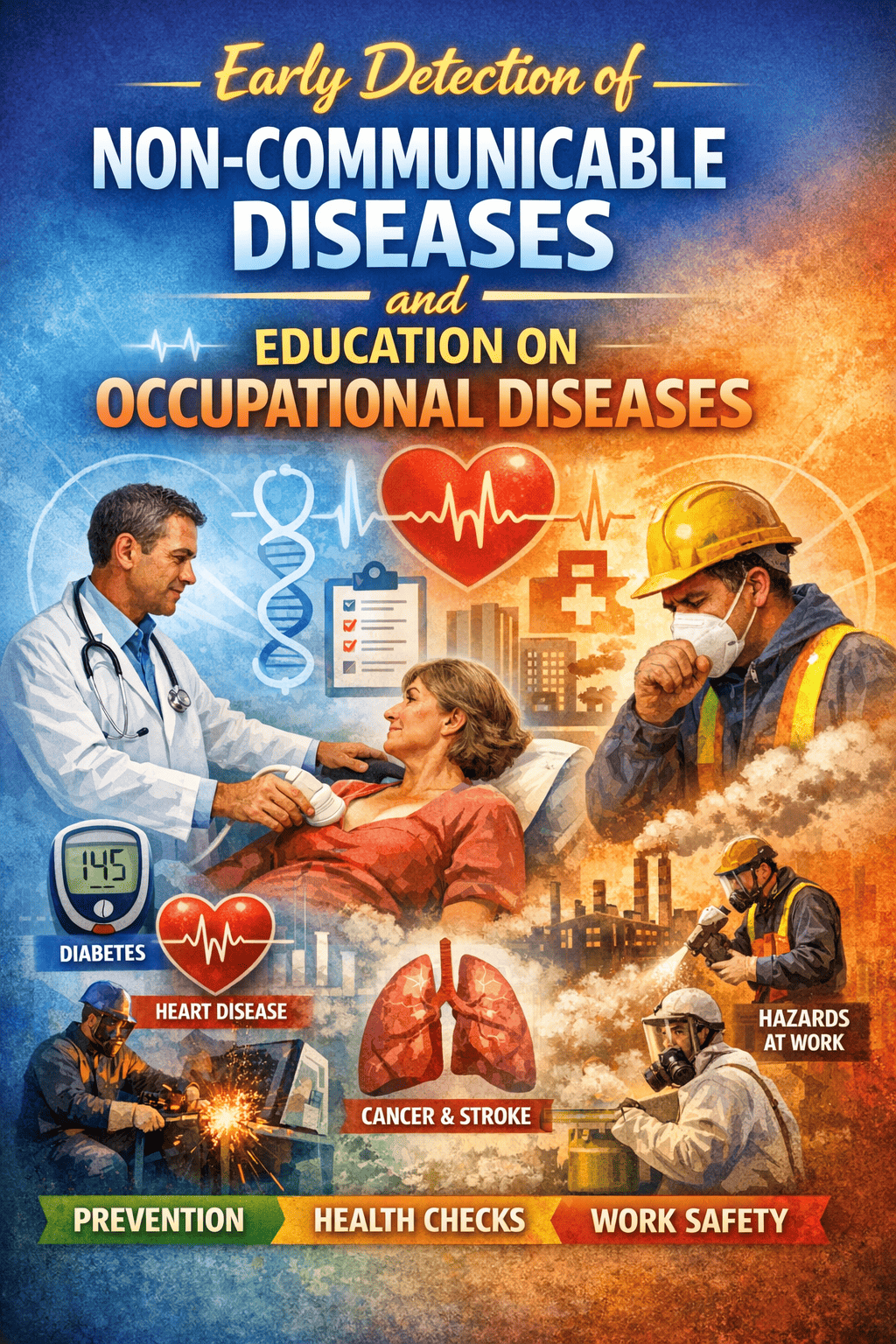
Early Detection of Non-Communicable Diseases and Education on Occupational Diseases
Keywords:
Penyakit tidak menular, deteksi dini, kesehatan kerjaAbstract
Approximately 71% of deaths worldwide are caused by non-communicable diseases, which kill 36 million
people each year, 80% of these deaths occurring in low- and middle-income countries. Although early
detection programs have been launched, their coverage and sustainability are still limited, especially in remote
or low-resource areas. Public awareness of the benefits of routine health checks is also low. To achieve optimal
health, the Waingapu Nursing Study Program conducts Non-Communicable Disease (NCD) Screening
activities. Where NCD screening is a form of community participation in early detection, monitoring, and early
follow-up of NCD risk factors independently and continuously. In addition to screening activities, the team
also provides counseling on occupational diseases at PT MSM, East Sumba Regency. Occupational diseases
are one of the health problems that can occur due to exposure to conditions or risk factors in the workplace.
This community service aims to detect non-communicable diseases early and provide education about
occupational diseases with the results of the activity being The number of people screened was 91 (Ninety one)
with the results of finding blood pressure of more than 120/90 mmHg, namely 10 people and less than 120/90
mmHg as many as 81 people, blood sugar with numbers above 140 mg / dL as many as 8 people and less than
140 mg / dL as many as 83 people, cholesterol more than 200 mg / dL as many as 36 people and less than 200
mg / dL as many as 55 people while for uric acid more than 6 mg / dL as many as 34 people and less than 6 mg
/ dL as many as 57 people. This activity has an extraordinary impact on changing the lifestyle of PT MSM staff
where with blood sugar, cholesterol and uric acid numbers that still have high numbers they are committed to
regularly participating in joint gymnastics and carrying out morning or evening walks for at least 30 minutes a
day. This activity should be conducted regularly so that the wider community can experience its benefits. It is
hoped that all parties will play an active role in preventing non-communicble diseases.
References
Berutu. (2020). Penggunaan APD Untuk Pencegahan Penyakit Akibat Kerja Pada Perawat. In OSF Preprints. https://osf.io/2ydm4/.
Raja Zulsefriandi, et al. (2023). Deteksi Dini Penyakit Tidak Menular Dengan Melakukan Pemeriksaan Kesehatan dan Edukasi Kesehatan. Jurnal Pengabdian Untuk Mu Negeri, 7 (2). https://doi.org/https://doi.org/10.37859/jpumri.v7i2.5390
N. P. Sari, Rahmawati, A., & Kusumawati. (2022). Pengaruh edukasi kesehatan terhadap peningkatan perilaku pencegahan penyakit tidak menular pada pekerja industri. Jurnal Promkes: The Indonesian Journal of Health Promotion and Health Education, 10 (1)
Yanuan Ben Olina, et al. (2024). Meningkatkan Kesadaran Hidup Sehat Melalui Skrining Deteksi Dini Penyakit Tidak Menular di Lingkungan Universitas Muhammadiyah Semarang. SALUTA: Jurnal Pengabdian Kepada Masyarakat, 4 (1). https://doi.org/https://doi.org/10.26714/sjpkm.v4i1.16404
Yeogyeong Yoon, et al. (2018). Working hours and depressive symptoms: the role of job stress factors. Annals of Occupational and Environmental Medicine, 30(1), 46. https://doi.org/10.1186/s40557-018-0257-5
Downloads
Published
How to Cite
Issue
Section
License
Copyright (c) 2025 Jurnal Abdimas Poltekkes Kupang

This work is licensed under a Creative Commons Attribution-NonCommercial-ShareAlike 4.0 International License.