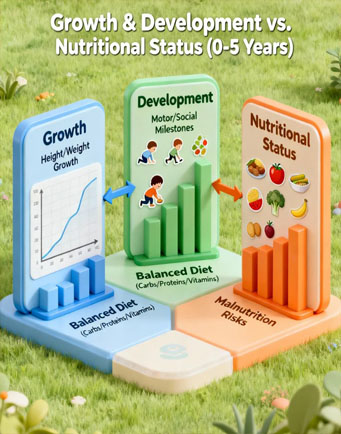
Relationship between Growth and Development with Nutritional Status Profile of Children Aged 0-5 Years

Downloads
Stunting remains a major concern in Indonesia, particularly in Jungkat Village, where early detection is crucial for mitigating its impact on child growth and development. While the Pre-Screening Development Questionnaire (KPSP) is commonly used to assess child development, its relationship with nutritional status remains unclear. This study is aimed to determine the nutritional status, KPSP category, and the relationship between these variables in children aged 0-5 years in Jungkat Village. A cross-sectional quantitative study was conducted from June to August 2023 in Jungkat Village, Mempawah Regency. Ethical approval was obtained from the Health Research Ethics Committee, Faculty of Medicine, Tanjungpura University. A total of 400 children aged 0 to 5 years and 11 months were selected using participatory sampling. Height, weight, and KPSP scores were measured following standardized guidelines, and nutritional status was categorized based on height-for-age, weight-for-age, and BMI-for-age indices. Ordinal logistic regression was performed using R to analyze the relationship between nutritional status and KPSP scores. The prevalence of stunting was 36.3% (10.5% severely stunted, 25.8% stunted), while 5.2% had very low weight and 19.2% were underweight. BMI analysis showed 80% had values within the normal range, while 2.2% were overweight, 0.2% obese, and 2.4% severely wasted. In terms of child development, 77.75% exhibited normal development, 19.75% required reassessment, and 2.5% showed developmental deviations. However, no significant correlation was found between nutritional status and KPSP scores (p > 0.05). These findings suggest that factors beyond nutritional status, such as environmental conditions and parenting practices, may have a greater influence on child development. Thus, national nutritional standards should be adapted to local ecological and genetic characteristics to improve the effectiveness of nutritional and health interventions. Further research integrating socio-environmental factors is recommended to gain a more comprehensive understanding of child development determinants.
Addo, O. Y., Stein, A. D., Fall, C. H., Gigante, D. P., Guntupalli, A. M., Horta, B. L., Kuzawa, C. W., Lee, N., Norris, S. A., Prabhakaran, P., Richter, L. M., Sachdev, H. S., & Martorell, R. (2013). Maternal Height and Child Growth Patterns. The Journal of Pediatrics, 163(2), 549-554. https://doi.org/10.1016/j.jpeds.2013.02.002
Andini, E. N., Udiyono, A., Sutiningsih, D., & Wuryanto, M. A. (2020). Faktor – Faktor yang Berhubungan dengan Status Gizi pada Anak Usia 0-23 Bulan Berdasarkan Composite Index of Anthropometric Failure (CIAF) di Wilayah Kerja Puskesmas Karangayu Kota Semarang. Jurnal Epidemiologi Kesehatan Komunitas, 5(2), 104-112. https://doi.org/10.14710/jekk.v5i2.5898
Arini, D., Mayasari, A. C., & Rustam, M. Z. A. (2019). Gangguan Perkembangan Motorik dan Kognitif pada Anak Toodler yang Mengalami Stunting di Wilayah Pesisir Surabaya. Journal of Health Science and Prevention, 3(2), 122-128. https://doi.org/10.29080/jhsp.v3i2.231
Aryanti, I., Hidana, R., Safitri, Y., Jufri, M. I., Hawa, P., Purnamasari, D. M., & Fitriani, E. (2022). Prevalensi Malnutrisi Balita di Desa Karimunting, Kec. Sungai Raya, Kab. Bengkayang, Provinsi Kalimantan Barat. Jurnal Sains Dan Kesehatan, 4(3), 284-289. https://doi.org/10.25026/jsk.v4i3.1048
Aty, Y. M. V. B., Herwanti, E., & Mochsen, R. (2021). Simultaneous Factors Affecting Toddler Nutritional Status. Jurnal Info Kesehatan, 19(1), 64-76. https://doi.org/10.31965/infokes.Vol19.Iss1.514
Baransano, L., Kawulur, E. I. J. J., & Sinuraya, S. (2016). Perspektif Evolusioner Ditinjau dari Indeks Massa Tubuh Anak Perempuan Suku Maybrat. Prosiding Seminar Nasional Biologi Indonesia XXIII.
Black, M. M., & Dewey, K. G. (2014). Promoting Equity Through Integrated Early Child Development and Nutrition Interventions. Annals of the New York Academy of Sciences, 1308(1), 1-10. https://doi.org/10.1111/nyas.12351
BPS-Statistics Mempawah Regency. (2024). Jongkat District in Figures 2024. Mempawag. Retrieved from: https://mempawahkab.bps.go.id/en/publication/2024/09/26/e9232f6532796798abb6ac0d/kecamatan-jongkat-dalam-angka-2024.html
Britto, P. R., Lye, S. J., Proulx, K., Yousafzai, A. K., Matthews, S. G., Vaivada, T., Perez-Escamilla, R., Rao, N., Ip, P., Fernald, L. C. H., MacMillan, H., Hanson, M., Wachs, T. D., Yao, H., Yoshikawa, H., Cerezo, A., Leckman, J. F., & Bhutta, Z. A. (2017). Nurturing Care: Promoting Early Childhood Development. The Lancet, 389(10064), 91-102. https://doi.org/10.1016/S0140-6736(16)31390-3
Choo, Y., Agarwal, P., How, C., & Yeleswarapu, S. (2019). Developmental Delay: Identification and Management at Primary Care Level. Singapore Medical Journal, 60(3), 119-123. https://doi.org/10.11622/smedj.2019025
Chung, W., & Kim, R. (2020). A Reversal of the Association between Education Level and Obesity Risk during Ageing: A Gender-Specific Longitudinal Study in South Korea. International Journal of Environmental Research and Public Health, 17(18), 1-18. https://doi.org/10.3390/ijerph17186755
Conery, M., & Grant, S. F. A. (2023). Human Height: A Model Common Complex Trait. Annals of Human Biology, 50(1), 258-266. https://doi.org/10.1080/03014460.2023.2215546
Costa, J. C., Blumenberg, C., & Victora, C. (2021). Growth Patterns by Sex and Age among Under-5 Children from 87 Low-Income and Middle-Income Countries. BMJ Global Health, 6(11), e007152. https://doi.org/10.1136/bmjgh-2021-007152
Creel, S. (2014). Model Selection and Multimodel Inference. https://www.montana.edu/
de Onis, M., Dewey, K. G., Borghi, E., Onyango, A. W., Blössner, M., Daelmans, B., Piwoz, E., & Branca, F. (2013). The World Health Organization’s Global Target for Reducing Childhood Stunting by 2025: Rationale and Proposed Actions. Maternal & Child Nutrition, 9(2), 6-26. https://doi.org/10.1111/mcn.12075
Digdowirogo, H. S., Firmansyah, A., Pusponegoro, H. D., Martoatmojo, K., Dhamayanti, M., & Nurmalia, N. (2010). Pedoman Praktik Dokter Spesialis Anak. IDAI.
Dinas Kesehatan Kalimantan Barat. (2021). Prevalensi Balita Stunting. Pontianak: Dinas Kesehatan Kalimantan Barat. Retrieved from: https://data.kalbarprov.go.id/dataset/status-gizi-balita-stunting-provinsi-kalimantan-barat-tahun-2021
Flegal, K. M. (2023). History of Medicine: Peer-Reviewed Article Use and Misuse of BMI Categories. AMA Journal of Ethics, 25(7), 550-558. https://doi.org/10.1001/amajethics.2023.550
Floris, J., Matthes, K. L., Le Vu, M., & Staub, K. (2023). Intergenerational Transmission of Height in a Historical Population: From Taller mothers to Larger Offspring at Birth (and as Adults). PNAS Nexus, 2(6), 1-9. https://doi.org/10.1093/pnasnexus/pgad208
Flynn, J., Alkaff, F. F., Sukmajaya, W. P., & Salamah, S. (2021). Comparison of WHO Growth Standard and National Indonesian Growth Reference in Determining Prevalence and Determinants of Stunting and Underweight in Children Under Five: A Cross-sectional Study from Musi Sub-district. F1000Research, 9, 324. https://doi.org/10.12688/f1000research.23156.4
Grantham-McGregor, S., Cheung, Y. B., Cueto, S., Glewwe, P., Richter, L., & Strupp, B. (2007). Developmental Potential in the First 5 Years for Children in Developing Countries. The Lancet, 369(9555), 60-70. https://doi.org/10.1016/S0140-6736(07)60032-4
Hackman, J. V., & Hruschka, D. J. (2020). Disentangling Basal and Accrued Height‐for‐Age for Cross‐population Comparisons. American Journal of Physical Anthropology, 171(3), 481-495. https://doi.org/10.1002/ajpa.23990
Kaur, H., Muhlhausler, B. S., Roberts, C. T., & Gatford, K. L. (2021). The Growth Hormone–Insulin-Like Growth Factor Axis in Pregnancy. Journal of Endocrinology, 251(3), 23-39. https://doi.org/10.1530/JOE-21-0087
Kementerian Kesehatan RI. (2016). Pedoman Pelaksanaan Stimulasi, Deteksi dan lntervensi Dini Tumbuh Kembang Anak. Jakarta: Kementerian Kesehatan RI.
Kementerian Kesehatan RI. (2018). Hasil Utama RISKESDAS) 2018. Jakarta: Kementerian Kesehatan Republik Indonesia.
Kementerian Kesehatan RI. (2020). Peraturan Menteri Kesehatan No 2 Tahun 2020 tentang Standar Antropometri Anak. Kementerian Kesehatan RI. Retrieved from: https://peraturan.bpk.go.id/Details/152505/permenkes-no-2-tahun-2020
Kementerian Kesehatan RI. (2024). Buku KIA Kesehatan Ibu dan Anak: Bagian Ibu. Jakarta: Kementerian Kesehatan RI.
Kementerian Sekretariat Negara RI. (2021). Percepatan Penurunan Stunting, Wapres Minta Rencana Aksi Nasional Segera Disusun. Kementerian Sekretariat Negara RI.
McNulty, K. (2021). Handbook of Regression Modeling in People Analytics: With Examples in R and Python. CRC Press.
Mei, Z., Grummer-Strawn, L. M., Pietrobelli, A., Goulding, A., Goran, M. I., & Dietz, W. H. (2002). Validity of Body Mass Index Compared with Other Body-Composition Screening Indexes for the Assessment of Body Fatness in Children and Adolescents. The American Journal of Clinical Nutrition, 75(6), 978-985. https://doi.org/10.1093/ajcn/75.6.978
Messner, A., Nairz, J., Kiechl, S., Winder, B., Pechlaner, R., Geiger, R., ... & Kiechl-Kohlendorfer, U. (2024). Comparison of body mass index and fat mass index to classify body composition in adolescents—The EVA4YOU study. European Journal of Pediatrics, 183(5), 2203-2214. https://doi.org/10.1007/s00431-024-05474-x
Moestue, H., de Pee, S., Hall, A., Hye, A., Sultana, N., Ishtiaque, M. Z., Huq, N., & Bloem, M. W. (2004). Conclusions about Differences in Linear Growth between Bangladeshi Boys and Girls Depend on the Growth Reference Used. European Journal of Clinical Nutrition, 58(5), 725-731. https://doi.org/10.1038/sj.ejcn.1601870
Monasor-Ortolá, D., Quesada-Rico, J. A., Nso-Roca, A. P., Rizo-Baeza, M., Cortés-Castell, E., Martínez-Segura, A., & Sánchez-Ferrer, F. (2021). Degree of Accuracy of the BMI Z-Score to Determine Excess Fat Mass Using DXA in Children and Adolescents. International Journal of Environmental Research and Public Health, 18(22), 1-9. https://doi.org/10.3390/ijerph182212114
Natale, V., & Rajagopalan, A. (2014). Worldwide Variation in Human Growth and the World Health Organization Growth Standards: a Systematic Review. BMJ Open, 4(1), e003735. https://doi.org/10.1136/bmjopen-2013-003735
Oberg, S. (2016). Height as A Measure of The Nutritional Status and Health of A Population. Proceedings of an Interdisciplinary Symposium on the Dynamics from Prehistory to Present. Retrieved from: https://gup.ub.gu.se/publication/240759%0Ahttps://gup.ub.gu.se/publication/240759
Okelo, K., Murray, A. L., King, J., Kitsao-Wekulo, P., Onyango, S., Nampijja, M., & Auyeung, B. (2024). Parental Stress and Child Stimulation Practices: Examining Associations with Child Developmental Outcomes Over Time in Kenya and Zambia. BMC Psychology, 12(1), 50. https://doi.org/10.1186/s40359-024-01533-y
Oktaviani, T. A., Suwarni, L., & Selviana, S. (2023). Risk Factors Related to Stunting. Jurnal Info Kesehatan, 21(4), 854-863. https://doi.org/10.31965/infokes.Vol21.Iss4.1292
Olofin, I., McDonald, C. M., Ezzati, M., Flaxman, S., Black, R. E., Fawzi, W. W., Caulfield, L. E., & Danaei, G. (2013). Associations of Suboptimal Growth with All-Cause and Cause-Specific Mortality in Children under Five Years: A Pooled Analysis of Ten Prospective Studies. PLoS ONE, 8(5), e64636. https://doi.org/10.1371/journal.pone.0064636
Picó, C., Serra, F., Rodríguez, A. M., Keijer, J., & Palou, A. (2019). Biomarkers of Nutrition and Health: New Tools for New Approaches. Nutrients, 11(5), 1-30. https://doi.org/10.3390/nu11051092
Pratiwi, R. (2021). Dampak Status Gizi Pendek (Stunting) Terhadap Prestasi Belajar. NURSING UPDATE : Jurnal Ilmiah Ilmu Keperawatan, 12(2), 11-23. https://doi.org/10.36089/nu.v12i2.317
Rokib, M. (2019). Gizi Buruk di Mempawah, Kecamatan Jungkat Jumlahnya Paling Banyak [Internet]. Tribun News. Retrieved from: https://pontianak.tribunnews.com/2019/08/30/gizi-buruk-di-mempawah-kecamatan-jungkat-paling-banyak-jumlahnya
Siddiqui, F., Salam, R. A., Lassi, Z. S., & Das, J. K. (2020). The Intertwined Relationship Between Malnutrition and Poverty. Frontiers in Public Health, 8. https://doi.org/10.3389/fpubh.2020.00453
Simeone, P., & Alberti, S. (2014). Epigenetic Heredity of Human Height. Physiological Reports, 2(6), 1-20. https://doi.org/10.14814/phy2.12047
Subramanian, S. V., Ackerson, L. K., Smith, G. D., & John, N. A. (2009). Association of Maternal Height With Child Mortality, Anthropometric Failure, and Anemia in India. JAMA, 301(16), 1691–1701. https://doi.org/10.1001/jama.2009.548
Sutigno, A. L., & Pigawati, B. (2015). Bentuk Adaptasi Masyarakat Terhadap Bencana Rob di Desa Sriwulan Kecamatan Sayung Kabupaten Demak. Jurnal Teknik PWK, 4(4), 499-513.
Tian, Q., Gao, X., Sha, T., He, Q., Cheng, G., Wu, X., Yang, F., Wu, X., Tang, C., Xie, Q., & Yan, Y. (2019). Differences between WHO Growth Standards and China Growth Standards in Assessing the Nutritional Status of Children Aged 0–36 Months Old. International Journal of Environmental Research and Public Health, 17(1), 251. https://doi.org/10.3390/ijerph17010251
Vanderwall, C., Randall Clark, R., Eickhoff, J., & Carrel, A. L. (2017). BMI is a Poor Predictor of Adiposity in Young Overweight and Obese Children. BMC Pediatrics, 17(1), 135. https://doi.org/10.1186/s12887-017-0891-z
Yousafzai, A. K., Rasheed, M. A., Rizvi, A., Armstrong, R., & Bhutta, Z. A. (2014). Effect of Integrated Responsive Stimulation and Nutrition Interventions in the Lady Health Worker Programme in Pakistan on Child Development, Growth, and Health Outcomes: a Cluster-Randomised Factorial Effectiveness Trial. The Lancet, 384(9950), 1282-1293. https://doi.org/10.1016/S0140-6736(14)60455-4
Copyright (c) 2025 JURNAL INFO KESEHATAN

This work is licensed under a Creative Commons Attribution-NonCommercial-ShareAlike 4.0 International License.
Copyright notice
Ownership of copyright
The copyright in this website and the material on this website (including without limitation the text, computer code, artwork, photographs, images, music, audio material, video material and audio-visual material on this website) is owned by JURNAL INFO KESEHATAN and its licensors.
Copyright license
JURNAL INFO KESEHATAN grants to you a worldwide non-exclusive royalty-free revocable license to:
- view this website and the material on this website on a computer or mobile device via a web browser;
- copy and store this website and the material on this website in your web browser cache memory; and
- print pages from this website for your use.
- All articles published by JURNAL INFO KESEHATAN are licensed under the Creative Commons Attribution 4.0 International License. This permits anyone to copy, redistribute, remix, transmit and adapt the work provided the original work and source is appropriately cited.
JURNAL INFO KESEHATAN does not grant you any other rights in relation to this website or the material on this website. In other words, all other rights are reserved.
For the avoidance of doubt, you must not adapt, edit, change, transform, publish, republish, distribute, redistribute, broadcast, rebroadcast or show or play in public this website or the material on this website (in any form or media) without appropriately and conspicuously citing the original work and source or JURNAL INFO KESEHATAN prior written permission.
Permissions
You may request permission to use the copyright materials on this website by writing to [email protected].
Enforcement of copyright
JURNAL INFO KESEHATAN takes the protection of its copyright very seriously.
If JURNAL INFO KESEHATAN discovers that you have used its copyright materials in contravention of the license above, JURNAL INFO KESEHATAN may bring legal proceedings against you seeking monetary damages and an injunction to stop you using those materials. You could also be ordered to pay legal costs.
If you become aware of any use of JURNAL INFO KESEHATAN copyright materials that contravenes or may contravene the license above, please report this by email to [email protected]
Infringing material
If you become aware of any material on the website that you believe infringes your or any other person's copyright, please report this by email to [email protected].