Maternal Factors, Low Birth Weight, and Early Stimulation as Determinants of Stunting in Children Aged 24-36 Months: A Systematic Review

Downloads
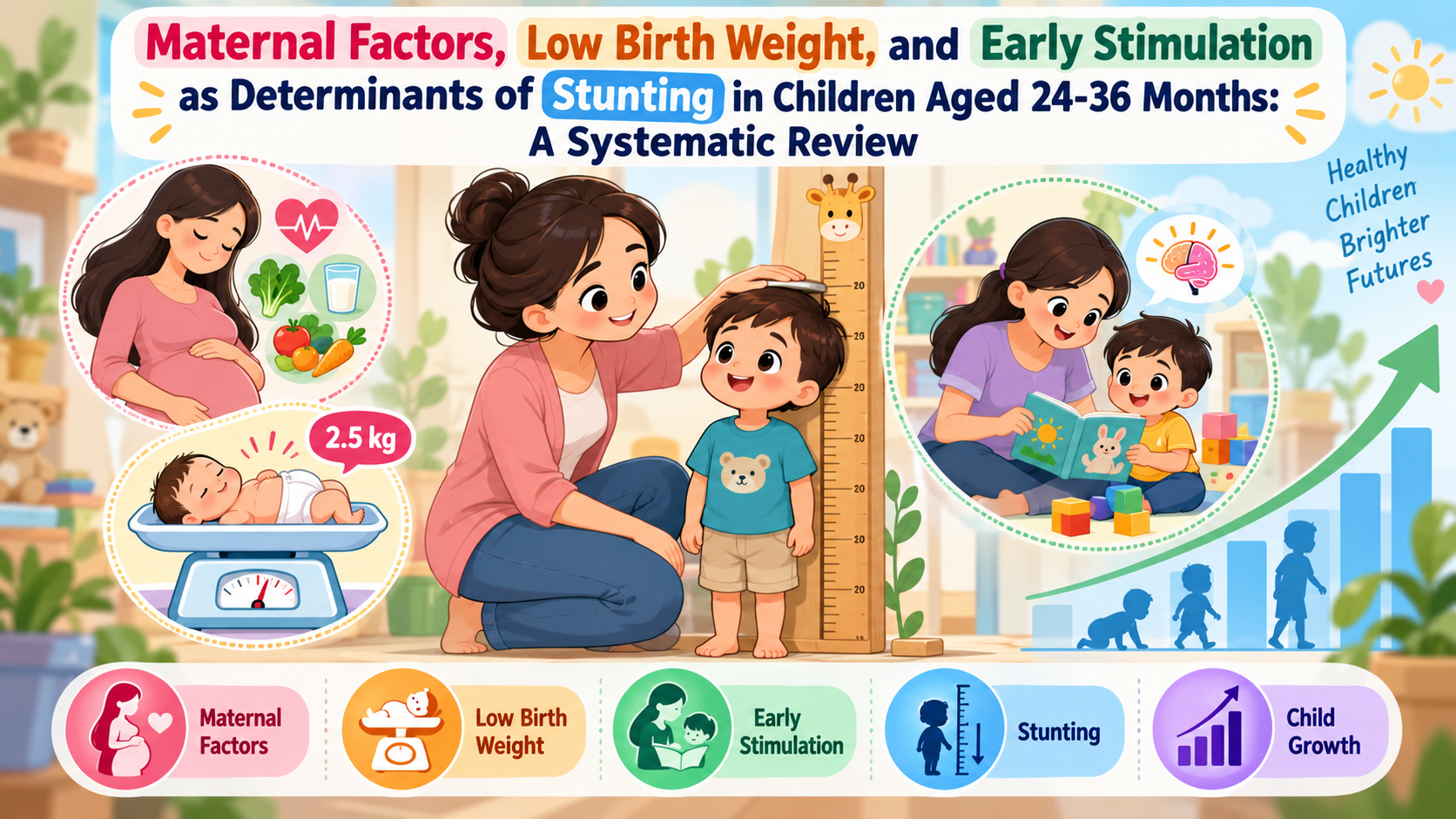
Stunting among children aged 24–36 months is associated with various maternal, perinatal, and environmental factors. This systematic review examined the relationships between maternal factors, birth weight, early stimulation, and stunting in this age group. The review was conducted in accordance with the PRISMA guidelines. Relevant studies were identified through searches of six major databases and selected based on predefined eligibility criteria, including study design, participants’ age, and the exposure variables examined. A narrative synthesis was used to summarize the findings. Methodological quality was assessed using the Newcastle–Ottawa Scale and the JBI checklist, while potential risks of bias were also considered. Ten studies were included in the final review. The findings indicated that several maternal factors, including nutritional status, tetanus toxoid immunization, household income, and the quality of antenatal care, were associated with stunting. Low birth weight emerged as a recurring predictor, with reported risk estimates ranging from 1.74 to 3.12. Early stimulation, particularly through responsive parenting and a supportive home environment, was identified as a potentially protective factor. However, differences in measurement methods and study designs limited the comparability of the findings. Variations were also observed in the assessment of exposures and confounding factors, although most studies met the minimum criteria for methodological quality. Overall, the evidence suggests that maternal factors, birth weight, and early stimulation are relevant to stunting among children aged 24–36 months. These findings highlight the need for integrated maternal and child health interventions that address maternal nutrition, access to quality antenatal care, the prevention of low birth weight, and family-based early stimulation to support healthy growth and development.
Ali, A. (2021). Current status of malnutrition and stunting in Pakistani children: What needs to be done? Journal of the American College of Nutrition, 40(2), 180–192. https://doi.org/10.1080/07315724.2020.1750504
Anastasia, H., Hadju, V., Hartono, R., Samarang, Manjilala, Sirajuddin, Salam, A., & Atmarita (2023). Determinants of stunting in children under five years old in South Sulawesi and West Sulawesi Province: 2013 and 2018 Indonesian Basic Health Survey. PloS one, 18(5), e0281962. https://doi.org/10.1371/journal.pone.0281962
Ardiyanto, M. A. A., Setiawan, K. H., & Pasek, M. S. (2025). Evidence Mapping of Low Birth Weight and Stunting Association: A Holistic Scoping Review (2022-2024). Journal of Syntax Literate, 10(11), 8715. https://doi.org/10.36418/syntax-literate.v10i11.62540
Aryastami, N. K., Shankar, A., Kusumawardani, N., Besral, B., Jahari, A. B., & Achadi, E. (2017). Low birth weight was the most dominant predictor associated with stunting among children aged 12–23 months in Indonesia. BMC Nutrition, 3(1), 16. https://doi.org/10.1186/s40795-017-0130-x
Attanasio, O., Baker-Henningham, H., Bernal, R., Meghir, C., Pineda, D., & Rubio-Codina, M. (2022). Early Stimulation and Nutrition: The Impacts of a Scalable Intervention. Journal of the European Economic Association, 20(4), 1395–1432. https://doi.org/10.1093/jeea/jvac005
Awaludin, A. A., Nurrachmawati, A., Fitriani, A. D., & Casia Reski. (2025). The long-term impact of childhood stunting on cognitive development and educational outcomes. Jurnal Penelitian Pendidikan IPA, 11(8), 70–77. https://doi.org/10.29303/jppipa.v11i8.12198
Azrimaidaliza, A., Resti, R., & Helmizar, H. (2024). Evaluation of the implementation stimulation, detection, and early intervention for toddlers growth and development in Nanggalo Health Center. Jurnal Gizi Indonesia (The Indonesian Journal of Nutrition), 12(2), 88–100. https://doi.org/10.14710/jgi.12.2.88-100
Bliznashka, L., Udo, I. E., Sudfeld, C. R., Fawzi, W. W., & Yousafzai, A. K. (2021). Associations between women’s empowerment and child development, growth, and nurturing care practices in sub-Saharan Africa: A cross-sectional analysis of demographic and health survey data. PLOS Medicine, 18(9), e1003781. https://doi.org/10.1371/journal.pmed.1003781
Burki A. A. (2025). Assessing the relative significance of key risk factors for child undernutrition in Punjab, Pakistan. BMC public health, 25(1), 1416. https://doi.org/10.1186/s12889-025-22626-2
Ekholuenetale, M., Barrow, A., Ekholuenetale, C. E., & Tudeme, G. (2020). Impact of stunting on early childhood cognitive development in Benin: Evidence from Demographic and Health Survey. Egyptian Pediatric Association Gazette, 68(1), 31. https://doi.org/10.1186/s43054-020-00043-x
Garina, L. A., Dewi, M. K., Trusda, S. A. D., Purbaningsih, W., Muflihah, H., Tursina, A., Respati, T., & Rahimah, S. B. (2024). Maternal, child, and household risk factors for children with stunting. The Open Public Health Journal, 17(1). http://dx.doi.org/10.2174/0118749445321448240823112908
Hadi, M. I., Kumalasari, M. L. F., & Kusumawati, E. (2019). Faktor Risiko yang Berhubungan dengan Kejadian Stunting di Indonesia: Studi Literatur. Journal of Health Science and Prevention, 3(2), 86–93. https://doi.org/10.29080/jhsp.v3i2.238
Haryani, S., Bakara, D. M., & Buana, C. (2022). The effectiveness of parents’ role in the prevention of stunting toddlers in Highlands Of Bengkulu. Dunia Keperawatan: Jurnal Keperawatan Dan Kesehatan, 10(3), 304–314.
Jana, A., Dey, D., & Ghosh, R. (2023). Contribution of low birth weight to childhood undernutrition in India: Evidence from the national family health survey 2019–2021. BMC Public Health, 23(1), 1336. https://doi.org/10.1186/s12889-023-16160-2
Kumala Putri, D. S., Widodo, Y., Gunardi, H., Kusharisupeni, Besral, Djahari, A. B., Syafiq, A., Achadi, E. L., & Bhutta, Z. A. (2023). When did the substantial loss of child linear growth occur?. PloS one, 18(9), e0291176. https://doi.org/10.1371/journal.pone.0291176
Lestari, M. C. D., Ayu Citra Dewi, Sri Intan Wahyuni, Juliwis Kardi, Yendri Junaidi, & Alif Laini. (2024). Implementation of stimulation, early detection, and intervention programs for monitoring the growth and development of children aged 2-3 Years. JPUD - Jurnal Pendidikan Usia Dini, 18(1), 183–194. https://doi.org/10.21009/JPUD.181.13
Ma, L. L., Wang, Y. Y., Yang, Z. H., Huang, D., Weng, H., & Zeng, X. T. (2020). Methodological quality (risk of bias) assessment tools for primary and secondary medical studies: what are they and which is better?. Military Medical Research, 7(1), 7. https://doi.org/10.1186/s40779-020-00238-8
Marine, B. T., Haile, Y. A., & Zewde, M. G. (2026). Maternal nutrition practices and its implications for child growth and development in Jimma Town a community based cross sectional study. Scientific Reports, 16(1), 15195. https://doi.org/10.1038/s41598-026-37151-4
Moosapour, H., Saeidifard, F., Aalaa, M., Soltani, A., & Larijani, B. (2021). The rationale behind systematic reviews in clinical medicine: a conceptual framework. Journal of diabetes and metabolic disorders, 20(1), 919–929. https://doi.org/10.1007/s40200-021-00773-8
Nguyen, P. H., Tran, L. M., Khuong, L. Q., Young, M. F., Duong, T. H., Nguyen, H. C., DiGirolamo, A. M., Martorell, R., & Ramakrishnan, U. (2021). Child Linear Growth During and After the First 1000 Days Is Positively Associated with Intellectual Functioning and Mental Health in School-Age Children in Vietnam. The Journal of nutrition, 151(9), 2816–2824. https://doi.org/10.1093/jn/nxab182
Prendergast, A. J., & Humphrey, J. H. (2014). The stunting syndrome in developing countries. Paediatrics and International Child Health, 34(4), 250–265. https://doi.org/10.1179/2046905514Y.0000000158
Putri, T. A., Salsabilla, D. A., & Saputra, R. K. (2021). The effect of low birth weight on stunting in children under five: A meta analysis.
Saleh, A., Syahrul, S., Hadju, V., Andriani, I., & Restika, I. (2021). Role of Maternal in Preventing Stunting: a Systematic Review. Gaceta sanitaria, 35 Suppl 2, S576–S582. https://doi.org/10.1016/j.gaceta.2021.10.087
Santosa, A., Novanda Arif, E., & Abdul Ghoni, D. (2022). Effect of maternal and child factors on stunting: partial least squares structural equation modeling. Clinical and experimental pediatrics, 65(2), 90–97. https://doi.org/10.3345/cep.2021.00094
Sari, D. P., Ekoriano, M., Pujihasvuty, R., Kistiana, S., Nasution, S. L., Ardiana, I., Purwoko, E., Devi, Y. P., & Muthmainnah, M. (2024). Antenatal care utilization on low birth weight children among women with high-risk births. F1000Research, 12, 399. https://doi.org/10.12688/f1000research.126814.2
Sari, Y. W., Khomsan, A., & Roosita, K. (2025). The role of stimulation, affection, and parenting patterns in stunting among children aged 24-59 months. AcTion: Aceh Nutrition Journal, 10(1), 146. https://doi.org/10.30867/action.v10i1.2289
Sartika, A. N., Khoirunnisa, M., Meiyetriani, E., Ermayani, E., Pramesthi, I. L., & Nur Ananda, A. J. (2021). Prenatal and postnatal determinants of stunting at age 0–11 months: A cross-sectional study in Indonesia. PLOS ONE, 16(7), e0254662. https://doi.org/10.1371/journal.pone.0254662
Sihotang, W. Y., Hulu, V. T., Samosir, F. J., Pane, P. Y., Hartono, H., Manalu, P., Siagian, M., & Panjaitan, H. I. (2023). Determinants of stunting in children under five: A scoping review. Jurnal Gizi Indonesia (The Indonesian Journal of Nutrition), 12(1), 9–20.
Upadhyay, R. P., Taneja, S., Strand, T. A., Sommerfelt, H., Hysing, M., Mazumder, S., Bhandari, N., Martines, J., Dua, T., Kariger, P., & Bahl, R. (2022). Early child stimulation, linear growth and neurodevelopment in low birth weight infants. BMC pediatrics, 22(1), 586. https://doi.org/10.1186/s12887-022-03579-6
Walker, S. P., Wachs, T. D., Grantham-McGregor, S., Black, M. M., Nelson, C. A., Huffman, S. L., Baker-Henningham, H., Chang, S. M., Hamadani, J. D., Lozoff, B., Gardner, J. M. M., Powell, C. A., Rahman, A., & Richter, L. (2011). Inequality in early childhood: Risk and protective factors for early child development. The Lancet, 378(9799), 1325–1338. https://doi.org/10.1016/S0140-6736(11)60555-2
Copyright (c) 2026 JURNAL INFO KESEHATAN

This work is licensed under a Creative Commons Attribution-NonCommercial-ShareAlike 4.0 International License.
Copyright notice
Ownership of copyright
The copyright in this website and the material on this website (including without limitation the text, computer code, artwork, photographs, images, music, audio material, video material and audio-visual material on this website) is owned by JURNAL INFO KESEHATAN and its licensors.
Copyright license
JURNAL INFO KESEHATAN grants to you a worldwide non-exclusive royalty-free revocable license to:
- view this website and the material on this website on a computer or mobile device via a web browser;
- copy and store this website and the material on this website in your web browser cache memory; and
- print pages from this website for your use.
- All articles published by JURNAL INFO KESEHATAN are licensed under the Creative Commons Attribution 4.0 International License. This permits anyone to copy, redistribute, remix, transmit and adapt the work provided the original work and source is appropriately cited.
JURNAL INFO KESEHATAN does not grant you any other rights in relation to this website or the material on this website. In other words, all other rights are reserved.
For the avoidance of doubt, you must not adapt, edit, change, transform, publish, republish, distribute, redistribute, broadcast, rebroadcast or show or play in public this website or the material on this website (in any form or media) without appropriately and conspicuously citing the original work and source or JURNAL INFO KESEHATAN prior written permission.
Permissions
You may request permission to use the copyright materials on this website by writing to [email protected].
Enforcement of copyright
JURNAL INFO KESEHATAN takes the protection of its copyright very seriously.
If JURNAL INFO KESEHATAN discovers that you have used its copyright materials in contravention of the license above, JURNAL INFO KESEHATAN may bring legal proceedings against you seeking monetary damages and an injunction to stop you using those materials. You could also be ordered to pay legal costs.
If you become aware of any use of JURNAL INFO KESEHATAN copyright materials that contravenes or may contravene the license above, please report this by email to [email protected]
Infringing material
If you become aware of any material on the website that you believe infringes your or any other person's copyright, please report this by email to [email protected].