Maternal and Pregnancy-Related Factors Associated with Low Birth Weight in Low- and Middle-Income Countries: A Scoping Review
Faktor Risiko Maternal Terhadap BBLR di Negara Berkembang: Scoping Review

Downloads
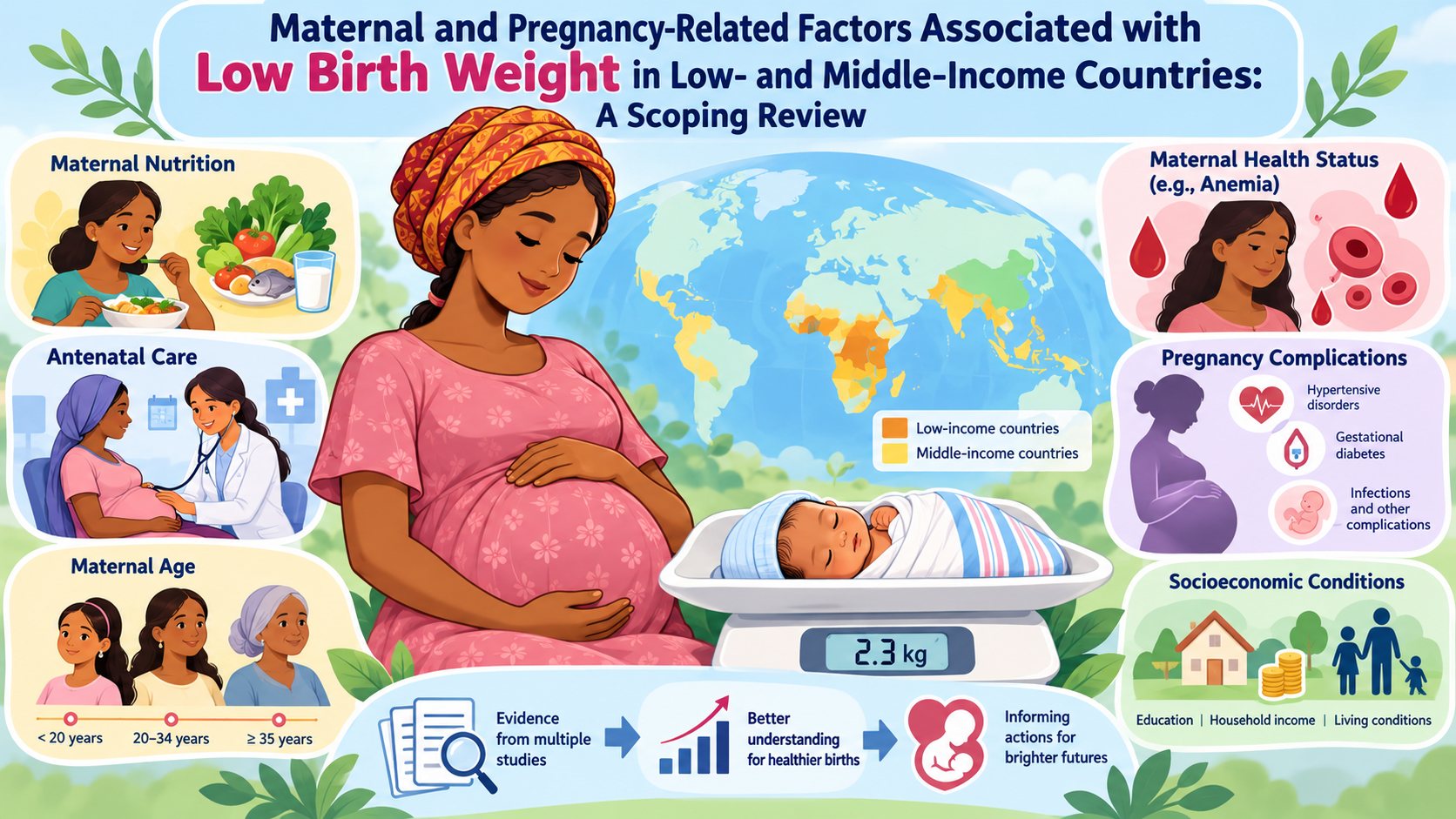
Background: Low birth weight (LBW) continues to be a significant public health problem worldwide, contributing substantially to neonatal morbidity and mortality. Approx 96% of LBW cases are seen in developing countries. Objective: The present review aims to explore and categorize maternal risk factors for LBW in low- and middle-income countries. Methods: A scoping review was performed following the PRISMA-ScR framework. Literature searches were conducted in four databases: PubMed, ScienceDirect, Cochrane Library and Google Scholar for studies published from 2021 to 2025. Results: A total of 500 records were identified and 16 articles were included after screening and assessment of eligibility. The methodological quality of eligible studies was assessed by JBI Critical Appraisal Tools. Results: The included studies were 16 articles, of which 75% were from Asia and 25% were from Africa. Thematic analysis identified 8 categories of maternal and pregnancy-related factors associated with LBW: maternal nutritional status and anthropometric characteristics, maternal age, obstetric history, pregnancy complications, sociodemographic factors, adequacy of antenatal care, preterm birth and multiple gestations, lifestyle and environmental factors. Pre-eclampsia, low gestational weight gain, maternal anemia and poor antenatal care were consistently reported to be associated with LBW . Study design, population, exposure definition and statistical adjustment differences contributed to variation in effect estimates. Conclusion: Maternal and pregnancy factors especially pre-eclampsia, poor maternal nutritional status, anemia, poor antenatal care and pregnancy complications have significant roles in occurrence of LBW. Holistic strategies that promote nutritional optimization, early detection and management of pregnancy complications, and improve quality of ANC are essential to reduce the burden of LBW in LMICs.
Aga, M. A., & Woldeamanuel, B. T. (2025). Nutritional and prenatal care factors associated with low birth weight among full-term infants in public hospitals of Addis Ababa, Ethiopia. BMJ paediatrics open, 9(1), e003732. https://doi.org/10.1136/bmjpo-2025-003732
Ahenkorah, B., Sakyi, S. A., Helegbe, G., Owiredu, E. W., Fondjo, L. A., Ofosu, W., … Gyan, B. (2022). Foeto-maternal complications associated with low birth weight: A prospective multicenter study in northern Ghana. PLoS ONE, 17(4), e0266796. https://doi.org/10.1371/journal.pone.0266796
Akaba, G. O., Anyang, U. I., & Ekele, B. A. (2021). Prevalence and materno-fetal outcomes of preeclampsia/eclampsia amongst pregnant women at a teaching hospital in north-central Nigeria: a retrospective cross-sectional study. Clinical hypertension, 27(1), 20. https://doi.org/10.1186/s40885-021-00178-y
Alam, M. J., Islam, M. M., Maniruzzaman, M., Ahmed, N. A. M. F., Tawabunnahar, M., Rahman, M. J., Roy, D. C., & Mydam, J. (2022). Socioeconomic inequality in the prevalence of low birth weight and its associated determinants in Bangladesh. PloS one, 17(10), e0276718. https://doi.org/10.1371/journal.pone.0276718
Al-Aziz, S. M. A. K., Khan, S., Haque, A. S. M. R., Rashid, S. M. A., & Baki, M. A. (2022). Correlation between maternal factors and risk of low birth weight. Scholars Journal of Applied Medical Sciences, 10(12), 2368–2376. https://doi.org/10.36347/sjams.2022.v10i12.048
Anwar, H., Farhat, A., Ahmed, A., Bashir, B., Khan, K., & Khan, I. (2024). Association of maternal factors with low birth weight newborns. Journal of the Liaquat University of Medical and Health Sciences, 23(2), 112–115. https://doi.org/10.22442/jlumhs.2024.01070
Badan Pusat Statistik. (2020). Laporan Survei Demografi dan Kesehatan Indonesia. https://www.bps.go.id
Barker D. J. (2007). The origins of the developmental origins theory. Journal of internal medicine, 261(5), 412–417. https://doi.org/10.1111/j.1365-2796.2007.01809.x
Blencowe, H., Krasevec, J., de Onis, M., Black, R. E., An, X., Stevens, G. A., … Cousens, S. (2019). National, regional, and worldwide estimates of low birthweight in 2015, with trends from 2000: A systematic analysis. The Lancet Global Health, 7(7), e849–e860. https://doi.org/10.1016/S2214-109X(18)30565-5
Cutland, C. L., Lackritz, E. M., Mallett-Moore, T., Bardají, A., Chandrasekaran, R., Lahariya, C., … Muñoz, F. M. (2017). Low birth weight: Case definition & guidelines for data collection, analysis, and presentation of maternal immunization safety data. Vaccine, 35, 6492–6500. https://doi.org/10.1016/j.vaccine.2017.01.049
Devaguru, A., Gada, S., Potpalle, D., Dinesh Eshwar, M., & Purwar, D. (2023). The prevalence of low birth weight among newborn babies and its associated maternal risk factors: A hospital-based cross-sectional study. Cureus. https://doi.org/10.7759/cureus.38587
Dewi, A. A. S., Hardjito, K., & Kundarti, F. I. (2022). Determinants of low birth weight: A systematic review. International Journal of Health Science and Technology, 4(2), 128–143. https://doi.org/10.31101/ijhst.v4i2.2693
Engidaw, M. T., Eyayu, T., & Tiruneh, T. (2022). The effect of maternal anemia on low birth weight among newborns in Northwest Ethiopia. Scientific Reports, 12, Article 19726. https://doi.org/10.1038/s41598-022-19726-z
Hong, K., Kim, S. H., Cha, D. H., & Park, H. J. (2021). Defective uteroplacental vascular remodeling in pre-eclampsia: Key molecular factors leading to long-term cardiovascular disease. International Journal of Molecular Sciences, 22. https://doi.org/10.3390/ijms222011202
Hughes, M. M., Black, R. E., & Katz, J. (2017). 2500-g Low Birth Weight Cutoff: History and Implications for Future Research and Policy. Maternal and child health journal, 21(2), 283–289. https://doi.org/10.1007/s10995-016-2131-9
Indriany, D. S., Yorita, E., Ekanugraheni, D., & Yanniarti, S. (2024). Pre-eclampsia is a risk factor for low birth weight (LBW) infants. JNKI (Jurnal Ners dan Kebidanan Indonesia), 12(2), 151–167. https://doi.org/10.21927/jnki.2024.12(2).151-167
Iqbal, S., Tanveer, A., Khan, Z., Junai, K. M., Mushtaq, N., & Ali, N. (2022). Risk factors of low birth weight in Pakistan. Pakistan Journal of Medical and Health Sciences, 16(3), 1163–1165. https://doi.org/10.53350/pjmhs221631163
Islam, T., Al Mahboob, A., & Ahammad, F. (2022). Role of Maternal & Fetal Factors in Relation to Low Birth Weight. Medicine Today, 34(2), 106-110. https://doi.org/10.3329/medtoday.v34i2.61423
Lin, L., Lu, C., Chen, W., Li, C., & Guo, V. Y. (2021). Parity and the risks of adverse birth outcomes: a retrospective study among Chinese. BMC pregnancy and childbirth, 21(1), 257. https://doi.org/10.1186/s12884-021-03718-4
Liu, Y., Li, N., An, H., Li, Z., Zhang, L., Li, H., … Ye, R. (2021). Impact of gestational hypertension and pre-eclampsia on low birthweight and small-for-gestational-age infants in China: A large prospective cohort study. Journal of Clinical Hypertension, 23(4), 835–842. https://doi.org/10.1111/jch.14176
Madumey, D. G., & Nareswari, S. (2025). Hubungan Usia, Paritas, Dan Kadar Hemoglobin Ibu Dengan Kejadian Bayi Berat Lahir Rendah (BBLR) Di RSUD Dr. H. Abdul Moeloek Provinsi. Medical Profession Journal of Lampung, 15(1), 99-105. https://doi.org/10.53089/medula.v15i1
Minda, B., Bekele, G., Hailemeskel, S., & Lambebo, A. (2024). Determinants of low birth weight among newborns delivered in public hospitals of North Shewa Zone, Amhara region, Ethiopia: A case-control study. PLoS ONE, 19(5), e0303364. https://doi.org/10.1371/journal.pone.0303364
Nurmawati, I., Arum, P., Muna, N., Sutantio, R. A., Nurjihan, I., Anelia, Z., & Hanin, T. N. (2025). Maternal factors influencing low birth weight in newborns: A retrospective study. Jurnal Promosi Kesehatan Indonesia, 20(3), 209-215. https://doi.org/10.14710/jpki.20.3.209-215
Patra, J., Bakker, R., Irving, H., Jaddoe, V. W., Malini, S., & Rehm, J. (2011). Dose-response relationship between alcohol consumption before and during pregnancy and the risks of low birthweight, preterm birth and small for gestational age (SGA)-a systematic review and meta-analyses. BJOG : an international journal of obstetrics and gynaecology, 118(12), 1411–1421. https://doi.org/10.1111/j.1471-0528.2011.03050.x
Poon, L. C., Shennan, A., Hyett, J. A., Kapur, A., Hadar, E., Divakar, H., McAuliffe, F., da Silva Costa, F., von Dadelszen, P., McIntyre, H. D., Kihara, A. B., Di Renzo, G. C., Romero, R., D'Alton, M., Berghella, V., Nicolaides, K. H., & Hod, M. (2019). The International Federation of Gynecology and Obstetrics (FIGO) initiative on pre-eclampsia: A pragmatic guide for first-trimester screening and prevention. International journal of gynaecology and obstetrics: the official organ of the International Federation of Gynaecology and Obstetrics, 145 Suppl 1(Suppl 1), 1–33. https://doi.org/10.1002/ijgo.12802
Ray, A., Roy, B. R., Begum, K., & Kakoli, N. J. (2025). Maternal risk factors and outcomes of low birth weight. Journal of Rangpur Medical College, 10(1), 93–98. https://doi.org/10.3329/jrpmc.v10i1.81570
Ruan, X., Chen, K., Li, Z., Wei, J., Chen, Y., Zou, Q., … Qin, J. (2025). The impact of maternal health and lifestyle on low birth weight: A prospective cohort study. Italian Journal of Pediatrics, 51(1). https://doi.org/10.1186/s13052-025-02080-x
Serunjogi, R., Barlow-Mosha, L., Mumpe-Mwanja, D., Williamson, D., Valencia, D., Tinker, S. C., … Musoke, P. (2021). Comparative analysis of perinatal outcomes and congenital disabilities amongst adolescent and older Ugandan mothers. Reproductive Health, 18, Article 1. https://doi.org/10.1186/s12978-021-01115-w
Shafi, H., Asad, U., Nafees, R., Mushtaq, N., & Anwar, S. (2022). Maternal risk factors related to term low birth weight. Pakistan Journal of Medical and Health Sciences, 16(5), 1485–1487. https://doi.org/10.53350/pjmhs221651485
Shaohua, Y., Bin, Z., Mei, L., Jingfei, Z., Pingping, Q., Yanping, H., … Guoshun, M. (2022). Maternal risk factors and neonatal outcomes associated with low birth weight. Frontiers in Genetics, 13. https://doi.org/10.3389/fgene.2022.1019321
Sharma, A., Patel, S., Aprajita, & Lodhi, P. (2025). Prevalence of low birth weight and maternal risk factors at a tertiary care hospital: A cross-sectional study. Asian Journal of Medical Sciences, 16(4), 19–25. https://doi.org/10.3126/ajms.v16i4.55730
Singh, D., Manna, S., Barik, M., Rehman, T., Kanungo, S., & Pati, S. (2023). Prevalence and correlates of low birth weight in India: findings from national family health survey 5. BMC pregnancy and childbirth, 23(1), 456. https://doi.org/10.1186/s12884-023-05726-y
Staff, A. C., Fjeldstad, H. E., Fosheim, I. K., Moe, K., Turowski, G., Johnsen, G. M., Alnaes-Katjavivi, P., & Sugulle, M. (2022). Failure of physiological transformation and spiral artery atherosis: their roles in preeclampsia. American journal of obstetrics and gynecology, 226(2S), S895–S906. https://doi.org/10.1016/j.ajog.2020.09.026
United Nations Children’s Fund, & World Health Organization. (2019). UNICEF-WHO Low Birthweight Estimates: Levels and Trends 2000–2015.
World Health Organization. (2014). Global Nutrition Targets 2025: Low Birth Weight Policy Brief.
World Health Organization. (2016). WHO recommendations for antenatal care to support a positive pregnancy experience.
Zanetti, D., Tikkanen, E., Gustafsson, S., Priest, J. R., Burgess, S., & Ingelsson, E. (2018). Birthweight, type 2 diabetes mellitus, and cardiovascular disease: Addressing the Barker hypothesis with Mendelian randomization. Circulation: Genomic and Precision Medicine, 11(6), e002054. https://doi.org/10.1161/CIRCGEN.117.002054
Copyright (c) 2026 JURNAL INFO KESEHATAN

This work is licensed under a Creative Commons Attribution-NonCommercial-ShareAlike 4.0 International License.
Copyright notice
Ownership of copyright
The copyright in this website and the material on this website (including without limitation the text, computer code, artwork, photographs, images, music, audio material, video material and audio-visual material on this website) is owned by JURNAL INFO KESEHATAN and its licensors.
Copyright license
JURNAL INFO KESEHATAN grants to you a worldwide non-exclusive royalty-free revocable license to:
- view this website and the material on this website on a computer or mobile device via a web browser;
- copy and store this website and the material on this website in your web browser cache memory; and
- print pages from this website for your use.
- All articles published by JURNAL INFO KESEHATAN are licensed under the Creative Commons Attribution 4.0 International License. This permits anyone to copy, redistribute, remix, transmit and adapt the work provided the original work and source is appropriately cited.
JURNAL INFO KESEHATAN does not grant you any other rights in relation to this website or the material on this website. In other words, all other rights are reserved.
For the avoidance of doubt, you must not adapt, edit, change, transform, publish, republish, distribute, redistribute, broadcast, rebroadcast or show or play in public this website or the material on this website (in any form or media) without appropriately and conspicuously citing the original work and source or JURNAL INFO KESEHATAN prior written permission.
Permissions
You may request permission to use the copyright materials on this website by writing to [email protected].
Enforcement of copyright
JURNAL INFO KESEHATAN takes the protection of its copyright very seriously.
If JURNAL INFO KESEHATAN discovers that you have used its copyright materials in contravention of the license above, JURNAL INFO KESEHATAN may bring legal proceedings against you seeking monetary damages and an injunction to stop you using those materials. You could also be ordered to pay legal costs.
If you become aware of any use of JURNAL INFO KESEHATAN copyright materials that contravenes or may contravene the license above, please report this by email to [email protected]
Infringing material
If you become aware of any material on the website that you believe infringes your or any other person's copyright, please report this by email to [email protected].