The Effect of Triglycerides and Total Cholesterol Levels of Lipemic Plasma on The Results of HBsAg Screening Using Chemiluminescence Immunoassay

Downloads
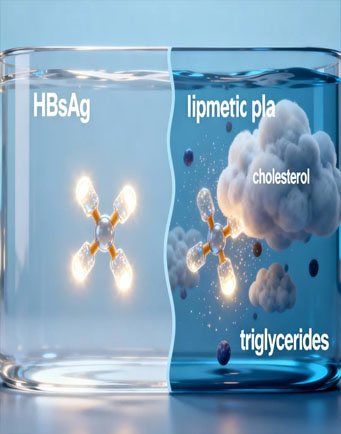
The results of the Immunochromatographic Method for Infectious Disease Testing (IMLTD) may vary depending on the presence of lipids in donor blood samples, potentially leading to false‐negative or false‐positive outcomes in hepatitis B surface antigen (HBsAg) screening. This study aimed to evaluate the effect of lipid interference on HBsAg screening using the chemiluminescent immunoassay (CLIA) method, to determine the range of triglyceride levels that may influence test results (100 mg/dL to >3000 mg/dL), and to assess practical lipid removal methods to ensure blood safety. An experimental laboratory study was conducted using two sample groups. The first group consisted of six bags of non-lipemic, HBsAg-reactive plasma that were rendered lipemic by the addition of Lipofundin. The second group included 25 bags of lipemic donor plasma that were non-reactive in the initial IMLTD screening and subsequently subjected to lipid removal treatments. Lipid reduction was performed using centrifugation, polyethylene glycol (PEG), and diethyl ether. The results showed no significant differences in HBsAg values before and after Lipofundin addition, indicating that lipemia did not affect HBsAg detection by the CLIA method. However, lipid removal using centrifugation, PEG, and diethyl ether significantly reduced triglyceride and total cholesterol levels (p < 0.05) in lipemic samples that interfered with CLIA analysis. In conclusion, lipemia does not directly affect HBsAg screening results using the CLIA method; however, lipid removal procedures are effective and necessary for managing highly lipemic samples to maintain the accuracy and reliability of blood screening tests.
Arulvijayavani, S., Mohanraj, P. S., & Reeta, R. (2023). Evaluating interference of lipemia on routine clinical biochemical tests. Journal of Laboratory Physicians, 15(02), 269-275. https://doi.org/10.1055/s-0042-1758664
Berman, M., & Hayes, J. (2024). A-119 Lipemia Interference. Clinical Chemistry, 70(Supplement_1), 106-118. https://doi.org/10.1093/clinchem/hvae106.118
Burdino, E., Ruggiero, T., Proietti, A., Milia, M. G., Olivero, A., Caviglia, G. P., ... & Ghisetti, V. (2014). Quantification of hepatitis B surface antigen with the novel DiaSorin LIAISON XL Murex HBsAg Quant: Correlation with the ARCHITECT quantitative assays. Journal of Clinical Virology, 60(4), 341-346. https://doi.org/10.1016/j.jcv.2014.05.013
Castro-Castro, M. J., Candás-Estébanez, B., Esteban-Salán, M., Calmarza, P., Arrobas-Velilla, T., Romero-Román, C., ... & Aguilar-Doreste, J. Á. (2018). Removing lipemia in serum/plasma samples: a multicenter study. Annals of laboratory medicine, 38(6), 518. https://doi.org/10.3343/alm.2018.38.6.518
Dean, C. L., Wade, J., & Roback, J. D. (2018). Transfusion-transmitted infections: an update on product screening, diagnostic techniques, and the path ahead. Journal of Clinical Microbiology, 56(7), 10-1128. https://doi.org/10.1128/JCM.00352-18
Dimeski, G., & Jones, B. W. (2011). Effective process for lipid reduction using high speed centrifugation compared with ultracentrifugation. Biochemia Medica, 21(1), 86-92. https://hrcak.srce.hr/64505
Fernández Prendes, C., Castro Castro, M. J., Sánchez Navarro, L., Rapún Mas, L., Morales Indiano, C., & Arrobas Velilla, T. (2023). Handling of lipemic samples in the clinical laboratory. Advances in Laboratory Medicine/Avances en Medicina de Laboratorio, 4(1), 5-15. https://doi.org/doi:10.1515/almed-2023-0003
Fu, P., Devare, S., Liu, J. F., Lv, X. T., Yin, P., Wu, B. T., ... & Shan, H. (2020). Evaluate performance of the Abbott chemiluminescent microparticle immunoassay assay for detection of syphilis infection in Chinese blood donors. Journal of Clinical Laboratory Analysis, 34(1), e23033. https://doi.org/10.1002/jcla.23033
Gardiner, C., Lane, P., Tailor, H., & Mackie, I. J. (2020). A practical method for reducing the interference due to lipaemia in coagulation tests. International Journal of Laboratory Hematology, 42(2), 140-144. https://doi.org/10.1111/ijlh.13129
Ghazal, K., Brabant, S., Prie, D., & Piketty, M. L. (2022). Hormone immunoassay interference: a 2021 update. Annals of laboratory medicine, 42(1), 3-23. https://doi.org/10.3343/alm.2022.42.1.3
Gupta, A., Sheedy, J., Ronzoni, S., & Lin, Y. (2022). Gross lipemia and blood bank testing. Transfusion, 62(12). https://doi.org/10.1111/trf.17103
Hippy, N. S. I., & Ukma, N. (2021). Prevalensi Kasus Reaktif HBsAg Pada Pendonor Dengan Metode ChLIA Dan Elisa Berdasarkan Usia Dan Jenis Kelamin Di Udd Pmi Kota Depok Pada Tahun 2019-2020. Ensiklopedia of Journal, 3(5), 114-120. https://doi.org/10.33559/eoj.v4i3.203
Jacob, E. A., Owoseni, M. F., Ibijola, A., Omisakin, C. T., Omoniyi, D. P., Oyedele, T., & Kolawole, F. (2023). Performance of enzyme linked immunosorbent assay and rapid screening techniques for detection of transfusion transmitted infections among blood donors. African Journal of Laboratory Haematology and Transfusion Science, 2(4), 239-246. https://doi.org/10.59708/ajlhts.v2i4.2326
Karin, A., Higgins, V., Miller, J., Brinc, D., Kulasingam, V., & Selvaratnam, R. (2023). Evaluation of hemolysis, lipemia, and icterus interference with common clinical immunoassays. Clinical Chemistry and Laboratory Medicine (CCLM), 61(6), 1035-1045. https://doi.org/10.1515/cclm-2022-0924
Kisniarti, L., Sukmana, D. J., Aini, A., Alfisahrin, A., & Halid, I. (2023). Prevalensi HBsAg Positif Pada Pendonor Darah Di Unit Daerah Palang Merah Indonesia Lombok Barat. Jurnal Sains Natural, 1(2), 51-55. https://doi.org/10.35746/jsn.v1i2.347
Maksymyuk, H., Boykiv, N., & Martianova, O. (2023). Factors Of Interference In Laboratory Investigations: Hemolysis, Icterus, Lipemia. Ukrainian Journal of Laboratory Medicine, 1(1), 22-32. https://doi.org/10.62151/2786-9288.1.1.2023.04
Martín-Calderón, J. L. (2022). Evaluation of endogenous interferences on several electrochemiluminescent immunoassays. La Rivista Italiana della Medicina di Laboratorio, 18(4), 196-202. https://doi.org/10.23736/S1825-859X.23.00167-6
Negash, M., Ayalew, M., Geremew, D., & Workineh, M. (2019). Seroprevalence and associated risk factors for HIV, Hepatitis B and C among blood Donors in South Gondar District blood Bank, Northwest Ethiopia. BMC infectious diseases, 19(1), 430. https://doi.org/10.1186/s12879-019-4051-y
Pliego-Sandoval, J. E., Díaz-Barbosa, A., Reyes-Nava, L. A., Angeles Camacho-Ruiz, M., Iñiguez-Muñoz, L. E., & Pinto-Pérez, O. (2023). Development and evaluation of a low-cost triglyceride quantification enzymatic biosensor using an Arduino-based microfluidic system. Biosensors, 13(8), 826. https://doi.org/10.3390/bios13080826
Soh, S. X., Loh, T. P., Sethi, S. K., & Ong, L. (2022). Methods to reduce lipemic interference in clinical chemistry tests: a systematic review and recommendations. Clinical Chemistry and Laboratory Medicine (CCLM), 60(2), 152-161. https://doi.org/doi:10.1515/cclm- 2021-0979
Soh, S. X., Loh, T. P., Sethi, S. K., & Ong, L. (2022). Methods to reduce lipemic interference in clinical chemistry tests: a systematic review and recommendations. Clinical Chemistry and Laboratory Medicine (CCLM), 60(2), 152-161. https://doi.org/10.1515/cclm-2021-0979
Winter, K. M., Webb, R. G., & Marks, D. C. (2022). Red cells manufactured from lipaemic whole blood donations: Do they have higher haemolysis?. Vox Sanguinis, 117(12), 1351-1359. https://doi.org/10.1111/vox.13366
Wiranto, R. R. P., Momuat, L. I., & Suryanto, E. (2024). Penggunaan Polietilena Glikol 6000 sebagai Flokulan Lipoprotein pada Serum Lipemik dalam Analisis Trigliserida. Chemistry Progress, 17(1), 97–103. https://doi.org/10.35799/cp.17.1.2024.54823
Copyright (c) 2026 JURNAL INFO KESEHATAN

This work is licensed under a Creative Commons Attribution-NonCommercial-ShareAlike 4.0 International License.
Copyright notice
Ownership of copyright
The copyright in this website and the material on this website (including without limitation the text, computer code, artwork, photographs, images, music, audio material, video material and audio-visual material on this website) is owned by JURNAL INFO KESEHATAN and its licensors.
Copyright license
JURNAL INFO KESEHATAN grants to you a worldwide non-exclusive royalty-free revocable license to:
- view this website and the material on this website on a computer or mobile device via a web browser;
- copy and store this website and the material on this website in your web browser cache memory; and
- print pages from this website for your use.
- All articles published by JURNAL INFO KESEHATAN are licensed under the Creative Commons Attribution 4.0 International License. This permits anyone to copy, redistribute, remix, transmit and adapt the work provided the original work and source is appropriately cited.
JURNAL INFO KESEHATAN does not grant you any other rights in relation to this website or the material on this website. In other words, all other rights are reserved.
For the avoidance of doubt, you must not adapt, edit, change, transform, publish, republish, distribute, redistribute, broadcast, rebroadcast or show or play in public this website or the material on this website (in any form or media) without appropriately and conspicuously citing the original work and source or JURNAL INFO KESEHATAN prior written permission.
Permissions
You may request permission to use the copyright materials on this website by writing to [email protected].
Enforcement of copyright
JURNAL INFO KESEHATAN takes the protection of its copyright very seriously.
If JURNAL INFO KESEHATAN discovers that you have used its copyright materials in contravention of the license above, JURNAL INFO KESEHATAN may bring legal proceedings against you seeking monetary damages and an injunction to stop you using those materials. You could also be ordered to pay legal costs.
If you become aware of any use of JURNAL INFO KESEHATAN copyright materials that contravenes or may contravene the license above, please report this by email to [email protected]
Infringing material
If you become aware of any material on the website that you believe infringes your or any other person's copyright, please report this by email to [email protected].