Effectiveness of Purple Sweet Potato and Red Bean Cookies on Fasting Blood Glucose Levels in Patients with Type II Diabetes Mellitus

Downloads
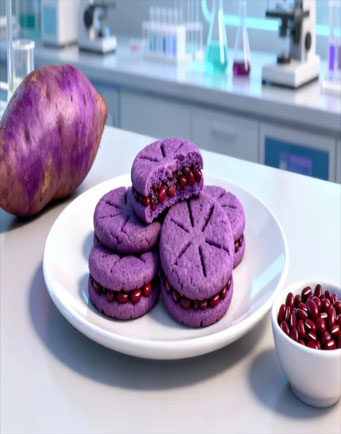
The worldwide prevalence of diabetes mellitus (DM) continues to climb yearly, with 1.5 million fatalities directly related to DM each year. The number of common instances of DM has been progressively growing during the last several decades. Poor dietary management in people with DM is one of the difficulties that commonly leads to uncontrolled blood glucose levels. Purple sweet potato and red bean cookies are utilized as an alternative treatment for persons with DM because purple sweet potatoes and red beans offer benefits in the form of a low glycemic index and high anthocyanin and fibre content. The goal of this research was to show the efficacy of purple sweet potato and red bean cookies on fasting blood glucose levels in individuals with type II diabetes mellitus. This research approach is a randomized control trial with a pretest-posttest design. Research includes 60 respondents split into 2 groups, utilizing a basic random selection approach. The research was performed for 21 days from 23 September to 13 October 2024 at the Sukamakmur health center region, Aceh Besar. This research employed a pre-test post-test difference test utilizing the Wilcoxon test, and the test across groups using the Mann-Whitney test. The findings of the pre-test average fasting blood sugar levels of intervention group respondents revealed results of 230.07 mg/dL to 152.10 mg/dL post-test (p 0.000), whereas the control group average pretest GDP 226.40 mg/dL to 186.60 mg/dL post-test (p 0.001). This research revealed significant changes in both the intervention and control groups before and after treatment. Statistical findings indicated that purple sweet potato and red bean cookies were more successful in decreasing blood glucose levels than purple sweet potato 104-gram cookies. Purple sweet potato and red bean cookies are excellent to be utilized as nutritious and practical snacks as a support system for persons with DM.
Alligood, M. R., Hamid, A.Y.S., & Ibrahim, K. (2017). Pakar teori keperawatan dan karya merdeka. Singapore: Elsevier.
Arania, R., Triwahyuni, T., Prasetya, T., & Cahyani, S. D. (2021). Hubungan antara pekerjaan dan aktivitas fisik dengan kejadian diabetes mellitus di Klinik Mardi Waluyo Kabupaten Lampung Tengah. Jurnal Medika Malahayati, 5(3), 163–169. https://doi.org/10.33024/jmm.v5i3.4110
Arisanti, C. I. S., Wirasuta, M. A. G., Musfiroh, I., Ikram, E. H. K., & Muchtaridi. (2023). Mechanism of anti-diabetic activity from sweet potato (Ipomoea batatas): A systematic review. Foods, 12(14), 1–16. https://doi.org/10.3390/foods12142810
Ariska, A. (2019). Efektivitas pemberian air rebusan lidah buaya (Aloe vera) terhadap kadar gula darah pada pasien diabetes mellitus tipe 2. Journal of Telenursing (JOTING), 1(1), 157-167. https://doi.org/10.31539/joting.v1i1.537
Armalia, N., & Herawati, T. (2020). Continuous Glucose Monitoring System (CGMS) Pada Penderita Diabetes Mellitus: Tinjauan Literatur. REAL in Nursing Journal, 3(2), 95-105. http://dx.doi.org/10.32883/rnj.v3i2.879
Badan Penelitian dan Pengembangan Kesehatan. (2018). Laporan Nasional Riskesdas 2018. Jakarta: Badan Penelitian dan Pengembangan Kesehatan.
Chan, K. C., Kok, K. E., Huang, K. F., Weng, Y. L., & Chung, Y. C. (2020). Effects of fermented red bean extract on nephropathy in streptozotocin-induced diabetic rats. Food & Nutrition Research, 64, 1–9. https://doi.org/10.29219/fnr.v64.4272
Cita, E. E., Yuanita, Y., & Antari, I. (2019). Self Care dan Kadar Gula Darah pada Pasien Diabetes Melitus Tipe 2. Jurnal Kesehatan Madani Medika, 10(2), 85-91. https://doi.org/10.36569/jmm.v10i2.75
Dinas Kesehatan Provinsi Aceh. (2022). Profil kesehatan Aceh. Aceh: Dinas Kesehatan Provinsi Aceh.
Dwipajati, D., Widajati, E., Ainaya, A. F., & Novanda, R. D. (2022). Potential of Indonesian community food sources which are rich in fiber as an alternative staple food for type 2 diabetics: A scoping review. Open Access Macedonian Journal of Medical Sciences, 10(T8), 47–53. https://doi.org/10.3889/oamjms.2022.9470
Fatria, I., Maidar, & Arifin, V. N. (2022). Faktor-faktor yang berhubungan dengan penyakit diabetes mellitus pada lansia. Journal of Health and Medical Science, 1(4), 29–40. https://doi.org/10.33559/eoj.v6i4.2029
Garedow, A. W., Jemaneh, T. M., Hailemariam, A. G., & Tesfaye, G. T. (2023). Lifestyle modification and medication use among diabetes mellitus patients. Scientific Reports, 13(1), 1–10. https://doi.org/10.1038/s41598-023-32145-y
Gipyapuri, R. A., Susyani, & Terati. (2020). Pengaruh pemberian puding D’Bingu terhadap penurunan kadar glukosa darah. Publikasi Penelitian Terapan dan Kebijakan, 2(1), 96–101. https://doi.org/10.46774/pptk.v2i1.96
Herikzah, R., Pudiastuti, R. S. E., & Widiyanto, B. (2024). Consumption of purple sweet potato snack bar and self-help group for blood glucose levels. International Journal of Innovative Science and Research Technology, 9(5), 1143–1149. https://doi.org/10.38124/ijisrt/ijisrt24may341
I’tishom, R., Wafa, I. A., Budi, D. S., & Pratama, N. R. (2021). Oral delivery of purple sweet potato extract-loaded nanocapsule in diabetic mice. Indian Journal of Pharmaceutical Education and Research, 55(3), 709–714. https://doi.org/10.5530/ijper.55.3.143
International Diabetes Federation. (2021). IDF diabetes atlas (10th ed.). Brussels: International Diabetes Federation.
Kementerian Kesehatan Republik Indonesia. (2018). Tabel komposisi pangan Indonesia 2017. Jakarta: Kementerian Kesehatan Republik Indonesia.
Komariah, K., & Rahayu, S. (2020). Hubungan usia, jenis kelamin, dan IMT dengan kadar gula darah puasa. Jurnal Kesehatan Kusuma Husada, 11(1), 41–50. https://doi.org/10.34035/jk.v11i1.412
Maina, P. M., Pienaar, M., & Reid, M. (2023). Self-management practices for preventing complications of type II diabetes mellitus. International Journal of Nursing Studies Advances, 5, 100136. https://doi.org/10.1016/j.ijnsa.2023.100136
Muslimin, N., Fanny, L., & Manjilala, M. (2018). Pemberian Kue Kering Tepung Ubi Jalar Ungu DenganTepung Tempe Terhadap Gula Darah Sewaktu Pada Penderita Diabetes Mellitus Type 2 Di Rumah Sakit dr. Tadjuddin Chalid Makassar. Media Gizi Pangan, 25(1), 33-38. https://doi.org/10.32382/mgp.v25i1.57
Noer, R. M., Juliana, T., Maulani, R. G., Nababan, A. N., Nurlince, & Tuwanakotta, M. (2022). Pemanfaatan ubi jalar ungu sebagai alternatif snack diabetes mellitus. GERVASI, 6(1), 250–257. https://doi.org/10.31571/gervasi.v6i1.3634
Yang, Y., Zhang, J. L., Shen, L. H., Feng, L. J., & Zhou, Q. (2021). Inhibition mechanism of anthocyanins from purple sweet potato. Food Chemistry, 359, 129934. https://doi.org/10.1016/j.foodchem.2021.129934
Zaddana, C., Almasyhuri, S.N., & Oktaviyanti, T. (2021). Snack bar berbahan dasar ubi ungu dan kacang merah. Amerta Nutrition, 5(3), 260–275. https://doi.org/10.20473/amnt.v5i3.2021.260-275
Copyright (c) 2026 JURNAL INFO KESEHATAN

This work is licensed under a Creative Commons Attribution-NonCommercial-ShareAlike 4.0 International License.
Copyright notice
Ownership of copyright
The copyright in this website and the material on this website (including without limitation the text, computer code, artwork, photographs, images, music, audio material, video material and audio-visual material on this website) is owned by JURNAL INFO KESEHATAN and its licensors.
Copyright license
JURNAL INFO KESEHATAN grants to you a worldwide non-exclusive royalty-free revocable license to:
- view this website and the material on this website on a computer or mobile device via a web browser;
- copy and store this website and the material on this website in your web browser cache memory; and
- print pages from this website for your use.
- All articles published by JURNAL INFO KESEHATAN are licensed under the Creative Commons Attribution 4.0 International License. This permits anyone to copy, redistribute, remix, transmit and adapt the work provided the original work and source is appropriately cited.
JURNAL INFO KESEHATAN does not grant you any other rights in relation to this website or the material on this website. In other words, all other rights are reserved.
For the avoidance of doubt, you must not adapt, edit, change, transform, publish, republish, distribute, redistribute, broadcast, rebroadcast or show or play in public this website or the material on this website (in any form or media) without appropriately and conspicuously citing the original work and source or JURNAL INFO KESEHATAN prior written permission.
Permissions
You may request permission to use the copyright materials on this website by writing to [email protected].
Enforcement of copyright
JURNAL INFO KESEHATAN takes the protection of its copyright very seriously.
If JURNAL INFO KESEHATAN discovers that you have used its copyright materials in contravention of the license above, JURNAL INFO KESEHATAN may bring legal proceedings against you seeking monetary damages and an injunction to stop you using those materials. You could also be ordered to pay legal costs.
If you become aware of any use of JURNAL INFO KESEHATAN copyright materials that contravenes or may contravene the license above, please report this by email to [email protected]
Infringing material
If you become aware of any material on the website that you believe infringes your or any other person's copyright, please report this by email to [email protected].