An Experimental Study: Aloe vera Extract Mouthwash against Dental Plaque

Downloads
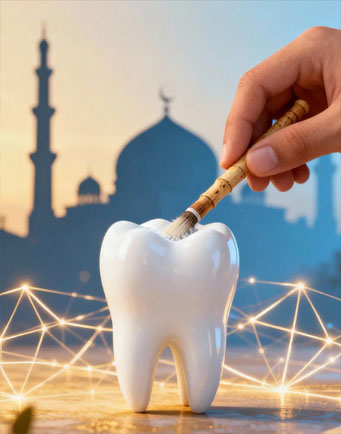
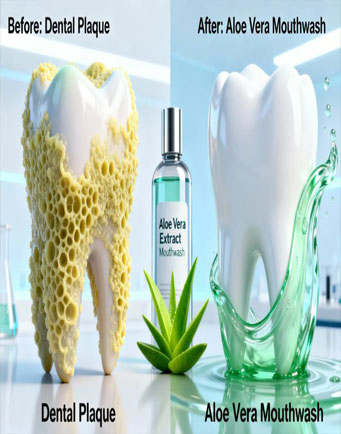
Recent studies have demonstrated the potential of Aloe vera as a natural agent in dental care based on in vivo and in vitro evidence; however, research evaluating its effectiveness as a mouthwash remains limited. This study aimed to assess the efficacy of Aloe vera mouthwash in reducing dental plaque among school-aged children in Indonesia. A structured experimental study with a pretest–posttest design was conducted involving 45 children aged 10–12 years in West Kalimantan. Dental plaque levels were measured using the Personal Hygiene Performance (PHP) Index before and after the intervention. The results showed that the mean dental plaque score decreased from 2.76 at baseline to 1.75 after the use of Aloe vera mouthwash. Statistical analysis using a paired t-test indicated a significant reduction in dental plaque scores following the intervention. In conclusion, Aloe vera mouthwash is effective in reducing dental plaque among children and may serve as a potential alternative preventive agent for periodontal disease.
Al‐Maweri, S. A., Nassani, M. Z., Alaizari, N., Kalakonda, B., Al‐Shamiri, H. M., Alhajj, M. N., ... & Alahmary, A. W. (2020). Efficacy of Aloe vera mouthwash versus chlorhexidine on plaque and gingivitis: A systematic review. International journal of dental hygiene, 18(1), 44-51. https://doi.org/10.1111/idh.12393
Alnouri, D. M. A., Kouchaji, C., Nattouf, A. H., & AlSayed Hasan, M. M. A. (2020). Effect of Aloe vera mouthwash on dental plaque and gingivitis indices in children: A randomized controlled clinical trial. Pediatric Dental Journal, 30(1), 1–8. https://doi.org/10.1016/j.pdj.2020.01.001
Anwar, M. A., Sayed, G. A., Hal, D. M., Hafeez, M. S. A. E., Shatat, A. A. S., Salman, A., ... & Aly, S. H. (2025). Herbal remedies for oral and dental health: a comprehensive review of their multifaceted mechanisms including antimicrobial, anti-inflammatory, and antioxidant pathways. Inflammopharmacology, 33(3), 1085-1160. https://doi.org/10.1007/s10787-024-01631-8
Arbab, S., Ullah, H., Weiwei, W., Wei, X., Ahmad, S. U., Wu, L., & Zhang, J. (2021). Comparative study of antimicrobial action of Aloe vera and antibiotics against different bacterial isolates from skin infection. Veterinary Medicine and Science, 7(5), 2061–2067. https://doi.org/10.1002/vms3.488
Armiati, I. G. K. (2018). Penurunan jumlah koloni Streptococcus mutans dalam rongga mulut oleh ekstrak etanol kulit daun lidah buaya. Interdental Jurnal Kedokteran Gigi (IJKG), 14(1), 1-4. https://doi.org/10.46862/interdental.v14i1.364
Athiban, P., Borthakur, B., Ganesan, S., & Swathika, B. (2012). Evaluation of antimicrobial efficacy of Aloe vera and its effectiveness in decontaminating gutta-percha cones. Journal of Conservative Dentistry, 15(3), 246–248. https://doi.org/10.4103/0972-0707.97949
Bhaiyana, S., Puri, A., Nangia, R., & Bhat, N. (2019). Antibacterial effect of Aloe vera gelagainst plaque and caries bacteria: an in-vitro study. International Journal of Health and Clinical Research, 2(3), 21–25.
Brookes, Z. L. S., McCullough, M., Kumar, P., & McGrath, C. (2023). Mouthwashes: Implications for Practice. International Dental Journal, 73, S98–S101. https://doi.org/10.1016/j.identj.2023.08.013
Chelu, M., Musuc, A. M., Popa, M., & Calderon Moreno, J. (2023). Aloe vera-based hydrogels for wound healing: properties and therapeutic effects. Gels, 9(7), 539. https://doi.org/10.3390/gels9070539
Farha, A. K., Yang, Q. Q., Kim, G., Li, H. B., Zhu, F., Liu, H. Y., ... & Corke, H. (2020). Tannins as an alternative to antibiotics. Food Bioscience, 38, 100751. https://doi.org/10.1016/j.fbio.2020.100751
Gupta, R. K., Gupta, D., Bhaskar, D. J. ohn, Yadav, A., Obaid, K., & Mishra, S. (2014). Preliminary antiplaque efficacy of Aloe vera mouthwash on 4 day plaque re-growth model: randomized control trial. Ethiopian Journal of Health Sciences, 24(2), 139–144. https://doi.org/10.4314/ejhs.v24i2.6
Hamonari, N., AL-Dabbagh, S. A., & Mudhir, A. M. (2021). The effect of aloevera mouthwash in reducing periodontal disease among secondary school students in Duhok, Kurdistan Region, Iraq: a quasi-experimental study. Indian Journal of Forensic Medicine & Toxicology, 15(3), 3707-3714. https://doi.org/10.37506/ijfmt.v15i3.15873
Hashemi, S. A., Madani, S. A., & Abediankenari, S. (2015). The review on properties of Aloe vera in healing of cutaneous wounds. BioMed research international, 2015(1), 714216. https://doi.org/10.1155/2015/714216
Haynes, A. B., Haukoos, J. S., & Dimick, J. B. (2021). TREND reporting guidelines for nonrandomized/quasi-experimental study designs. JAMA surgery, 156(9), 879-880. https://doi.org/10.1001/jamasurg.2021.0552
Kamath, N. P., Tandon, S., Nayak, R., Naidu, S., Anand, P. S., & Kamath, Y. S. (2020). The effect of Aloe vera and tea tree oil mouthwashes on the oral health of school children. European Archives of Paediatric Dentistry, 21(1), 61-66. https://doi.org/10.1007/s40368-019-00445-5
Badan Penelitian dan Pengembangan Kesehatan. (2018). Laporan Nasional Riskesdas 2018. Jakarta: Badan Penelitian dan Pengembangan Kesehatan.
Maftuchan, M., & Hadi, E. (2020). Kiddie doctors education strategy in improving the knowledge, attitude, and oral hygiene status of elementary school children. Journal of International Society of Preventive and Community Dentistry, 10(5), 549–554. https://doi.org/10.4103/jispcd.JISPCD_116_20
Mehta, V., Mathur, A., Tripathy, S., Sa, R., & Sharma, T. (2024). Effectiveness of herbal oral care products in reducing dental plaque and gingivitis: an overview of systematic reviews. Canadian Journal of Dental Hygiene, 58(2), 120. Retrieved from: https://pmc.ncbi.nlm.nih.gov/articles/PMC11223638/
Moghadam, E. T., Yazdanian, M., Tahmasebi, E., Tebyanian, H., Ranjbar, R., Yazdanian, A., ... & Tafazoli, A. (2020). Current herbal medicine as an alternative treatment in dentistry: In vitro, in vivo and clinical studies. European journal of pharmacology, 889, 173665. https://doi.org/10.1016/j.ejphar.2020.173665
Pattnaik, N., Mohanty, R., Satpathy, A., Nayak, R., Shamim, R., & Praharaj, A. K. (2022). Aloe vera mouthwashes can be a natural alternative to chemically formulated ones – A randomized-controlled trial. Journal of Taibah University Medical Sciences, 17(3), 424-432. https://doi.org/10.1016/j.jtumed.2021.10.006
Prueksrisakul, T., Chantarangsu, S., & Thunyakitpisal, P. (2015). Effect of daily drinking of Aloe vera gel extract on plasma total antioxidant capacity and oral pathogenic bacteria in healthy volunteer: A short-term study. Journal of Complementary and Integrative Medicine, 12(2), 159–164. https://doi.org/10.1515/jcim-2014-0060
Putri, M., Herijulianti, E., & Nurjannah, N. (2013). Ilmu Pencegahan Penyakit Jaringan Keras dan Jaringan Pendukung Gigi. Jakarta: EGC.
Sakaue, Y., Takenaka, S., Ohsumi, T., Domon, H., Terao, Y., & Noiri, Y. (2018). The effect of chlorhexidine on dental calculus formation: An in vitro study. BMC Oral Health, 18(1), 52. https://doi.org/10.1186/s12903-018-0517-3
Sánchez, M., González-Burgos, E., Iglesias, I., & Gómez-Serranillos, M. P. (2020). Pharmacological update properties of Aloe vera and its major active constituents. Molecules, 25(6), 1324. https://doi.org/10.3390/molecules25061324
Shamsudin, N. F., Ahmed, Q. U., Mahmood, S., Ali Shah, S. A., Khatib, A., Mukhtar, S., ... & Zakaria, Z. A. (2022). Antibacterial effects of flavonoids and their structure-activity relationship study: A comparative interpretation. Molecules, 27(4), 1149. https://doi.org/10.3390/molecules27041149
Sinto, R. (2022). COVID-19 Pandemic-to-endemic transition in Indonesia: What does the future hold?. Acta Medica Indonesiana, 54(2), 159-159. Retrieved from: https://www.actamedindones.org/index.php/ijim/article/view/2158
Swastini, I. G. A. A. P. (2017). Daya Hambat Ekstrak Daun Lidah Buaya (Aloe vera L) Terhadap Bakteri Streptococcus mutans Penyebab Dental Plak: The Inhibition of Aloe vera Rind Extract to The Growth of Bacteria Streptococcus Mutans Caused of Dental Plaque. Jurnal Sangkareang Mataram, 3(2), 6-10. Retrieved from: https://sangkareang.org/index.php/SANGKAREANG/article/view/227
Tatikonda, A., Debnath, S., Chauhan, V., Chaurasia, V., Taranath, M., & Sharma, A. (2014). Effects of herbal and non-herbal toothpastes on plaque and gingivitis: A clinical comparative study. Journal of International Society of Preventive and Community Dentistry, 4(5), S126–S129. https://doi.org/10.4103/2231-0762.146220
Tsai, C. L., & Wu, P. C. (2020). Possible beneficial role of throat gargling in the coronavirus disease pandemic. Public health, 185, 45–46. https://doi.org/10.1016/j.puhe.2020.05.055
United Nations. (2023). WHO chief declares end to COVID-19 as a global health emergency. UN News. https://news.un.org/en/story/2023/05/1136367
Vangipuram, S., Jha, A., & Bhashyam, M. (2016). Comparative efficacy of Aloe vera mouthwash and chlorhexidine on periodontal health: A randomized controlled trial. Journal of Clinical and Experimental Dentistry, 18(4), 442–447. https://doi.org/10.4317/jced.53033
Veseli, E., & Breznica, E. (2025). Mouthwash use in children and adolescents: should parents be worried?. European Archives of Paediatric Dentistry, 26(4), 813-814. https://doi.org/10.1007/s40368-024-00991-7
Vlahov, D. (2004). Transparent reporting of evaluations with nonrandomized designs (TREND). Journal of Urban Health, 81(2), 163-164. https://doi.org/10.1093/jurban/jth099
WHO. (2022). Global Status Report on Oral Health 2022. Geneva: WHO. Retrieved from: https://www.who.int/team/noncommunicable-diseases/global-status-report-on-oral-health-2022
Copyright (c) 2026 JURNAL INFO KESEHATAN

This work is licensed under a Creative Commons Attribution-NonCommercial-ShareAlike 4.0 International License.
Copyright notice
Ownership of copyright
The copyright in this website and the material on this website (including without limitation the text, computer code, artwork, photographs, images, music, audio material, video material and audio-visual material on this website) is owned by JURNAL INFO KESEHATAN and its licensors.
Copyright license
JURNAL INFO KESEHATAN grants to you a worldwide non-exclusive royalty-free revocable license to:
- view this website and the material on this website on a computer or mobile device via a web browser;
- copy and store this website and the material on this website in your web browser cache memory; and
- print pages from this website for your use.
- All articles published by JURNAL INFO KESEHATAN are licensed under the Creative Commons Attribution 4.0 International License. This permits anyone to copy, redistribute, remix, transmit and adapt the work provided the original work and source is appropriately cited.
JURNAL INFO KESEHATAN does not grant you any other rights in relation to this website or the material on this website. In other words, all other rights are reserved.
For the avoidance of doubt, you must not adapt, edit, change, transform, publish, republish, distribute, redistribute, broadcast, rebroadcast or show or play in public this website or the material on this website (in any form or media) without appropriately and conspicuously citing the original work and source or JURNAL INFO KESEHATAN prior written permission.
Permissions
You may request permission to use the copyright materials on this website by writing to [email protected].
Enforcement of copyright
JURNAL INFO KESEHATAN takes the protection of its copyright very seriously.
If JURNAL INFO KESEHATAN discovers that you have used its copyright materials in contravention of the license above, JURNAL INFO KESEHATAN may bring legal proceedings against you seeking monetary damages and an injunction to stop you using those materials. You could also be ordered to pay legal costs.
If you become aware of any use of JURNAL INFO KESEHATAN copyright materials that contravenes or may contravene the license above, please report this by email to [email protected]
Infringing material
If you become aware of any material on the website that you believe infringes your or any other person's copyright, please report this by email to [email protected].