The Association Between Dental Caries and Halitosis in Patients with Substance Use Disorder (SUD) at Lido Rehabilitation Center

Downloads
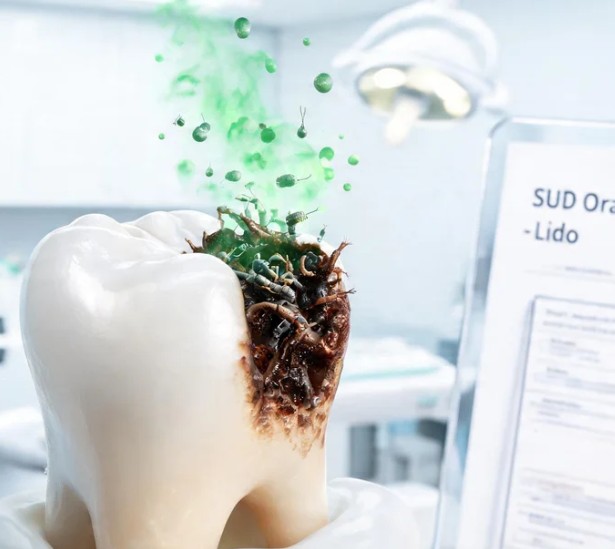
Patients with substance use disorders are known to harm their oral health. Drug effects can induce vasoconstriction and reduce the salivary flow. The reduction in salivary flow may alter salivary pH, and a lower pH can accelerate dental caries. Furthermore, dental caries can increase the production of volatile sulfur compounds (VSCs) through bacterial degradation of food debris, contributing to halitosis. This cross-sectional study involved 100 respondents at Lido Rehabilitation Center. Data was collected in August 2025. The independent variable is dental caries, measured using the DMF-T index, and the dependent variable is halitosis, evaluated using the organoleptic method. Other risk factors, including age, sex, education, occupation, smoking history, alcohol consumption history, systemic diseases, type of drugs, and dental scaling history, were identified. The correlation between these variables was analyzed using the Chi-square test. The study found that 98 participants had dental caries and 68 had halitosis, with an average DMF-T score of 8.35. The analysis showed no significant relationship between dental caries and halitosis (p=0.516). However, the history of dental scaling was significantly correlated with halitosis severity (p=0.049). This study shows that the prevalence of dental caries and halitosis among the respondents is relatively high. Dental caries showed no significant correlation with halitosis among patients with substance use disorder (SUD). Routine scaling by a dental professional should be implemented at the Lido Rehabilitation Center.
Adnyani, N. P., Made, I., & Artawa, B. (2016). Pengaruh penyakit gigi dan mulut terhadap halitosis. Jurnal Kesehatan Gigi, 4(1), 24–28. https://doi.org/10.33992/jkg.v4i1.504
Aimetti, M., Perotto, S., Castiglione, A., Ercoli, E., & Romano, F. (2015). Prevalence estimation of halitosis and its association with oral health-related parameters in an adult population of a city in North Italy. Journal of clinical periodontology, 42(12), 1105–1114. https://doi.org/10.1111/jcpe.12474
Alasqah, M., Khan, S., Elqomsan, M. A., Gufran, K., Kola, Z., & Hamza, M. O. B. (2016). Assessment of halitosis using the organoleptic method and volatile sulfur compounds monitoring. Journal of Dental Research and Reviews, 3(3), 94-98. https://doi.org/10.4103/2348-2915.194833
AlSadhan S. A. (2016). Self-perceived halitosis and related factors among adults residing in Riyadh, Saudi Arabia. A cross sectional study. The Saudi dental journal, 28(3), 118–123. https://doi.org/10.1016/j.sdentj.2016.06.001
Aydin, M., Bollen, C. M., & Özen, M. E. (2016). Diagnostic Value of Halitosis Examination Methods. Compendium of continuing education in dentistry (Jamesburg, N.J. : 1995), 37(3), 174–quiz180.
Bollen, C. M., & Beikler, T. (2012). Halitosis: the multidisciplinary approach. International journal of oral science, 4(2), 55–63. https://doi.org/10.1038/ijos.2012.39
Briguglio, G., Teodoro, M., Italia, S., Verduci, F., Pollicino, M., Coco, M., De Vita, A., Micali, E., Alibrandi, A., Lembo, G., Costa, C., & Fenga, C. (2021). Salivary Biomarkers and Work-Related Stress in Night Shift Workers. International journal of environmental research and public health, 18(6), 3184. https://doi.org/10.3390/ijerph18063184
Clague, J., Belin, T. R., & Shetty, V. (2017). Mechanisms underlying methamphetamine-related dental disease. Journal of the American Dental Association, (1939), 148(6), 377–386. https://doi.org/10.1016/j.adaj.2017.02.054
Cossa, F., Piastra, A., Sarrion-Pérez, M. G., & Bagán, L. (2020). Oral manifestations in drug users: A review. Journal of clinical and experimental dentistry, 12(2), e193–e200. https://doi.org/10.4317/jced.55928
Dayma, A., Jain, M., Saxena, V., Torwane, N., Vishu, V., & Khare, A. (2020). Validation of organoleptics and instrumental measurement for halitosis among patient with malodour. J Dent Health Oral Disord Ther, 11(1), 6-10. https://doi.org/10.15406/jdhodt.2020.11.00511
Du, M., Li, L., Jiang, H., Zheng, Y., & Zhang, J. (2019). Prevalence and relevant factors of halitosis in Chinese subjects: a clinical research. BMC oral health, 19(1), 45. https://doi.org/10.1186/s12903-019-0734-4
Effendi, N. Z., Louisa, M., Theresia, T. T., Parorrongan, C. A., Putri, A. T. D., & Putri, R. R. (2025). The differences in quality of life between healthy and periodontal disease patients with SUD at lido rehabilitation center: an observational analytical study. Padjadjaran Journal of Dentistry, 37(1), 44-50. https://doi.org/10.24198/pjd.vol37no1.59202
Einhorn, O. M., Georgiou, K., & Tompa, A. (2020). Salivary dysfunction caused by medication usage. Physiology international, 107(2), 195–208. https://doi.org/10.1556/2060.2020.00019
Kementerian Kesehatan Republik Indonesia. (2018). Riset Kesehatan Dasar (Riskesdas). Kementerian Kesehatan Republik Indonesia.
Irianto, A., Irwanto, Antasi, E., Sulistyorini, D., & Marliani, S. N. (2019). Riset kesehatan dampak penyalahgunaan narkoba 2019. Badan Narkotika Nasional Republik Indonesia.
Izidoro, C., Botelho, J., Machado, V., Reis, A. M., Proença, L., Alves, R. C., & Mendes, J. J. (2022). Revisiting Standard and Novel Therapeutic Approaches in Halitosis: A Review. International journal of environmental research and public health, 19(18), 11303. https://doi.org/10.3390/ijerph191811303
Kameyama, A., Ishii, K., Tomita, S., Tatsuta, C., Sugiyama, T., Ishizuka, Y., Takahashi, T., & Tsunoda, M. (2015). Correlations between Perceived Oral Malodor Levels and Self-Reported Oral Complaints. International journal of dentistry, 2015, 343527. https://doi.org/10.1155/2015/343527
Kapoor, U., Sharma, G., Juneja, M., & Nagpal, A. (2016). Halitosis: Current concepts on etiology, diagnosis and management. European journal of dentistry, 10(2), 292–300. https://doi.org/10.4103/1305-7456.178294
Khounganian, R. M., Alasmari, O. N., Aldosari, M. M., & Alghanemi, N. M. (2023). Causes and Management of Halitosis: A Narrative Review. Cureus, 15(8), e43742. https://doi.org/10.7759/cureus.43742
Kristianingsih, N. (2019). Hubungan Pengetahuan Menyikat Gigi malam sebelum Tidur Terhadap Status Ohi-S Pada Murid Kelas Iv Dan V Sd Integral di Yayasan Pesantren Hidayatullah Kendari. Jurnal Kesehatan Dan Kesehatan Gigi. 2(1), 1-6. Retrieved from : https://www.polbinhus.ac.id/jurnal/kesehatangigikendari/article/view/159
Markus, H., Harapan, I. K., & Raule, J. H. (2020). Gambaran karies gigi pada pasien karyawan PT Freeport Indonesia berdasarkan karakteristik di rumah sakit tembagapura Kabupaten Mimika Papua tahun 2018-2019. JIGIM (Jurnal Ilmiah Gigi dan Mulut), 3(2), 65-72. https://doi.org/10.47718/jgm.v3i2.1437
Mohaus, H. A. (2019). Dental caries among tasters and non-tasters of PTC substance in students of Qurna population. J Mol Biol Res, 9(1), 82. https://doi.org/10.5539/jmbr.v9n1p82
Mukherjee, A., Dye, B. A., Clague, J., Belin, T. R., & Shetty, V. (2018). Methamphetamine use and oral health-related quality of life. Quality of life research : an international journal of quality of life aspects of treatment, care and rehabilitation, 27(12), 3179–3190. https://doi.org/10.1007/s11136-018-1957-6
Muñoz, M. D. S., Pola, N. M., Colussi, P. R. G., Rösing, C. K., & Muniz, F. W. M. G. (2024). Association between salivary flow and dental caries in institutionalized adolescents: Cross-sectional study. Journal of oral biology and craniofacial research, 14(1), 55–60. https://doi.org/10.1016/j.jobcr.2023.12.004
Musa, N. (2018). Gambaran Status Kesehatan Gigi, Mulut, dan Karakteristik Saliva Pada Residen Di Balai Rehabilitasi BNN Baddoka Makassar (Skripsi). Universitas Hasanuddin.
Naji, N. A., Hamad, S. A., AlAdel, S. K., Musa, H. T., & Malik, S. S. (2024). An intra-oral infection Halitosis and its Causes, Diagnosis, and Treatment Strategies–A Systematic Review. Journal of Angiotherapy, 8(3), 1-9. https://doi.org/10.25163/angiotherapy.849514
Parorrongan, C. A., Theresia, T. T., Louisa, M., Effendi, N. Z., Putri, A. T. D., & Putri, R. R. (2025). Correlation between dental caries with quality of life in people with substance use disorder (SUD) at the lido rehabilitation center: a cross-sectional study. Padjadjaran Journal of Dentistry, 37(1), 1-7. https://doi.org/10.24198/pjd.vol37no1.59203
Pasiga, B. D., Djamaluddin, N., & Akbar, F. H. (2020). Oral health status and saliva characteristics of drug user at the rehabilitation center in Makassar. Sys Rev Pharmacy, 11, 24-30.
Pidada, I. B. G. S. P., Basworo, W., & Putrayasa, A. O. (2021). Risk Factor Analysis on Drug Abuse Handled by National Narcotics Board of Republic of Indonesia in the Special Region of Yogyakarta during 2020. SOEPRA, 7(2), 312–326. https://doi.org/10.24167/shk.v7i2.4135
Silva, M. F., Leite, F. R. M., Ferreira, L. B., Pola, N. M., Scannapieco, F. A., Demarco, F. F., & Nascimento, G. G. (2018). Estimated prevalence of halitosis: a systematic review and meta-regression analysis. Clinical oral investigations, 22(1), 47–55. https://doi.org/10.1007/s00784-017-2164-5
Silveira, J. O., Costa, F. O., Oliveira, P. A. D., Dutra, B. C., Cortelli, S. C., Cortelli, J. R., Cota, L. O. M., & Oliveira, A. M. S. D. (2017). Effect of non-surgical periodontal treatment by full-mouth disinfection or scaling and root planing per quadrant in halitosis-a randomized controlled clinical trial. Clinical oral investigations, 21(5), 1545–1552. https://doi.org/10.1007/s00784-016-1959-0
Sulistyorini, D., Utami, P. W., Pinuri, W., Bastara P., Prastya, A., & Wulan, L. W. (2024). Indonesia drug report. Badan Narkotika Nasional Republik Indonesia.
Teshome, A., Derese, K., & Andualem, G. (2021). The Prevalence and Determinant Factors of Oral Halitosis in Northwest Ethiopia: A Cross-Sectional Study. Clinical, cosmetic and investigational dentistry, 13, 173–179. https://doi.org/10.2147/CCIDE.S308022
United Nations Office on Drugs and Crime. (2025). World drug report 2025. United Nations.
Wu, J., Cannon, R. D., Ji, P., Farella, M., & Mei, L. (2020). Halitosis: prevalence, risk factors, sources, measurement and treatment - a review of the literature. Australian dental journal, 65(1), 4–11. https://doi.org/10.1111/adj.12725
Zahara, E., Niakurniawati, N., & Mufizarni, M. (2023). Derajat keasaman (pH) saliva dengan karies gigi di SDN Leue Kabupaten Aceh besar. JDHT, 4(1), 13–17. https://doi.org/10.36082/jdht.v4i1.925
Copyright (c) 2026 JURNAL INFO KESEHATAN

This work is licensed under a Creative Commons Attribution-NonCommercial-ShareAlike 4.0 International License.
Copyright notice
Ownership of copyright
The copyright in this website and the material on this website (including without limitation the text, computer code, artwork, photographs, images, music, audio material, video material and audio-visual material on this website) is owned by JURNAL INFO KESEHATAN and its licensors.
Copyright license
JURNAL INFO KESEHATAN grants to you a worldwide non-exclusive royalty-free revocable license to:
- view this website and the material on this website on a computer or mobile device via a web browser;
- copy and store this website and the material on this website in your web browser cache memory; and
- print pages from this website for your use.
- All articles published by JURNAL INFO KESEHATAN are licensed under the Creative Commons Attribution 4.0 International License. This permits anyone to copy, redistribute, remix, transmit and adapt the work provided the original work and source is appropriately cited.
JURNAL INFO KESEHATAN does not grant you any other rights in relation to this website or the material on this website. In other words, all other rights are reserved.
For the avoidance of doubt, you must not adapt, edit, change, transform, publish, republish, distribute, redistribute, broadcast, rebroadcast or show or play in public this website or the material on this website (in any form or media) without appropriately and conspicuously citing the original work and source or JURNAL INFO KESEHATAN prior written permission.
Permissions
You may request permission to use the copyright materials on this website by writing to [email protected].
Enforcement of copyright
JURNAL INFO KESEHATAN takes the protection of its copyright very seriously.
If JURNAL INFO KESEHATAN discovers that you have used its copyright materials in contravention of the license above, JURNAL INFO KESEHATAN may bring legal proceedings against you seeking monetary damages and an injunction to stop you using those materials. You could also be ordered to pay legal costs.
If you become aware of any use of JURNAL INFO KESEHATAN copyright materials that contravenes or may contravene the license above, please report this by email to [email protected]
Infringing material
If you become aware of any material on the website that you believe infringes your or any other person's copyright, please report this by email to [email protected].