Air Conditioner Condensate and Mineral Water as Alternative Solvents for Potato Dextrose Agar: Comparative Growth of Trichophyton rubrum

Downloads
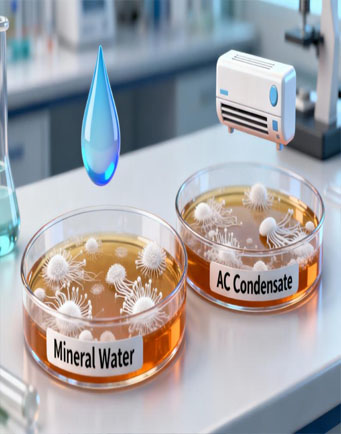
Trichophyton rubrum is the predominant cause of dermatophytosis worldwide, particularly in tropical countries such as Indonesia. Potato Dextrose Agar (PDA) is a standard medium for fungal culture, conventionally prepared with distilled water; however, its limited availability and high cost in resource-constrained laboratories necessitate alternative solvents. This study aimed to evaluate the growth of T. rubrum on PDA prepared with distilled water, air conditioner (AC) condensate, and bottled mineral water by comparing colony diameter and morphology. A quasi-experimental study with a post-test-only non-equivalent control group design was conducted. PDA was prepared using the three solvents, inoculated by the single-dot method, and incubated at a fixed temperature of 28°C for 7 days. Colony diameter and macroscopic and microscopic morphology were assessed. Statistical analyses included the Shapiro–Wilk test, One-Way ANOVA, and Independent Sample T-test (p < 0.05). All media supported typical T. rubrum growth. Colony diameters obtained using AC condensate were not significantly different from those obtained using distilled water, whereas mineral water resulted in significantly smaller colonies. These findings indicate that AC condensate can serve as an effective and economical substitute for distilled water in PDA preparation, while the use of mineral water should be limited due to variability in composition and lack of standardization.
Ahmed, H. M. (2024). Air Conditioning Condensate: A Potential Water Source for Irrigation. In Business Sustainability with Artificial Intelligence (AI): Challenges and Opportunities. Cham: Springer Nature Switzerland (Studies in Systems, Decision and Control), pp. 1213–1223. https://doi.org/10.1007/978-3-031-71526-6_105
Anton, A., Plinet, M., Peyret, T., Cazaudarré, T., Pesant, S., Rouquet, Y., ... & François, J. M. (2023). Rapid and Accurate Diagnosis of Dermatophyte Infections Using the DendrisCHIP® Technology. Diagnostics, 13(22), 3430. https://doi.org/10.3390/diagnostics13223430
Bains, W., Petkowski, J. J., Zhan, Z., & Seager, S. (2021). Evaluating alternatives to water as solvents for life: The example of sulfuric acid. Life, 11(5), 400. https://doi.org/10.3390/life11050400
Bitew, A. (2018). Dermatophytosis: Prevalence of dermatophytes and non‐dermatophyte fungi from patients attending Arsho Advanced Medical Laboratory, Addis Ababa, Ethiopia. Dermatology research and practice, 2018(1), 1–6. https://doi.org/10.1155/2018/8164757
Bueno, L., & Gallardo, R. (1998). Preservación de hongos filamentosos en agua destilada estéril. Rev Iberoam Micol, 15(3), 166-168.
Chiewchan, N., Phungamngoen, C., & Siriwattanayothin, S. (2006). Effect of homogenizing pressure and sterilizing condition on quality of canned high fat coconut milk. Journal of food engineering, 73(1), 38-44. https://doi.org/10.1016/j.jfoodeng.2005.01.003
Collins, M. T., Marcucci, G., Anders, H. J., Beltrami, G., Cauley, J. A., Ebeling, P. R., ... & Thakker, R. V. (2022). Skeletal and extraskeletal disorders of biomineralization. Nature Reviews Endocrinology, 18(8), 473-489. https://doi.org/10.1038/s41574-022-00682-7
Cordero, R. J., & Casadevall, A. (2017). Functions of fungal melanin beyond virulence. Fungal Biology Reviews, 31(2), 99-112. https://doi.org/10.1016/j.fbr.2016.12.003
Dehnavi, A. G., Sarikhani, R., & Nagaraju, D. (2011). Hydro geochemical and rock water interaction studies in East of Kurdistan, NW of Iran. Int J Environ Sci Res, 1(1), 16-22.
Dicks, A. P. (2009). A review of aqueous organic reactions for the undergraduate teaching laboratory. Green Chemistry Letters and Reviews, 2(1), 9-21. https://doi.org/10.1080/17518250902820182
Dong, H., Huang, L., Zhao, L., Zeng, Q., Liu, X., Sheng, Y., ... & Chen, H. (2022). A critical review of mineral–microbe interaction and co-evolution: mechanisms and applications. National science review, 9(10), 1-21. https://doi.org/10.1093/nsr/nwac128
Felle, H. H. (2001). pH: signal and messenger in plant cells. Plant biology, 3(06), 577-591. https://doi.org/10.1055/s-2001-19372
Fiorentini, D., Cappadone, C., Farruggia, G., & Prata, C. (2021). Magnesium: biochemistry, nutrition, detection, and social impact of diseases linked to its deficiency. Nutrients, 13(4), 1136. https://doi.org/10.3390/nu13041136
Fogarty, R. V., & Tobin, J. M. (1996). Fungal melanins and their interactions with metals. Enzyme and microbial technology, 19(4), 311-317. https://doi.org/10.1016/0141-0229(96)00002-6
Fogle, M. R., Douglas, D. R., Jumper, C. A., & Straus, D. C. (2008). Growth and mycotoxin production by Chaetomium globosum is favored in a neutral pH. International journal of molecular sciences, 9(12), 2357-2365. https://doi.org/10.3390/ijms9122357
Gao, D., Knight, M. R., Trewavas, A. J., Sattelmacher, B., & Plieth, C. (2004). Self-reporting Arabidopsis expressing pH and [Ca2+] indicators unveil ion dynamics in the cytoplasm and in the apoplast under abiotic stress. Plant physiology, 134(3), 898-908. https://doi.org/10.1104/pp.103.032508
Gmoser, R., Ferreira, J. A., Lennartsson, P. R., & Taherzadeh, M. J. (2017). Filamentous ascomycetes fungi as a source of natural pigments. Fungal biology and biotechnology, 4(4), 1-25. https://doi.org/10.1186/s40694-017-0033-2
Hailes, H. C. (2007). Reaction solvent selection: the potential of water as a solvent for organic transformations. Organic process research & development, 11(1), 114-120. https://doi.org/10.1021/op060157x
Hamada, N., & Fujita, T. (2002). Effect of air-conditioner on fungal contamination. Atmospheric Environment, 36(35), 5443-5448. https://doi.org/10.1016/S1352-2310(02)00661-1
Jahne, M., King, D., Kovalcik, K., Donohue, M., Pfaller, S., Helmick, K., Eades, G., Pait, M., Nye, M., Thimons, S., & J. Garland. (2023). Water Quality Assessment of AC Condensate for Onsite Collection and Use. United States Enviromental Protection Agency.
Jiang, L., Pettitt, T. R., Buenfeld, N., & Smith, S. R. (2022). A critical review of the physiological, ecological, physical and chemical factors influencing the microbial degradation of concrete by fungi. Building and Environment, 214, 108925. https://doi.org/10.1016/j.buildenv.2022.108925
Khan, M. O. (2023). Quality Assessment of Condensate Water Generating from Air Conditioning Units. https://doi.org/10.20944/preprints202310.1639.v1
Khan, S. S., & Saunte, D. M. L. (2025). Dermatophyte Treatment Failure: A Rapid Global Response to an Emerging Global Health Issue. Acta dermato-venereologica, 105, adv42948. https://doi.org/10.2340/actadv.v105.42948
Kumar, P., Ramachandran, S., Das, S., Bhattacharya, S. N., & Taneja, B. (2023). Insights into changing dermatophyte spectrum in India through analysis of cumulative 161,245 cases between 1939 and 2021. Mycopathologia, 188(3), 183-202. https://doi.org/10.1007/s11046-023-00720-6
Lakshmanan, E., Kannan, R., & Kumar, M. S. (2003). Major ion chemistry and identification of hydrogeochemical processes of ground water in a part of Kancheepuram district, Tamil Nadu, India. Environmental geosciences, 10(4), 157-166. https://doi.org/10.1306/eg100403011
Lin, L., & Xu, J. (2022). Production of fungal pigments: molecular processes and their applications. Journal of Fungi, 9(1), 44. https://doi.org/10.3390/jof9010044
Macêdo, W. V., Sakamoto, I. K., Azevedo, E. B., & Damianovic, M. H. R. (2019). The effect of cations (Na+, Mg2+, and Ca2+) on the activity and structure of nitrifying and denitrifying bacterial communities. Science of the Total Environment, 679, 279-287. https://doi.org/10.1016/j.scitotenv.2019.04.397
Mahvi, A. H., Alipour, V., & Rezaei, L. (2013). Atmospheric moisture condensation to water recovery by home air conditioners. American Journal of Applied Sciences, 10(8), 917. –923. https://doi.org/10.3844/ajassp.2013.917.923
Maia, V. R. T., Sampaio, E. B. T., de Oliveira, A. J., da Silva Santos, L., da Silva, M. K., de Queiroz, A. C., ... & Duarte, A. W. F. (2025). Pigment Production by Fungi from Polar Environments: From Cold to Industry. In Polar Microbes and Climate Change: A Molecular Understanding for Sustainable Future. Cham: Springer Nature Switzerland. https://doi.org/10.1007/978-3-032-07096-8_13
Matarneh, S., AlQaraleh, L., Alkhrissat, T., & Abdel-Jaber, M. (2024). Assessing water production from air conditioning systems as an unconventional supply source: A focus on water quality and social acceptance perspectives. Case Studies in Chemical and Environmental Engineering, 9, 100585. https://doi.org/10.1016/j.cscee.2023.100585
Matthews, C. (2003). Soft Drinks | Production. Encyclopedia of Food Sciences and Nutrition (Second Edition), 2023, 5352–5358. https://doi.org/10.1016/B0-12-227055-X/01102-0
Muksy, R., Kolo, K., & Abdullah, S. M. (2023). Bacterial and fungal-mineral interactions and their application in bioremediation–A review. Journal of Ecological Engineering, 24(5), 1-13. https://doi.org/10.12911/22998993/157567
Nigam, P.K., Syed, H.A. and Saleh, D. (2025). Tinea Pedis. Treasure Island (FL): StatPearls Publishing. Retrieved from: https://www.ncbi.nlm.nih.gov/books/NBK470421/
Prakoeswa, F. R. S., Pramuningtyas, R., & Dimawan, R. S. A. (2022). The Epidemiologic and Sociodemographic Features of Superficial Fungal Infection Among Children in East Java Suburban Public Hospital. Berkala Ilmu Kesehatan Kulit dan Kelamin, 34(2), 120-124. https://doi.org/10.20473/bikk.V34.2.2022.120-124
Prameswari, F. U., Muharram, F. R., Setyaningrum, T., & Prakoeswa, C. R. S. (2023). Burden of skin and subcutaneous diseases in Indonesia 1990 to 2019. Acta Dermato-Venereologica, 103, 18291. https://doi.org/10.2340/actadv.v103.18291
Ribeiro, E. C., Araújo, E. K. N., Penha, M. S. C., Nascimento, A. S. D., da Silva, D. F., & Miranda, R. D. C. M. D. (2025). Optimisation of Potato Dextrose Agar Culture Medium for Actinobacteria Growth. Microorganisms, 13(3), 654. https://doi.org/10.3390/microorganisms13030654
Risbandini, C. (2020). Utilization of Unused Autoclaves to Produce Aquades (Aquabits) in the Laboratory of Biosciences and Plant Technology, Department of Biology, Faculty of Science ITS. Jurnal Temapela, 3(1), 19–24. https://doi.org/10.25077/temapela.3.1.19-24.2020
Robinson, J. R., Isikhuemhen, O. S., & Anike, F. N. (2021). Fungal–metal interactions: a review of toxicity and homeostasis. Journal of Fungi, 7(3), 225. https://doi.org/10.3390/jof7030225
Romulo, A., Zuhud, E. A., Rondevaldova, J., & Kokoska, L. (2018). Screening of in vitro antimicrobial activity of plants used in traditional Indonesian medicine. Pharmaceutical biology, 56(1), 287-293. https://doi.org/10.1080/13880209.2018.1462834
Rosborg, I., Nihlgård, B., Gerhardsson, L., Gernersson, M. L., Ohlin, R., & Olsson, T. (2005). Concentrations of inorganic elements in bottled waters on the Swedish market. Environmental Geochemistry and Health, 27(3), 217-227. https://doi.org/10.1007/s10653-004-1612-8
Rosling, A., Lindahl, B. D., Taylor, A. F., & Finlay, R. D. (2004). Mycelial growth and substrate acidification of ectomycorrhizal fungi in response to different minerals. FEMS microbiology ecology, 47(1), 31-37. https://doi.org/10.1016/S0168-6496(03)00222-8
Samukha, V., Fantasma, F., D’Urso, G., Caprari, C., De Felice, V., Saviano, G., ... & Iorizzi, M. (2024). NMR metabolomics and chemometrics of commercial varieties of Phaseolus vulgaris L. seeds from Italy and in vitro antioxidant and antifungal activity. Plants, 13(2), 227. https://doi.org/10.3390/plants13020227
Sanders, E. R. (2012). Aseptic laboratory techniques: plating methods. Journal of Visualized Experiments (JoVE), (63), e3064. https://doi.org/10.3791/3064
Sanguino, T. C., Jarros, I. C., & Negri, M. (2019). Occurrence of dermatophytoses in patients from the Sistema Único de Saúde. Anais brasileiros de dermatologia, 94(3), 293-297. https://doi.org/10.1590/abd1806-4841.20197491
Scalize, P. S., Soares, S. S., Alves, A. C. F., Marques, T. A., Mesquita, G. G. M., Ballaminut, N., & Albuquerque, A. C. J. (2018). Use of condensed water from air conditioning systems. Open Engineering, 8(1), 284-292. https://doi.org/10.1515/eng-2018-0031
Seidel, D., Wurster, S., Jenks, J. D., Sati, H., Gangneux, J. P., Egger, M., ... & Kontoyiannis, D. P. (2024). Impact of climate change and natural disasters on fungal infections. The Lancet Microbe, 5(6), e594-e605. https://doi.org/10.1016/S2666-5247(24)00039-9
Semenov, M. V., Krasnov, G. S., Semenov, V. M., & van Bruggen, A. (2022). Mineral and organic fertilizers distinctly affect fungal communities in the crop rhizosphere. Journal of Fungi, 8(3), 251. https://doi.org/10.3390/jof8030251
Sengupta, P. (2013). Potential health impacts of hard water. International journal of preventive medicine, 4(8), 866–875. Retrieved from: https://pmc.ncbi.nlm.nih.gov/articles/PMC3775162/
Shree, A., Pal, S., & Verma, P. K. (2024). Structural diversification of fungal cell wall in response to the stress signaling and remodeling during fungal pathogenesis. Physiology and Molecular Biology of Plants, 30(5), 733-747. https://doi.org/10.1007/s12298-024-01453-6
Singh, D., Chaturvedi, V., & Verma, P. (2025). The amazing world of biological pigments: A review on microbial melanins. Dyes and Pigments, 237, 112711. https://doi.org/10.1016/j.dyepig.2025.112711
Smijs, T. G., Bouwstra, J. A., Schuitmaker, H. J., Talebi, M., & Pavel, S. (2007). A novel ex vivo skin model to study the susceptibility of the dermatophyte Trichophyton rubrum to photodynamic treatment in different growth phases. Journal of Antimicrobial Chemotherapy, 59(3), 433-440. https://doi.org/10.1093/jac/dkl490
Smit, Y., Cameron, M., Venter, P., & Witthuhn, R. C. (2011). Alicyclobacillus spoilage and isolation–a review. Food Microbiology, 28(3), 331-349. https://doi.org/10.1016/j.fm.2010.11.008
Sophia, A., & Suraini. (2023). The effectiveness of aquabidest and AC water as a solution of SDA media for the growth of Candida albicans. Bioma : Jurnal Biologi Makassar, 8(1), 16–22. Retrieved from: https://www.cabidigitallibrary.org/doi/full/10.5555/20230031340
Täuber, A., & Müller-Goymann, C. C. (2014). Comparison of the antifungal efficacy of terbinafine hydrochloride and ciclopirox olamine containing formulations against the dermatophyte Trichophyton rubrum in an infected nail plate model. Molecular pharmaceutics, 11(7), 1991-1996. https://doi.org/10.1021/mp400711q.
Terrones-Fernandez, I., Casino, P., López, A., Peiró, S., Ríos, S., Nardi-Ricart, A., ... & Piqué, N. (2023). Improvement of the pour plate method by separate sterilization of agar and other medium components and reduction of the agar concentration. Microbiology spectrum, 11(1), e0316122. Retrieved from: https://doi.org/10.1128/spectrum.03161-22
Tominik, V. I., & Haiti, M. (2020). Limbah air AC sebagai pelarut media sabouraud dextrose agar (SDA) pada jamur Candida albicans. Masker Medika Jurnal STIKes Muhamadiyah Palembang, 8(1), 15-20. https://doi.org/10.52523/maskermedika.v8i1.368.
Trofimova, Y., Walker, G., & Rapoport, A. (2010). Anhydrobiosis in yeast: influence of calcium and magnesium ions on yeast resistance to dehydration–rehydration. FEMS microbiology letters, 308(1), 55-61. https://doi.org/10.1111/j.1574-6968.2010.01989.x.
Wadhwa, K., Kapoor, N., Kaur, H., Abu-Seer, E. A., Tariq, M., Siddiqui, S., ... & Alghamdi, S. (2024). A comprehensive review of the diversity of fungal secondary metabolites and their emerging applications in healthcare and environment. Mycobiology, 52(6), 335-387. https://doi.org/10.1080/12298093.2024.2416736
Westphal, K. R., Heidelbach, S., Zeuner, E. J., Riisgaard-Jensen, M., Nielsen, M. E., Vestergaard, S. Z., ... & Sondergaard, T. E. (2021). The effects of different potato dextrose agar media on secondary metabolite production in Fusarium. International Journal of Food Microbiology, 347, 109171. https://doi.org/10.1016/j.ijfoodmicro.2021.109171.
Zehner, L.M., Krespach, M.K.C., Stroe, M.C., Rosin, M., Schroeckh, V., & Brakhage, A.A.. (2023). Activation of Secondary Metabolite Production in Fungi. In: Pöggeler, S., James, T. (eds) Evolution of Fungi and Fungal-Like Organisms. Cham: Springer. https://doi.org/10.1007/978-3-031-29199-9_11
Zheng, H., Xie, W., Li, D., Mei, H., Li, X., & Liu, W. (2025). A New Medium That Promotes Mass Sporulation of Trichophyton rubrum In Vitro. Mycoses, 68(3), e70039. https://doi.org/10.1111/myc.70039
Copyright (c) 2026 JURNAL INFO KESEHATAN

This work is licensed under a Creative Commons Attribution-NonCommercial-ShareAlike 4.0 International License.
Copyright notice
Ownership of copyright
The copyright in this website and the material on this website (including without limitation the text, computer code, artwork, photographs, images, music, audio material, video material and audio-visual material on this website) is owned by JURNAL INFO KESEHATAN and its licensors.
Copyright license
JURNAL INFO KESEHATAN grants to you a worldwide non-exclusive royalty-free revocable license to:
- view this website and the material on this website on a computer or mobile device via a web browser;
- copy and store this website and the material on this website in your web browser cache memory; and
- print pages from this website for your use.
- All articles published by JURNAL INFO KESEHATAN are licensed under the Creative Commons Attribution 4.0 International License. This permits anyone to copy, redistribute, remix, transmit and adapt the work provided the original work and source is appropriately cited.
JURNAL INFO KESEHATAN does not grant you any other rights in relation to this website or the material on this website. In other words, all other rights are reserved.
For the avoidance of doubt, you must not adapt, edit, change, transform, publish, republish, distribute, redistribute, broadcast, rebroadcast or show or play in public this website or the material on this website (in any form or media) without appropriately and conspicuously citing the original work and source or JURNAL INFO KESEHATAN prior written permission.
Permissions
You may request permission to use the copyright materials on this website by writing to [email protected].
Enforcement of copyright
JURNAL INFO KESEHATAN takes the protection of its copyright very seriously.
If JURNAL INFO KESEHATAN discovers that you have used its copyright materials in contravention of the license above, JURNAL INFO KESEHATAN may bring legal proceedings against you seeking monetary damages and an injunction to stop you using those materials. You could also be ordered to pay legal costs.
If you become aware of any use of JURNAL INFO KESEHATAN copyright materials that contravenes or may contravene the license above, please report this by email to [email protected]
Infringing material
If you become aware of any material on the website that you believe infringes your or any other person's copyright, please report this by email to [email protected].