Synergistic Impacts of Water Hyacinth Bloom and Organic Pollution on Water Quality and Public Health Risk

Downloads
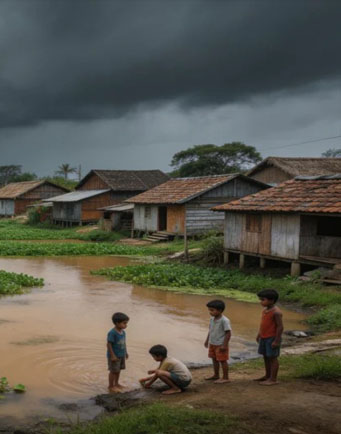
Multifunctional tropical reservoirs face increasing threats from water quality degradation due to anthropogenic activities, posing significant risks to both the ecosystem and public health. This study evaluates the synergistic impacts of water hyacinth (Eichhornia crassipes) bloom and organic pollution on Cengklik Reservoir. It assessed the combined effect of these factors on oxygen dynamics and inferred the potential risks to human health for communities reliant on the reservoir. The research utilized historical data (2020-2024) for Biochemical Oxygen Demand (BOD) and Dissolved Oxygen (DO) from the official BBWS Surakarta website. Standard test methods (SNI 6989.72.2009 for BOD and APHA 2017 for DO) were used to ensure data quality. This study indicates a synergistic interaction between organic pollution and water hyacinth proliferation that contributes to water quality degradation and conditions favorable for pathogen and toxin occurrence. A temporal trend analysis and a comparison with national water quality standards were performed. The analysis revealed a significant increase in average BOD concentrations (4.3-7.9 mg/L) and a decrease in average DO (3.78 mg/L) throughout the study period. These values exceeded the Class II water quality standard for BOD (3 mg/L) and did not comply with the DO standard (>4 mg/L) as per PP RI No. 22 of 2021. Linier regression= 0.820 (Not statistically significant. Simultaneously, BOD does not have a significant effect on DO. This indicates that the BOD variable is not an effective predictor of the DO variable). These findings indicate a high organic load and widespread oxygen depletion. This highlights the urgent need for an integrated management strategy to protect the reservoir’s ecological sustainability and the health of the surrounding community.
Akhtar, N., Syakir Ishak, M. I., Bhawani, S. A., & Umar, K. (2021). Various Natural and Anthropogenic Factors Responsible for Water Quality Degradation: A Review. Water, 13(19), 2660. https://doi.org/10.3390/w13192660
Al Haffar, M., Fajloun, Z., Azar, S., Sabatier, J. M., & Abi Khattar, Z. (2024). Lesser-Known Cyanotoxins: A Comprehensive Review of Their Health and Environmental Impacts. Toxins , 16(12), 552. https://doi.org/10.3390/toxins16120551
Ariyani, N., Maharani, N. E., & Nurbaya, F. (2024). Kajian Temporal Tingkat Pencemaran Lingkungan Perairan Waduk Cengklik Kabupaten Boyolali – Jawa Tengah. Jurnal Kesehatan Masyarakat Indonesia, 19(3), 6-13. https://doi.org/10.26714/jkmi.19.3.2024.6-13
Asmaranto, R., & Suryono, A. (2017). Kajian Daya Dukung Waduk Untuk Budidaya Ikan (Studi Kasus: Bendungan Cengklik). Pertemuan Ilmiah Tahunan XXXIV HATHI - Papua, 1–11.
Bbosa, W. K., Feng, L., Odongol, E. E., Su, Y., Liu, T., & Xu, B. (2024). Environmental sustainable treatment and disposal technologies for reservoir wastes: a review. Environmental Science and Pollution Research, 31(50), 59749–59766. https://doi.org/10.1007/s11356-024-35125-5
Brebu, M. (2020). Environmental Degradation of Plastic Composites with Natural Fillers—A Review. Polymers, 12(1), 166. https://doi.org/10.3390/polym12010166
Chai, D., Cui, K., Yu, K., Chen, X., Guo, Z., & Chen, Y. (2023). Comprehensive insights into the occurrence, distribution, risk assessment of typical pesticides and their environmental driving effects in a large drinking water reservoir. Journal of Environmental Chemical Engineering, 11(5), 110513. https://doi.org/10.1016/j.jece.2023.110513
Correa-Mejía, L. F., & Garcés-Gómez, Y. A. (2025). Water Hyacinth Invasion and Management in a Tropical Hydroelectric Reservoir: Insights from Random Forest and SVM Classification. Ecologies, 6(1), 8. https://doi.org/10.3390/ecologies6010008
Cortés-Sánchez, A. D. J., Espinosa-Chaurand, L. D., Díaz-Ramirez, M., & Torres-Ochoa, E. (2021). Plesiomonas: A review on food safety, fish‐borne diseases, and tilapia. The Scientific World Journal, 2021(1), 3119958. https://doi.org/10.1155/2021/3119958
Demelash Abera, B., & Alefe Adimas, M. (2024). Health benefits and health risks of contaminated fish consumption: Current research outputs, research approaches, and perspectives. Heliyon, 10(13), e33905. https://doi.org/10.1016/j.heliyon.2024.e33905
Elmahdi, A. (2024). Addressing water scarcity in agricultural irrigation: By exploring alternative water resources for sustainable irrigated agriculture. Irrigation and Drainage, 73(5), 1675–1683. https://doi.org/10.1002/ird.2973
Gao, Q.-F., & Dong, S.-L. (2023). Cage Farming of Fish in Open Waters. In Aquaculture Ecology (pp. 425–445). Springer Nature Singapore. https://doi.org/10.1007/978-981-19-5486-3_12
Honlah, E., Yao Segbefia, A., Odame Appiah, D., Mensah, M., & Atakora, P. O. (2019). Effects of water hyacinth invasion on the health of the communities, and the education of children along River Tano and Abby-Tano Lagoon in Ghana. Cogent Social Sciences, 5(1), 1619652. https://doi.org/10.1080/23311886.2019.1619652
Krisnawati, A., Masykuri, M., & Sunarto. (2020, November). The dynamics of organic pollutant pollution of phosphate, sulphate, nitrite, and nitrate parameters in Cengklik Reservoir water. AIP Conference Proceedings, 2296, 020005. https://doi.org/10.1063/5.0030685
Kurniati, R. I., Komala, P. S., & Zulkarnaini, Z. (2021). Analisis Beban Pencemar Total Nitrogen dan Total Fosfat akibat Aktivitas Antropogenik di Danau Maninjau. Jurnal Ilmu Lingkungan, 19(2), 355–364. https://doi.org/10.14710/jil.19.2.355-364
Kurniawan, A., Khasanah, K., & Jayatri, F. N. M. (2022, February). Study on the application of phytoremediation of phosphate content to eutrophication in Cengklik Reservoir, Boyolali Regency. In IOP Conference Series: Earth and Environmental Science, 986(1), 012075. https://doi.org/10.1088/1755-1315/986/1/012075
May, L., Olszewska, J., Gunn, I. D. M., Meis, S., & Spears, B. M. (2020). Eutrophication and restoration in temperate lakes. IOP Conference Series: Earth and Environmental Science, 535(1), 012001. https://doi.org/10.1088/1755-1315/535/1/012001
Maharani, S. M.D., Suwarto, & Rusdiyana, E. (2025). The sustainability of freshwater fish cultivation business in Boyolali, Indonesia. IOP Conference Series: Earth and Environmental Science, 1489(1), 1-6. https://doi.org/10.1088/1755-1315/1489/1/012018
Mokoena, M. M. (2024). Microcystins in water containers used in the home: A review of their potential health effects. Ecotoxicology and Environmental Safety, 269(November 2023), 115787. https://doi.org/10.1016/j.ecoenv.2023.115787
Morris, Z. J., Stommel, E. W., & Metcalf, J. S. (2025). Airborne Cyanobacterial Toxins and Their Links to Neurodegenerative Diseases. Molecules, 30(11), 1–26. https://doi.org/10.3390/molecules30112320
Nathanailides, C., Kolygas, M., Tsoumani, M., Gouva, E., Mavraganis, T., & Karayanni, H. (2023). Addressing Phosphorus Waste in Open Flow Freshwater Fish Farms: Challenges and Solutions. Fishes, 8(9), 1–17. https://doi.org/10.3390/fishes8090442
Tiwari, A. K., & Pal, D. B. (2022). Nutrients contamination and eutrophication in the river ecosystem. In Ecological Significance of River Ecosystems (pp. 203–216). Elsevier. https://doi.org/10.1016/B978-0-323-85045-2.00001-7
Wisnu, R. P., Karuniasa, M., & Moersidik, S. S. (2019). The effect of fish aquaculture on water quality in Lake Cilala, Bogor Regency. IOP Conference Series: Earth and Environmental Science, 399(1), 012111. https://doi.org/10.1088/1755-1315/399/1/012111
Yan, S.-H., Song, W., & Guo, J.-Y. (2017). Advances in management and utilization of invasive water hyacinth (Eichhornia crassipes) in aquatic ecosystems – a review. Critical Reviews in Biotechnology, 37(2), 218–228. https://doi.org/10.3109/07388551.2015.1132406
Zewdu, Z., Tarko, A., Kassa, Y., Mulugeta, M., Moges, Z., Yenealem, D., Fentie, T., Amare, A., Mulu, T., Ayele, H. S., Lemma, B., & Tibebe, D. (2024). Comprehensive assessment of water pollution and health risks in the Angereb Reservoirs, Gondar, Ethiopia. Scientific African, 25(August), e02338. https://doi.org/10.1016/j.sciaf.2024.e02338
Copyright (c) 2026 JURNAL INFO KESEHATAN

This work is licensed under a Creative Commons Attribution-NonCommercial-ShareAlike 4.0 International License.
Copyright notice
Ownership of copyright
The copyright in this website and the material on this website (including without limitation the text, computer code, artwork, photographs, images, music, audio material, video material and audio-visual material on this website) is owned by JURNAL INFO KESEHATAN and its licensors.
Copyright license
JURNAL INFO KESEHATAN grants to you a worldwide non-exclusive royalty-free revocable license to:
- view this website and the material on this website on a computer or mobile device via a web browser;
- copy and store this website and the material on this website in your web browser cache memory; and
- print pages from this website for your use.
- All articles published by JURNAL INFO KESEHATAN are licensed under the Creative Commons Attribution 4.0 International License. This permits anyone to copy, redistribute, remix, transmit and adapt the work provided the original work and source is appropriately cited.
JURNAL INFO KESEHATAN does not grant you any other rights in relation to this website or the material on this website. In other words, all other rights are reserved.
For the avoidance of doubt, you must not adapt, edit, change, transform, publish, republish, distribute, redistribute, broadcast, rebroadcast or show or play in public this website or the material on this website (in any form or media) without appropriately and conspicuously citing the original work and source or JURNAL INFO KESEHATAN prior written permission.
Permissions
You may request permission to use the copyright materials on this website by writing to [email protected].
Enforcement of copyright
JURNAL INFO KESEHATAN takes the protection of its copyright very seriously.
If JURNAL INFO KESEHATAN discovers that you have used its copyright materials in contravention of the license above, JURNAL INFO KESEHATAN may bring legal proceedings against you seeking monetary damages and an injunction to stop you using those materials. You could also be ordered to pay legal costs.
If you become aware of any use of JURNAL INFO KESEHATAN copyright materials that contravenes or may contravene the license above, please report this by email to [email protected]
Infringing material
If you become aware of any material on the website that you believe infringes your or any other person's copyright, please report this by email to [email protected].