Diagnostic Test of Randhawa Preoperative Scoring System in Predicting Laparoscopic Cholecystectomy Difficulty

Downloads
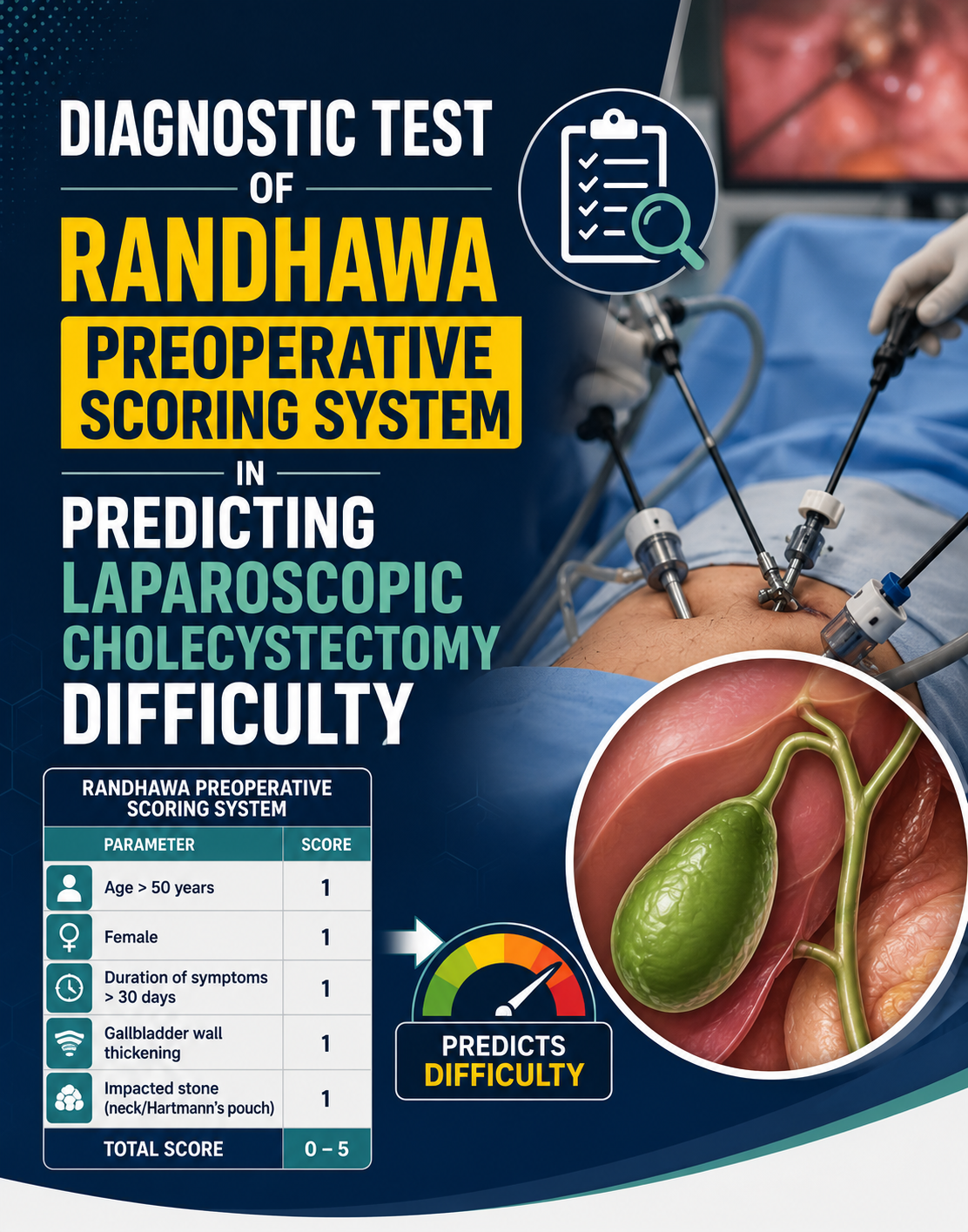
Despite its minimally invasive nature, laparoscopic cholecystectomy carries inherent risks of complications and unplanned conversions to open procedures. Scoring systems, such as the one developed by Randhawa and Pujahari, are used to assess this risk preoperatively. While the Randhawa scoring system shows great performance in the original study, external validation is essential before it can be widely implemented. To address this, we conducted a study with a cross-sectional analytical design where all data prospectively collected to externally validate the diagnostic value of the Rhandawa scoring system in predicting laparoscopic cholecystectomy difficulty. Using consecutive sampling, this study was conducted at the Dr. Zainoel Abidin General Hospital surgical ward and operating theatre between August and December 2025. Patients were evaluated preoperatively one day prior to surgery using the Randhawa scoring system, and intraoperative data, including duration, complications, and conversion, were recorded. Surgical difficulty was classified as easy, difficult, or very difficult based on these findings. Bivariate and multivariate analyses were performed to identify risk factors in the scoring system that were significantly associated with laparoscopic cholecystectomy difficulty. The area under the ROC curve (AUC) was calculated to assess the diagnostic performance of the scoring system, along with sensitivity, specificity, accuracy, positive predictive value (PPV), and negative predictive value (NPV). A history of hospitalization for acute cholecystitis was found to be significantly associated with laparoscopic cholecystectomy difficulty in both bivariate (p = 0.009) and multivariate (OR 4.85; 95% CI: 1.52–15.40; p = 0.007) analyses. The preoperative score and laparoscopic cholecystectomy difficulties were found to be significantly associated (p < 0.05). Our findings also demonstrated that the Randhawa preoperative scoring system demonstrated good diagnostic accuracy with an AUC of 0.836. Using a cutoff threshold of ≤5 and >5, the scoring system yielded 56.25% (95% CI: 29.88%–80.25%) sensitivity, 87.5% (95% CI: 67.64%–97.34%) specificity, 75% (95% CI: 57.80%–87.88%) accuracy, 75% (95% CI: 48.11%–90.73%) PPV, and 70% (95% CI: 63.80%–83.66%) NPV. We concluded that the Randhawa preoperative scoring system is reliable and beneficial in predicting laparoscopic cholecystectomy difficulty. Furthermore, we suggest for subsequent multicenter validation with larger patient samples
Abdallah, H. S., Sedky, M. H., & Sedky, Z. H. (2025). The difficult laparoscopic cholecystectomy: a narrative review. BMC surgery, 25(1), 156. https://doi.org/10.1186/s12893-025-02847-3
Agarwal, R., Prabhu, V. M. D., & Rao, N. A. R. (2025). From the operating room: Surgeons' views on difficult laparoscopic cholecystectomies. Annals of hepato-biliary-pancreatic surgery, 29(2), 150–156. https://doi.org/10.14701/ahbps.24-219
Ahmed, N. M., Djote, S. M., Alemayehu, G. D., Amtataw, W., & Ahmed, S. M. (2025). Validation of preoperative predictor score for difficult laparascopic cholecystectomy and a modified intraoperative grading score of the difficulty of laparascopic cholecystectomy: from a resource limited setting. BMC surgery, 25(1), 42. https://doi.org/10.1186/s12893-025-02784-1
Aji, S. P., Arania, R., & Maharyuni, E. (2020). Hubungan usia, jenis kelamin, dan kadar bilirubin dengan kolelitiasis. Jurnal Wacana Kesehatan, 5(2), 583-587. https://doi.org/https://doi.org/10.52822/jwk.v5i2.152
Anbiar, M. A. P., Suchitra, A., & Desmawati, D. (2022). The Hubungan Obesitas dengan Kejadian Kolelitiasis di RSUP Dr. M. Djamil Padang Periode Januari – Desember 2019. Jurnal Ilmu Kesehatan Indonesia, 2(2), 65–73. https://doi.org/10.25077/jikesi.v2i2.455
Ashok, R. N. S., & Kumar, B. (2023). Laparoscopic Versus Open Cholecystectomy in Acute Cholecystitis: A Comparative Study. European Journal of Cardiovascular Medicine, 13, 1833-1837. https://doi.org/10.5083/ejcm/2023
Biantara, I., Dewi, V. R., Kharomah, L. N., Dwikijayanti, G. P., Hidayat, Y. T., & Supriyanto, S. (2023). Studi Kasus: Penerapan Perioperatif Care Pada Diagnosa Cholelithiasis Dengan Tindakan Operasi Kolesistektomi Laparatomi. Jurnal Sains dan Kesehatan, 7(1), 39-48. https://doi.org/https://doi.org/10.57214/jusika.v7i1.276
Collins, G. S., Dhiman, P., Ma, J., Schlussel, M. M., Archer, L., Van Calster, B., Harrell, F. E., Jr, Martin, G. P., Moons, K. G. M., van Smeden, M., Sperrin, M., Bullock, G. S., & Riley, R. D. (2024). Evaluation of clinical prediction models (part 1): from development to external validation. BMJ (Clinical research ed.), 384, e074819. https://doi.org/10.1136/bmj-2023-074819
Darmayanti, D., Armaijn, L., & Supriyatni, N. (2025). Clinical Symptoms of Cholelithiasis and Abdominal Ultrasound Findings in the Radiology Installation of RSD. Indonesian Journal of Global Health Research, 7(2), 487-492. https://doi.org/10.37287/ijghr.v7i2.5501
Fakje, T. H. S. A., Hasso, B. S. S. A. A., & Mashhadani, A. A. (2025). Pathogenesis of fibrosis: A comprehensive review of oxidative, inflammatory, and immune mechanisms underlying tissue damage in multiple organ systems. Jurnal Riset Ilmu Farmasi dan Kesehatan, 3(3), 317-335. https://doi.org/https://doi.org/10.61132/obat.v3i5.1705
Farhangmehr, N., & Menzies, D. (2020). Laparoscopic cholecystectomy: from elective to urgent surgery. Laparoscopic Surgery, 5. https://doi.org/http://dx.doi.org/10.21037/ls-20-46
Febyan, F., Dhilion, H. R. S., Ndraha, S., & Tendean, M. (2017). Karakteristik Penderita Kolelitiasis Berdasarkan Faktor Risiko di Rumah Sakit Umum Daerah Koja. Jurnal Kedokteran Meditek, 23(63). https://doi.org/10.36452/jkdoktmeditek.v23i63.1565
Filia, M. (2019). Aspek hukum persetujuan tindakan medis (informed consent) dalam penerapan teknik operasi bedah jantung. Esensi Hukum, 1(1), 96-108. https://doi.org/https://doi.org/10.35586/esensihukum.v1i1.15
Fisher, A. T., Bessoff, K. E., Khan, R. I., Touponse, G. C., Yu, M. M. K., Patil, A. A., Choi, J., Stave, C. D., & Forrester, J. D. (2022). Evidence-based surgery for laparoscopic cholecystectomy. Surgery open science, 10, 116–134. https://doi.org/10.1016/j.sopen.2022.08.003
Javid, M., Hadian, M., Rezapour, A., Salehi, M., & Toroski, M. (2018). Cost-utility analysis of laparoscopic cholecystectomy and open cholecystectomy in Kashani Hospital, Shahr-e-Kord, Iran. Iran Red Crescent Med J, 21(S1), 1-5. https://doi.org/10.5812/ircmj.27885
Jebakumar, G. S., Muthiah, J., Jayapal, L., Kumar, R. S., Tasgaonkar, S., Anand, K. S. S., Jameel, J. K. A., Swain, S. K., Raghunath, K. J., Reddy, P. K., & Balachandar, T. G. (2024). Laparoscopic management of remnant gall bladder with stones: Lessons from a tertiary care centre's experience. Laparoscopic, Endoscopic and Robotic Surgery, 7(1), 27-33. https://doi.org/10.1016/j.lers.2024.02.004
Khan, A., Ahmed, M. K., Faraz, N., & Husain, M. (2026). Cholelithiasis risk factors in young age patients less than 30 years of age. International Journal of Research in Medical Sciences, 14(2), 570–576. https://doi.org/10.18203/2320-6012.ijrms20260244
Mahanta, J., Tiadi, A., & Pradhan, N. (2025). Pre-operative Prediction of Difficult Laparoscopic Cholecystectomy. SSR Institute of International Journal of Life Sciences, 11(5), 8454-8460. https://doi.org/10.21276/SSR-IIJLS.2025.11.5.37
Nassar, A. H. M., Zanati, H. E., Ng, H. J., Khan, K. S., & Wood, C. (2022). Open conversion in laparoscopic cholecystectomy and bile duct exploration: subspecialisation safely reduces the conversion rates. Surgical endoscopy, 36(1), 550–558. https://doi.org/10.1007/s00464-021-08316-1
Philip, A. M., & Anjarbeedu, R. R. (2023). Predicting difficulty in laparoscopic cholecystectomy preoperatively using modified Randhawa scoring system. International Surgery Journal, 10(3), 403-407. https://doi.org/https://dx.doi.org/10.18203/2349-2902.isj20230491
Pookhao, N., Sohn, M. B., Li, Q., Jenkins, I., Du, R., Jiang, H., & An, L. (2015). A two-stage statistical procedure for feature selection and comparison in functional analysis of metagenomes. Bioinformatics (Oxford, England), 31(2), 158–165. https://doi.org/10.1093/bioinformatics/btu635
Radunovic, M., Lazovic, R., Popovic, N., Magdelinic, M., Bulajic, M., Radunovic, L., Vukovic, M., & Radunovic, M. (2016). Complications of Laparoscopic Cholecystectomy: Our Experience from a Retrospective Analysis. Open access Macedonian journal of medical sciences, 4(4), 641–646. https://doi.org/10.3889/oamjms.2016.128
Ramspek, C. L., Jager, K. J., Dekker, F. W., Zoccali, C., & van Diepen, M. (2020). External validation of prognostic models: what, why, how, when and where?. Clinical kidney journal, 14(1), 49–58. https://doi.org/10.1093/ckj/sfaa188
Randhawa, J. S., & Pujahari, A. K. (2009). Preoperative prediction of difficult lap chole: a scoring method. The Indian journal of surgery, 71(4), 198–201. https://doi.org/10.1007/s12262-009-0055-y
Raza, M., & M., V. R. (2019). Predicting difficulty in laparoscopic cholecystectomy preoperatively using a scoring system. International Surgery Journal, 6(3), 957–962. https://doi.org/10.18203/2349-2902.isj20190831
Steyerberg, E. W. (2019). Clinical prediction models a practical approach to development, validation, and updating. Springers. https://doi.org/ https://doi.org/10.1007/978-3-030-16399-0.
Sugrue, M., Coccolini, F., Bucholc, M., Johnston, A., & Contributors from WSES (2019). Intra-operative gallbladder scoring predicts conversion of laparoscopic to open cholecystectomy: a WSES prospective collaborative study. World journal of emergency surgery : WJES, 14, 12. https://doi.org/10.1186/s13017-019-0230-9
Tan, J. R., & Lunevicius, R. (2024). Cholecystoappendiceal fistula associated with xanthogranulomatous cholecystitis. BMJ case reports, 17(8), e260954. https://doi.org/10.1136/bcr-2024-260954
Tongyoo, A., Chotiyasilp, P., Sriussadaporn, E., Limpavitayaporn, P., & Mingmalairak, C. (2021). The pre-operative predictive model for difficult elective laparoscopic cholecystectomy: A modification. Asian journal of surgery, 44(4), 656–661. https://doi.org/10.1016/j.asjsur.2020.11.018
Tuuk, A. L., Panelewen, J., & Noersasongko, A. D. (2016). Profil kasus batu empedu di RSUP Prof. Dr. R. D. Kandou Manado periode Oktober 2015-Oktober 2016. E-CliniC, 4(2). https://doi.org/10.35790/ecl.v4i2.14454
Valverde, A. J. (2020). Sample size for the evaluation of presence-absence models. Ecological Indicators, 114. https://doi.org/https://doi.org/10.1016/j.ecolind.2020.106289
Wang, X., Yu, W., Jiang, G., Li, H., Li, S., Xie, L., Bai, X., Cui, P., Chen, Q., Lou, Y., Zou, L., Li, S., Zhou, Z., Zhang, C., Sun, P., & Mao, M. (2024). Global Epidemiology of Gallstones in the 21st Century: A Systematic Review and Meta-Analysis. Clinical gastroenterology and hepatology : the official clinical practice journal of the American Gastroenterological Association, 22(8), 1586–1595. https://doi.org/10.1016/j.cgh.2024.01.051
Wei, H. H., Wang, Y. X., Xu, B., & Zhang, Y. G. (2024). Preoperative systemic and local inflammation are independent risk factors for difficult laparoscopic cholecystectomy after percutaneous transhepatic gallbladder drainage. Heliyon, 10(16), e36081. https://doi.org/10.1016/j.heliyon.2024.e36081
Copyright (c) 2026 JURNAL INFO KESEHATAN

This work is licensed under a Creative Commons Attribution-NonCommercial-ShareAlike 4.0 International License.
Copyright notice
Ownership of copyright
The copyright in this website and the material on this website (including without limitation the text, computer code, artwork, photographs, images, music, audio material, video material and audio-visual material on this website) is owned by JURNAL INFO KESEHATAN and its licensors.
Copyright license
JURNAL INFO KESEHATAN grants to you a worldwide non-exclusive royalty-free revocable license to:
- view this website and the material on this website on a computer or mobile device via a web browser;
- copy and store this website and the material on this website in your web browser cache memory; and
- print pages from this website for your use.
- All articles published by JURNAL INFO KESEHATAN are licensed under the Creative Commons Attribution 4.0 International License. This permits anyone to copy, redistribute, remix, transmit and adapt the work provided the original work and source is appropriately cited.
JURNAL INFO KESEHATAN does not grant you any other rights in relation to this website or the material on this website. In other words, all other rights are reserved.
For the avoidance of doubt, you must not adapt, edit, change, transform, publish, republish, distribute, redistribute, broadcast, rebroadcast or show or play in public this website or the material on this website (in any form or media) without appropriately and conspicuously citing the original work and source or JURNAL INFO KESEHATAN prior written permission.
Permissions
You may request permission to use the copyright materials on this website by writing to [email protected].
Enforcement of copyright
JURNAL INFO KESEHATAN takes the protection of its copyright very seriously.
If JURNAL INFO KESEHATAN discovers that you have used its copyright materials in contravention of the license above, JURNAL INFO KESEHATAN may bring legal proceedings against you seeking monetary damages and an injunction to stop you using those materials. You could also be ordered to pay legal costs.
If you become aware of any use of JURNAL INFO KESEHATAN copyright materials that contravenes or may contravene the license above, please report this by email to [email protected]
Infringing material
If you become aware of any material on the website that you believe infringes your or any other person's copyright, please report this by email to [email protected].