Body Mass Index, Blood Glucose, and Physical Activity as Determinants of Lactic Acid Levels among Textile Workers

Downloads
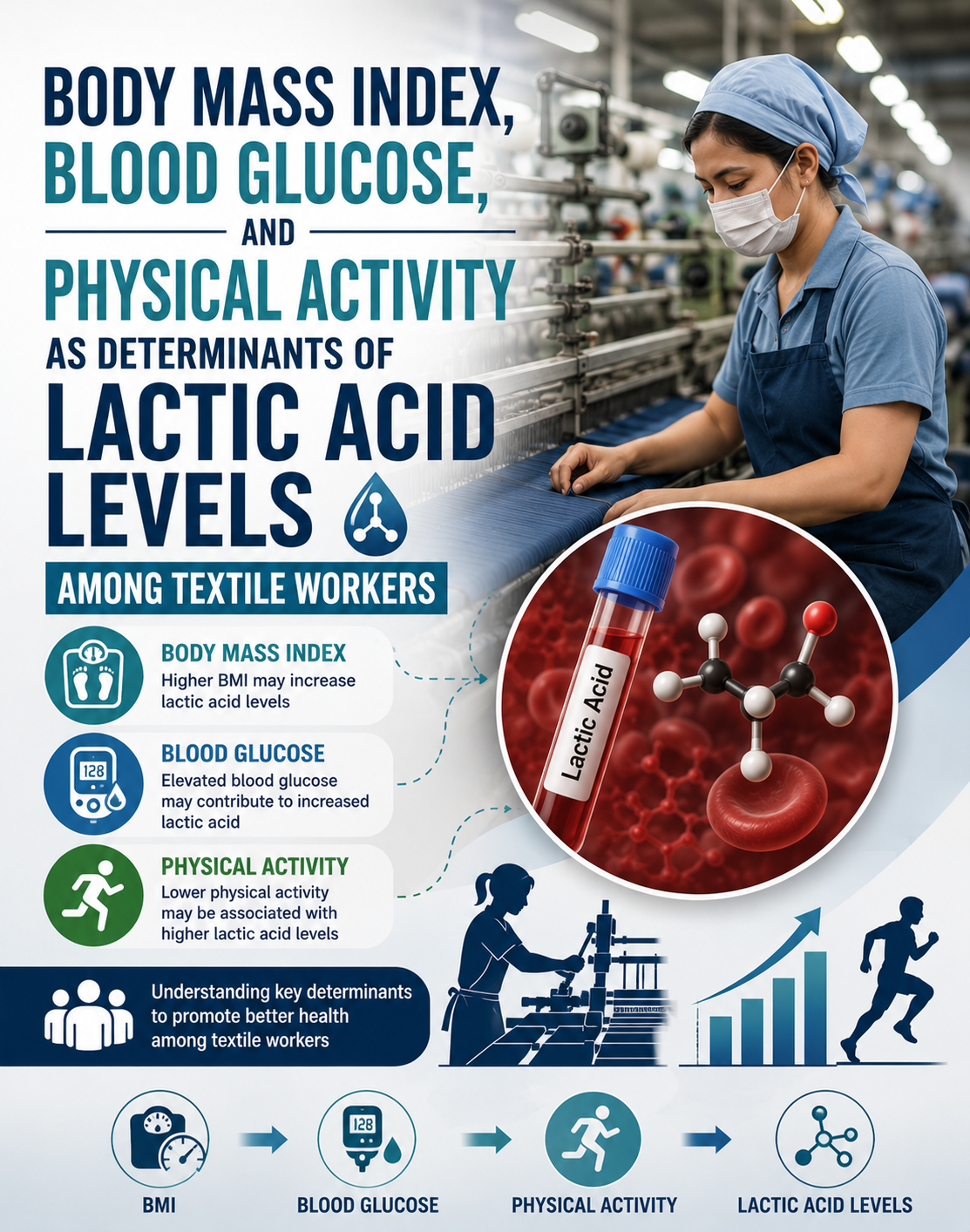
Textile industry is a labour-intensive industry with repetitive activities and heavy physical workload, thereby likely to cause metabolic fatigue as reflected by high levels of lactic acid. This study aims to examine the independent and combined associations of Body Mass Index (BMI), blood glucose levels, and physical activity with elevated lactic acid levels among textile workers. A cross-sectional analytical study was conducted among 80 textile workers selected using at a textile company in Surakarta between January and March 2023. A series of binary logistic regression analysis were conducted, adjusting for age and sex, with statistical significance set to p < 0.05. The overall statistical significance of the model was found to be significant (p < 0.001) and the explanatory power of the model was very high (Nagelkerke R² = 55.2%). The most dominant factor associated with high levels of lactic acid was found to be the level of blood glucose above 180 mg/dL (aOR = 15.525; 95% CI: 3.003–80.263), followed by BMI over 25 kg/m² (aOR = 9.695; 95% CI: 2.155–43.617). Physical activity was found to be protective (aOR = 0.182; 95% CI: 0.037–0.891), but age and sex were not significant. These results suggest that metabolic behavioural factors are significantly associated with elevated lactic acid levels, which may indicate metabolic fatigue among textile employees. These findings highlight the importance of strengthening metabolic screening and promoting physical activity within occupational health programmes.
American Diabetes Association Professional Practice Committee. (2024). Diagnosis and Classification of Diabetes: Standards of Care in Diabetes—2024. Diabetes Care, 47(January), 20–42. https://doi.org/10.2337/dc24-S002
Anugrah, A., Mohamad, H. H., Otniel, J., Fahrezi, R., Radian, M., & Siswajanthy, F. (2024). Analisis Industri Tekstil di Jawa Barat Sebelum dan Setelah Krisis Ekonomi. Doktrin: Jurnal Dunia Ilmu Hukum Dan Politik, 2(2), 118–135. https://doi.org/10.59581/Doktrin-widyakarya.v2i1.2579
Blagov, A., Nedosugova, L., Kirichenko, T., Sukhorukov, V., Melnichenko, A., & Orekhov, A. (2024). Mitochondrial Dysfunction as a Factor of Energy Metabolism Disorders in Type 2 Diabetes Mellitus. Frontiers in Bioscience-Scholar, 16(1), 1–10. https://doi.org/10.31083/j.fbs1601005
Bose, M. B. (2024). Introduction Stitching Together Gender, Textile and Garment Labor, and Heritage in Asia. In Threads of Globalization: Fashion, Textiles, and Gender in Asia in the Long Twentieth Century (pp. 1–22). Manchester University Press. https://doi.org/10.7765/9781526163417.00005
Bull, F. C., Al-Ansari, S. S., Biddle, S., Borodulin, K., Buman, M. P., Cardon, G., Carty, C., Chaput, J.-P., Chastin, S., Chou, R., Dempsey, P. C., DiPietro, L., Ekelund, U., Firth, J., Friedenreich, C. M., Garcia, L., Gichu, M., Jago, R., Katzmarzyk, P. T., … Willumsen, J. F. (2020). World Health Organization 2020 Guidelines on Physical Activity and Sedentary Behaviour. British Journal of Sports Medicine, 54(September), 1451–1462. https://doi.org/10.1136/bjsports-2020-102955
Cao, Q., Zheng, R., He, R., Wang, T., Xu, M., Lu, J., Dai, M., Zhang, D., Chen, Y., Zhao, Z., Wang, S., Lin, H., Wang, W., Ning, G., Yufang Bi, Xu, Y., & Li, M. (2022). Age-Specific Prevalence, Subtypes and Risk Factors of Metabolic Diseases in Chinese Adults and the Different Patterns from Other Racial/Ethnic Populations. BMC Public Health, 22(November), 1–11. https://doi.org/10.1186/s12889-022-14555-1
Chen, M., Deng, Q., Kang, H., Li, K., Wu, Y., Zhang, J., Zhu, J., Zheng, T., Zhang, A., Sheng, J., & Liu, X. (2025). Association of Body Composition with Insulin Resistance in a Middle-Aged Population. Hormone and Metabolic Research, 57(9), 520–528. https://doi.org/10.1055/a-2691-0442
Darshi, M., Kugathasan, L., Maity, S., Sridhar, V. S., Fernandez, R., Limonte, C. P., Grajeda, B. I., Saliba, A., Zhang, G., Drel, V. R., Darshi, M., Kugathasan, L., Maity, S., Sridhar, V. S., Fernandez, R., Limonte, C. P., Grajeda, B. I., Saliba, A., Zhang, G., … Wang, J. (2024). Glycolytic Lactate in Diabetic Kidney Disease. JCI Insight, 9(11), 1–15. https://doi.org/10.1172/jci.insight.168825
Disperindag Jateng. (2026). Sebaran Jumlah Perusahaan Tekstil di Jawa Tengah. Disperindag Jateng. https://disperindag.jatengprov.go.id/v3/publik/berita_baca/MDIxZDE1MmY4Mj BkZjEyYjg3MWQwOGYyZmUyMzQ2NDFlNmViYzNkNDY3NTljZjllZmU3YjM4NDc0ZTE0ZTMz
Ekblom-bak, E., Ekblom, B., Paulsson, S., Wallin, P., & Väisänen, D. (2024). Revisiting the Physical Activity Paradox: the Role of Cardiorespiratory Fitness in Workers with High Aerobic Demands. Scandinavian Journal of Public Health, 52(December 2022), 123–127. https://doi.org/10.1177/14034948221151137
Erees, S. (2022). Effects of Dichotomizing Continuous Outcome on Efficiencies of Measures of Explained Variation in Logistic Regression: Simulation Study and Application. Communications in Statistics: Case Studies, Data Analysis and Applications, 8(1), 1–19. https://doi.org/10.1080/23737484.2022.2139019
Fasching, P., Rinnerhofer, S., Wultsch, G., Birnbaumer, P., & Hofmann, P. (2020). The First Lactate Threshold Is a Limit for Heavy Occupational Work. Journal of Functional Morphology and Kinesiology, 5(66), 1–13. https://doi.org/10.3390/jfmk5030066
Ferdina, A. R., Arfines, P. P., & Aryastami, N. K. (2024). Obesity in Urban Indonesia: Evidence from the 2007 and 2018 Basic Health Research. Medical Journal of Indonesia, 33(May), 119–127. https://doi.org/10.13181/mji.oa.247183
GBD 2021 Adolescent BMI Collaborators. (2025). Global, Regional, and National Prevalence of Child and Adolescent Overweight and Obesity, 1990–2021, with Forecasts to 2050: A Forecasting Study for the Global Burden of Disease Study 2021. The Lancet, 405(March), 785–812. https://doi.org/10.1016/S0140-6736(25)00397-6
Genitsaridi, I., Salpea, P., Salim, A., Sajjadi, S. F., Tomic, D., James, S., Thirunavukkarasu, S., Issaka, A., Chen, L., Basit, A., Luk, A. O. Y., Ma, R. C. W., Mbanya, J., Ramachandran, A., Wild, S. H., Duncan, B. B., Boyko, E. J., & Magliano, D. J. (2024). 11th Edition of the IDF Diabetes Atlas: Global, Regional, and National Diabetes Prevalence Estimates for 2024 and Projections for 2050. THE LANCET Diabetes & Endocrinology, 14(2), 149–156. https://doi.org/10.1016/S2213-8587(25)00299-2
González, P., Lozano, P., Ros, G., & Solano, F. (2023). Hyperglycemia and Oxidative Stress: An Integral, Updated and Critical Overview of Their Metabolic Interconnections. International Journal of Molecular Sciences, 24(May), 1–35. https://doi.org/10.3390/ijms24119352
Grevendonk, L., Connell, N. J., Mccrum, C., Fealy, C. E., Bilet, L., Bruls, Y. M. H., Mevenkamp, J., Jörgensen, J. A., Schaart, G., Havekes, B., Bosch, J. D. V. Den, Bragt, M. C. E., Meijer, K., Schrauwen, P., & Hoeks, J. (2021). Impact of Aging and Exercise on Skeletal Muscle Mitochondrial Capacity, Energy Metabolism, and Physical Function. Nature Communications, 12(August), 1–17. https://doi.org/10.1038/s41467-021-24956-2
Jones, J. M. (2023). Glucose: Metabolism and Homeostasis. In Encyclopedia of Human Nutrition (Fourth Edition) (Issue March, pp. 70–78). https://doi.org/10.1016/B978-0-12-821848-8.00130-X
Kapoor, G., Chauhan, P., Singh, G., Malhotra, N., & Chahal, A. (2022). Physical Activity for Health and Fitness: Past, Present and Future. Journal of Lifestyle Medicine, 12(1), 9–14. https://doi.org/10.15280/jlm.2022.12.1.9
Kościuszko, M., Buczyńska, A., Łuka1, K., Duraj, E., Żuk-Czerniawska, K., Adamska, A., Siewko, K., Wiatr, A., Krętowski, A. J., & Popławska-Kita, A. (2024). Assessing the Impact of Body Composition, Metabolic and Oxidative Stress Parameters on Insulin Resistance as a Prognostic Marker for Reactive Hypoglycemia: A Cross-Sectional Study in Overweight, Obese, and Normal Weight Individuals. Frontier in Pharmacology, 15(April), 1–13. https://doi.org/10.3389/fphar.2024.1329802
Kumar, S., Sahu, N., Jawaid, T., Chellammal, H. S. J., & Upadhyay, P. (2025). Dual Role of Lactate in Human Health and Disease. Frontiers in Physiology, 81(August), 1–18. https://doi.org/10.3389/fphys.2025.1621358
Lardika, R. A., Tarigan, B., Ray, H. R. D., & Yudiana, Y. (2023). Lactic Acid and Cognitive Function: An Investigation Among Female Volleyball Athletes. Journal Sport Area, 8(2), 281–290. https://doi.org/10.25299/sportarea.2023.vol8(2).12707
Mahumud, R. A., Sahle, B. W., Owusu-Addo, E., Chen, W., Morton, R. L., & Renzaho, A. M. N. (2021). Association of Dietary Intake, Physical Activity, and Sedentary Behaviours with Overweight and Obesity Among 282,213 Adolescents in 89 Low and Middle Income to High-Income Countries. International Journal of Obesity, 45(May), 2404–2418. https://doi.org/10.1038/s41366-021-00908-0
Mandadzhiev, N. (2025). The Contemporary Role of Lactate in Exercise Physiology and Exercise Prescription – A Review of the Literature. Folia Medica, 67(1), 1–7. https://doi.org/10.3897/folmed.67.e144693
Meo, S. A., Muneif, Y. A. Bin, BenOmran, N. A., AlSadhan, M. A., Hashem, R. F., & Alobaisi, A. S. (2020). Prevalence of Pre Diabetes and Type 2 Diabetes Mellitus Among Cement Industry Workers. Pakistan Journal of Medical Sciences, 36(2), 32–36. https://doi.org/10.12669/pjms.36.2.1266
Meyer, A., Dowd, J., Kim, N., Nguyen, M., Misch, M., Marmo, K., Will, C., Janosevic, M., & Stephenson, E. J. (2024). Inactivity-Mediated Molecular Adaptations: Insights from a Preclinical Model of Physical Activity Reduction. Physiological Reports, 12(November), 1–16. https://doi.org/10.14814/phy2.70140
Miaomiao, Z., Fanming, K., & Qian, Z. (2023). Exercise Regulates Lactic Acid Metabolism. Chinese Journal of Tissue Engineering Research, 27(2), 322–328. https://doi.org/ 10.12307/2022.1028
Muscogiuri, G., Verde, L., & Colao, A. (2023). Body Mass Index (BMI): Still be Used? European Journal of Internal Medicine, 117(August), 50–51. https://doi.org/10.1016/ j.ejim.2023.09.002
Owesny, P., & Grune, T. (2023). The Link Between Obesity and Aging - Insights Into Cardiac Energy Metabolism. Mechanisms of Ageing and Development, 216(July), 1–21. https://doi.org/10.1016/j.mad.2023.111870
Pillai, G. P., Varghis, J. S., Binu, S., & James, R. T. (2025). Assessing The Rising Tide: A Comprehensive Analysis of Overweight and Obesity Prevalence Among Adults. International Journal for Multidisciplinary Research, 7(2), 1–6. https://doi.org/10.36948/ ijfmr.2025.v07i02.42715
Public Relations of BKPK. (2025). Physical Activity of Indonesian Population. Kemenkes BKPK. https://www.badankebijakan.kemkes.go.id/en/aktifitas-fisik-penduduk-indonesia/
Qin, B., Wang, Y., & Ding, J. (2025). The Role of Mitochondrial Function in the Pathogenesis of Diabetes. Frontier in Endocrinology, 16(August), 1–16. https://doi.org/10.3389/ fendo.2025.1607641
Ramadhania, A. R., Hasna, A. N., Winata, R. K., Ridwan, H., & Sopiah, P. (2024). Hubungan Aktivitas Fisik dan Pola Makan terhadap Status Indeks Masa Tubuh Normal. SEHATMAS (Jurnal Ilmiah Kesehatan Masyarakat), 3(1), 58–66. https://doi.org/10.55123/ sehatmas.v3i1.3057
Safitri, N. H., Sabilu, Y., & Lestari, H. (2025). Analisis Faktor Perilaku Sedentari, Pemesanan Makanan Online dan Faktor Genetik Terhadap Kejadian Obesitas di Wilayah Kerja BLUD UPTD Puskesmas Benu-Benua Kecamatan Kendari Barat. Indonesian Journal of Health Science, 5(3), 441–454. https://doi.org/10.54957/ijhs.v5i3.1502
Seidu, R. K., Ofori, E. A., Eghan, B., Fobiri, G. K., Afriyie, A. O., & Acquaye, R. (2024). A Systematic Review of Work-Related Health Problems of Factory Workers in the Textile and Fashion Industry. Journal of Occupational Health, 66(1), 1–9. https://doi.org/ 10.1093/JOCCUH/uiae007
Soeatmadji, D. W., Rosandi, R., Saraswati, M. R., Sibarani, R. P., & Tarigan, W. O. (2023). Clinicodemographic Profile and Outcomes of Type 2 Diabetes Mellitus in the Indonesian Cohort of DISCOVER: A 3-Year Prospective Cohort Study. Journal of the ASEAN Federation of Endocrine Societies, 38(1), 68–74. https://doi.org/10.15605/jafes.038.01.10
Sohn, J.-W., & Ho, W.-K. (2020). Cellular and Systemic Mechanisms for Glucose Sensing and Homeostasis. European Journal of Physiology, 472(September), 1547–1561. https://doi.org/10.1007/s00424-020-02466-2
Sumardiyono, S., Widjanarti, M. P., Suratna, F. S. N., Wijayanti, R., Fauzi, R. P., Ada, Y. R., Setyawan, H., Puspitasari, Y. D., & Agathara, R. A. (2025). Lactic Acid as a Biomarker of Occupational Fatigue in Textile Industry Workers. Malaysian Journal of Medicine and Health Sciences, 21(5), 78–84. https://doi.org/10.47836/mjmhs.21.5.10
The Indonesia Textiles & Apparel Community Reference. (2026). Menjahit Ulang Daya Saing: Jalan Panjang Kebangkitan Industri Tekstil Indonesia. https://indotextiles.com/joomla30/ 3196-menjahit-ulang-daya-saing-jalan-panjang-kebangkitan-industri-tekstil-indonesia
UNICEF. (2025). Obesity Exceeds Underweight for the First Time among School-Age Children and Adolescents Globally – UNICEF. UNICEF. https://www.unicef.org/press-releases/ obesity-exceeds-underweight-first-time-among-school-age-children-and-adolescents
World Health Organization. (2025). Obesity and Overweight. https://www.who.int/en/news-room/fact-sheets/detail/obesity-and-overweight?utm_source=chatgpt.com
Zhuang, H., Karvinen, S., Zhang, X., Ojanen, X., & Törmakangas, T. (2020). Interactive Effects of Aging and Aerobic Capacity on Energy Metabolism-Related Metabolites of Serum, Skeletal Muscle, and White Adipose Tissue. BioRxiv, July, 1–41. https://doi.org/10.1101/2020.07.16.207746
Copyright (c) 2026 JURNAL INFO KESEHATAN

This work is licensed under a Creative Commons Attribution-NonCommercial-ShareAlike 4.0 International License.
Copyright notice
Ownership of copyright
The copyright in this website and the material on this website (including without limitation the text, computer code, artwork, photographs, images, music, audio material, video material and audio-visual material on this website) is owned by JURNAL INFO KESEHATAN and its licensors.
Copyright license
JURNAL INFO KESEHATAN grants to you a worldwide non-exclusive royalty-free revocable license to:
- view this website and the material on this website on a computer or mobile device via a web browser;
- copy and store this website and the material on this website in your web browser cache memory; and
- print pages from this website for your use.
- All articles published by JURNAL INFO KESEHATAN are licensed under the Creative Commons Attribution 4.0 International License. This permits anyone to copy, redistribute, remix, transmit and adapt the work provided the original work and source is appropriately cited.
JURNAL INFO KESEHATAN does not grant you any other rights in relation to this website or the material on this website. In other words, all other rights are reserved.
For the avoidance of doubt, you must not adapt, edit, change, transform, publish, republish, distribute, redistribute, broadcast, rebroadcast or show or play in public this website or the material on this website (in any form or media) without appropriately and conspicuously citing the original work and source or JURNAL INFO KESEHATAN prior written permission.
Permissions
You may request permission to use the copyright materials on this website by writing to [email protected].
Enforcement of copyright
JURNAL INFO KESEHATAN takes the protection of its copyright very seriously.
If JURNAL INFO KESEHATAN discovers that you have used its copyright materials in contravention of the license above, JURNAL INFO KESEHATAN may bring legal proceedings against you seeking monetary damages and an injunction to stop you using those materials. You could also be ordered to pay legal costs.
If you become aware of any use of JURNAL INFO KESEHATAN copyright materials that contravenes or may contravene the license above, please report this by email to [email protected]
Infringing material
If you become aware of any material on the website that you believe infringes your or any other person's copyright, please report this by email to [email protected].