Effect of FITT Education (Frequency, Intensity, Type, Time) on Knowledge, Attitude, and Physical Activity Behavior among Overweight Members: A Pre-Experimental Study in a Running Community

Downloads
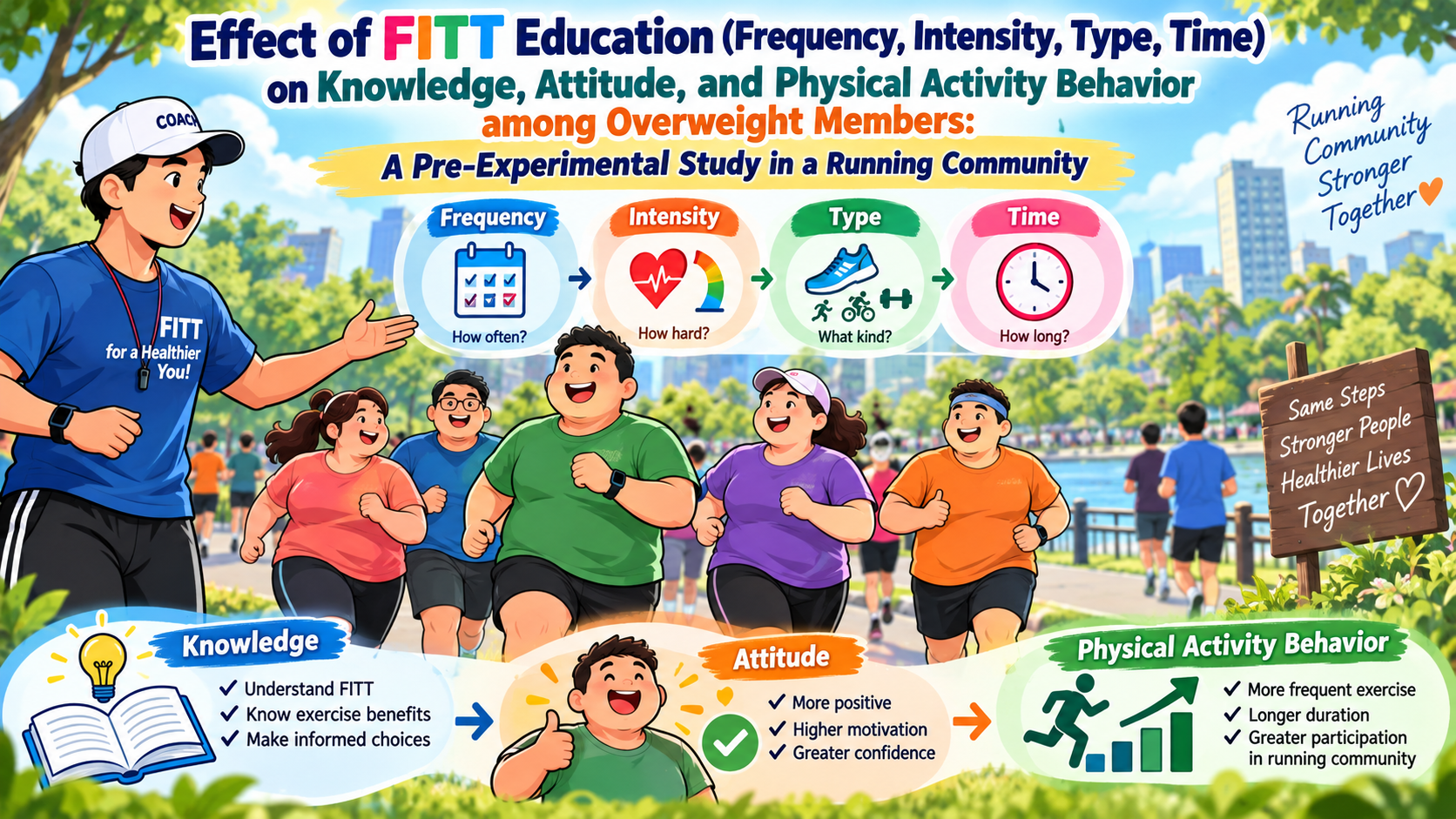
Overweight is a growing public health concern because it raises the risk of non-communicable diseases. Regular physical activity is central to managing overweight, and it should follow the FITT (Frequency, Intensity, Type, and Time) principles. Insufficient knowledge and unsuitable attitudes can get in the way of appropriate physical activity. This study analyzed the effect of FITT-based education on knowledge, attitude, and physical activity behavior among overweight members of the Teman Sehat running community in Bengkulu City. A pre-experimental one-group pretest-posttest design was used, with FITT-based education as the independent variable and knowledge, attitude, and physical activity behavior as the dependent variables. Of the 54 community members, 30 overweight members were chosen by purposive sampling; they were older than 18 years, had a BMI ≥25 kg/m², were literate, and agreed to take part. Knowledge and attitude were measured with structured questionnaires, and physical activity was recorded with an observation checklist built on the FITT components. The intervention consisted of structured lectures supported by the Athleta educational module. Because the data were not normally distributed, descriptive statistics and the Wilcoxon signed-rank test were applied. Mean knowledge rose significantly from 58.67±6.81 to 86.67±6.07 (mean difference 28.00; p<0.001). Mean attitude rose from 10.43±0.94 to 14.97±0.89 (mean difference 4.54; p<0.001), and mean physical activity behavior rose from 9.20±1.50 to 11.80±0.86 (mean difference 2.60; p<0.001). All FITT domains improved. FITT-based education therefore significantly improved knowledge, attitude, and physical activity behavior among overweight members of the Teman Sehat running community in Bengkulu City, and it can be used as a promotive and preventive strategy for overweight management in community health programs.
Amalia, Gisha, and Ratih Kurniasari. (2025). “The Effectiveness of Nutrition Media on Knowledge and Attitudes Towards Physical Activity in Late Adults and Early Seniors with Overweight.” Darussalam Nutrition Journal 9(1):51–60. https://doi.org/10.21111/dnj.v9i1.13179.
Bellicha, A., van Baak, M. A., Battista, F., Beaulieu, K., Blundell, J. E., Busetto, L., Carraça, E. V., Dicker, D., Encantado, J., Ermolao, A., Farpour-Lambert, N., Pramono, A., Woodward, E., & Oppert, J. M. (2021). Effect of exercise training on weight loss, body composition changes, and weight maintenance in adults with overweight or obesity: An overview of 12 systematic reviews and 149 studies. Obesity reviews : an official journal of the International Association for the Study of Obesity, 22 Suppl 4(Suppl 4), e13256. https://doi.org/10.1111/obr.13256
Buja, A., Rabensteiner, A., Sperotto, M., Grotto, G., Bertoncello, C., Cocchio, S., Baldovin, T., Contu, P., Lorini, C., & Baldo, V. (2020). Health Literacy and Physical Activity: A Systematic Review. Journal of physical activity & health, 17(12), 1259–1274. https://doi.org/10.1123/jpah.2020-0161
Carraça, E., Encantado, J., Battista, F., Beaulieu, K., Blundell, J., Busetto, L., van Baak, M., Dicker, D., Ermolao, A., Farpour-Lambert, N., Pramono, A., Woodward, E., Bellicha, A., & Oppert, J. M. (2021). Effective behavior change techniques to promote physical activity in adults with overweight or obesity: A systematic review and meta-analysis. Obesity reviews : an official journal of the International Association for the Study of Obesity, 22 Suppl 4(Suppl 4), e13258. https://doi.org/10.1111/obr.13258
Chao, H. H., Liao, Y. H., & Chou, C. C. (2021). Influences of Recreational Tennis-Playing Exercise Time on Cardiometabolic Health Parameters in Healthy Elderly: The ExAMIN AGE Study. International journal of environmental research and public health, 18(3), 1255. https://doi.org/10.3390/ijerph18031255
Corrêa, R., & Tabak, B. M. (2024). The Influence of Behavioral Sciences on Adherence to Physical Activity and Weight Loss in Overweight and Obese Patients: A Systematic Review of Randomized Controlled Trials. International journal of environmental research and public health, 21(5), 630. https://doi.org/10.3390/ijerph21050630
Curran, F., Davis, M. E., Murphy, K., Tersigni, N., King, A., Ngo, N., & O'Donoghue, G. (2023). Correlates of physical activity and sedentary behavior in adults living with overweight and obesity: A systematic review. Obesity reviews : an official journal of the International Association for the Study of Obesity, 24(11), e13615. https://doi.org/10.1111/obr.13615
Feil, K., Fritsch, J., & Rhodes, R. E. (2023). The intention-behaviour gap in physical activity: a systematic review and meta-analysis of the action control framework. British journal of sports medicine, 57(19), 1–14. https://doi.org/10.1136/bjsports-2022-106640
Feil, K., Fritsch, J., & Rhodes, R. E. (2023). The intention-behaviour gap in physical activity: a systematic review and meta-analysis of the action control framework. British journal of sports medicine, 57(19), 1265–1271. https://doi.org/10.1136/bjsports-2022-106640
Huangfu, P., Pearson, F., Abu-Hijleh, F. M., Wahlich, C., Willis, K., Awad, S. F., Abu-Raddad, L. J., & Critchley, J. A. (2024). Impact of price reductions, subsidies, or financial incentives on healthy food purchases and consumption: a systematic review and meta-analysis. The Lancet. Planetary health, 8(3), e197–e212. https://doi.org/10.1016/S2542-5196(24)00004-4
Jacob, E., Moura, A., & Avery, A. (2024). A systematic review of physical activity and nutritional interventions for the management of normal weight and overweight obesity. Nutrition, Metabolism and Cardiovascular Diseases, 34(12), 2642-2658. https://doi.org/10.1016/j.numecd.2024.08.001.
Jayedi, A., Soltani, S., Emadi, A., Zargar, M. S., & Najafi, A. (2024). Aerobic Exercise and Weight Loss in Adults: A Systematic Review and Dose-Response Meta-Analysis. JAMA network open, 7(12), e2452185. https://doi.org/10.1001/jamanetworkopen.2024.52185.
Khani Jeihooni, A., Layeghiasl, M., Yari, A., & Rakhshani, T. (2022). The effect of educational intervention based on the theory of planned behavior on improving physical and nutrition status of obese and overweight women. BMC women's health, 22(1), 13. https://doi.org/10.1186/s12905-022-01593-5
Lee, H. S., & Lee, J. (2021). Effects of Exercise Interventions on Weight, Body Mass Index, Lean Body Mass and Accumulated Visceral Fat in Overweight and Obese Individuals: A Systematic Review and Meta-Analysis of Randomized Controlled Trials. International journal of environmental research and public health, 18(5), 2635. https://doi.org/10.3390/ijerph18052635
Liu, X., Gao, Y., Lu, J., Ma, Q., Shi, Y., Liu, J., Xin, S., & Su, H. (2022). Effects of Different Resistance Exercise Forms on Body Composition and Muscle Strength in Overweight and/or Obese Individuals: A Systematic Review and Meta-Analysis. Frontiers in physiology, 12, 791999. https://doi.org/10.3389/fphys.2021.791999
Lopez, P., Radaelli, R., Taaffe, D. R., Galvão, D. A., Newton, R. U., Nonemacher, E. R., Wendt, V. M., Bassanesi, R. N., Turella, D. J. P., & Rech, A. (2022). Moderators of Resistance Training Effects in Overweight and Obese Adults: A Systematic Review and Meta-analysis. Medicine and science in sports and exercise, 54(11), 1804–1816. https://doi.org/10.1249/MSS.0000000000002984.
Martínez-Vizcaíno, V., Fernández-Rodríguez, R., Reina-Gutiérrez, S., Rodríguez-Gutiérrez, E., Garrido-Miguel, M., Núñez de Arenas-Arroyo, S., & Torres-Costoso, A. (2024). Physical activity is associated with lower mortality in adults with obesity: a systematic review with meta-analysis. BMC public health, 24(1), 1867. https://doi.org/10.1186/s12889-024-19383-z
Ominyi, J., Clifton, A., & Cushen-Brewster, N. (2024). Long-term effectiveness of physical activity interventions for adults across income contexts: a systematic review of strategies and outcome. Bulletin of Faculty of Physical Therapy, 29(1), 90. https://doi.org/10.1186/s43161-024-00257-9.
Rakhshani, T., Jalalpour, Z., Jafari, M., Taravatmanesh, S., Kamyab, A., & Jeihooni, A. K. (2025). The impact of training based on the transtheoretical model on increasing physical activity in overweight and obese housewives. BMC women's health, 25(1), 218. https://doi.org/10.1186/s12905-025-03767-3
Rodrigues, M. S. A., Atanasio, L. M., Dos Santos, I. K., da Silva, J. C. G., Cabral, B. G. A. T., & Dantas, P. M. S. (2026). Efficacy of Interventions to Promote Exercise Adherence in People With Overweight or Obesity: A Systematic Review. Journal of obesity, 2025, 4164477. https://doi.org/10.1155/jobe/4164477
Rotunda, W., Rains, C., Jacobs, S. R., Ng, V., Lee, R., Rutledge, S., Jackson, M. C., & Myers, K. (2024). Weight Loss in Short-Term Interventions for Physical Activity and Nutrition Among Adults With Overweight or Obesity: A Systematic Review and Meta-Analysis. Preventing chronic disease, 21, E21. https://doi.org/10.5888/pcd21.230347
Rugbeer, N., Constantinou, D., & Torres, G. (2021). Comparison of High-Intensity Training Versus Moderate-Intensity Continuous Training on Cardiorespiratory Fitness and Body Fat Percentage in Persons With Overweight or Obesity: A Systematic Review and Meta-Analysis of Randomized Controlled Trials. Journal of physical activity & health, 18(5), 610–623. https://doi.org/10.1123/jpah.2020-0335
Stavrinou, P. S., Astorino, T. A., Giannaki, C. D., Aphamis, G., & Bogdanis, G. C. (2025). Customizing intense interval exercise training prescription using the "frequency, intensity, time, and type of exercise" (FITT) principle. Frontiers in physiology, 16, 1553846. https://doi.org/10.3389/fphys.2025.1553846
Strain, T., Flaxman, S., Guthold, R., Semenova, E., Cowan, M., Riley, L. M., Bull, F. C., Stevens, G. A., & Country Data Author Group (2024). National, regional, and global trends in insufficient physical activity among adults from 2000 to 2022: a pooled analysis of 507 population-based surveys with 5·7 million participants. The Lancet. Global health, 12(8), e1232–e1243. https://doi.org/10.1016/S2214-109X(24)00150-5.
Wahlich, C., Chaudhry, U. A. R., Fortescue, R., Cook, D. G., Hirani, S., Knightly, R., & Harris, T. (2020). Effectiveness of adult community-based physical activity interventions with objective physical activity measurements and long-term follow-up: a systematic review and meta-analysis. BMJ open, 10(5), e034541. https://doi.org/10.1136/bmjopen-2019-034541
Wang, X., Yang, X., Juzaily Bin Mohd Nasiruddin, N., Wei, S., Dong, D., & Bin Samsudin, S. (2024). Social Support and Physical Activity in College and University Students: A Meta-Analysis. Health education & behavior : the official publication of the Society for Public Health Education, 51(4), 533–543. https://doi.org/10.1177/10901981231216735
Wang, Y., Yang, X., Deng, J., Wang, Z., Yang, D., Han, Y., & Wang, H. (2024). Combined high-intensity interval and resistance training improves cardiorespiratory fitness more than high-intensity interval training in young women with overweight/obesity: a randomized controlled trial. Frontiers in endocrinology, 15, 1450944. https://doi.org/10.3389/fendo.2024.1450944
World Health Organization. (2020). WHO guidelines on physical activity and sedentary behaviour. World Health Organization.
World Health Organization. 2022. “Obesity and Overweight. Geneva, Switzerland: Author.”
World Health Organization. 2024. “Obesity: Health Consequences of Being Overweight. Geneva, Switzerland: Author.”
Copyright (c) 2026 JURNAL INFO KESEHATAN

This work is licensed under a Creative Commons Attribution-NonCommercial-ShareAlike 4.0 International License.
Copyright notice
Ownership of copyright
The copyright in this website and the material on this website (including without limitation the text, computer code, artwork, photographs, images, music, audio material, video material and audio-visual material on this website) is owned by JURNAL INFO KESEHATAN and its licensors.
Copyright license
JURNAL INFO KESEHATAN grants to you a worldwide non-exclusive royalty-free revocable license to:
- view this website and the material on this website on a computer or mobile device via a web browser;
- copy and store this website and the material on this website in your web browser cache memory; and
- print pages from this website for your use.
- All articles published by JURNAL INFO KESEHATAN are licensed under the Creative Commons Attribution 4.0 International License. This permits anyone to copy, redistribute, remix, transmit and adapt the work provided the original work and source is appropriately cited.
JURNAL INFO KESEHATAN does not grant you any other rights in relation to this website or the material on this website. In other words, all other rights are reserved.
For the avoidance of doubt, you must not adapt, edit, change, transform, publish, republish, distribute, redistribute, broadcast, rebroadcast or show or play in public this website or the material on this website (in any form or media) without appropriately and conspicuously citing the original work and source or JURNAL INFO KESEHATAN prior written permission.
Permissions
You may request permission to use the copyright materials on this website by writing to [email protected].
Enforcement of copyright
JURNAL INFO KESEHATAN takes the protection of its copyright very seriously.
If JURNAL INFO KESEHATAN discovers that you have used its copyright materials in contravention of the license above, JURNAL INFO KESEHATAN may bring legal proceedings against you seeking monetary damages and an injunction to stop you using those materials. You could also be ordered to pay legal costs.
If you become aware of any use of JURNAL INFO KESEHATAN copyright materials that contravenes or may contravene the license above, please report this by email to [email protected]
Infringing material
If you become aware of any material on the website that you believe infringes your or any other person's copyright, please report this by email to [email protected].