Associations of Anxiety, Physical Activity, Parity, and Sleeping Position with Sleep Quality among Third-Trimester Pregnant Women in Palangka Raya, Indonesia

Downloads
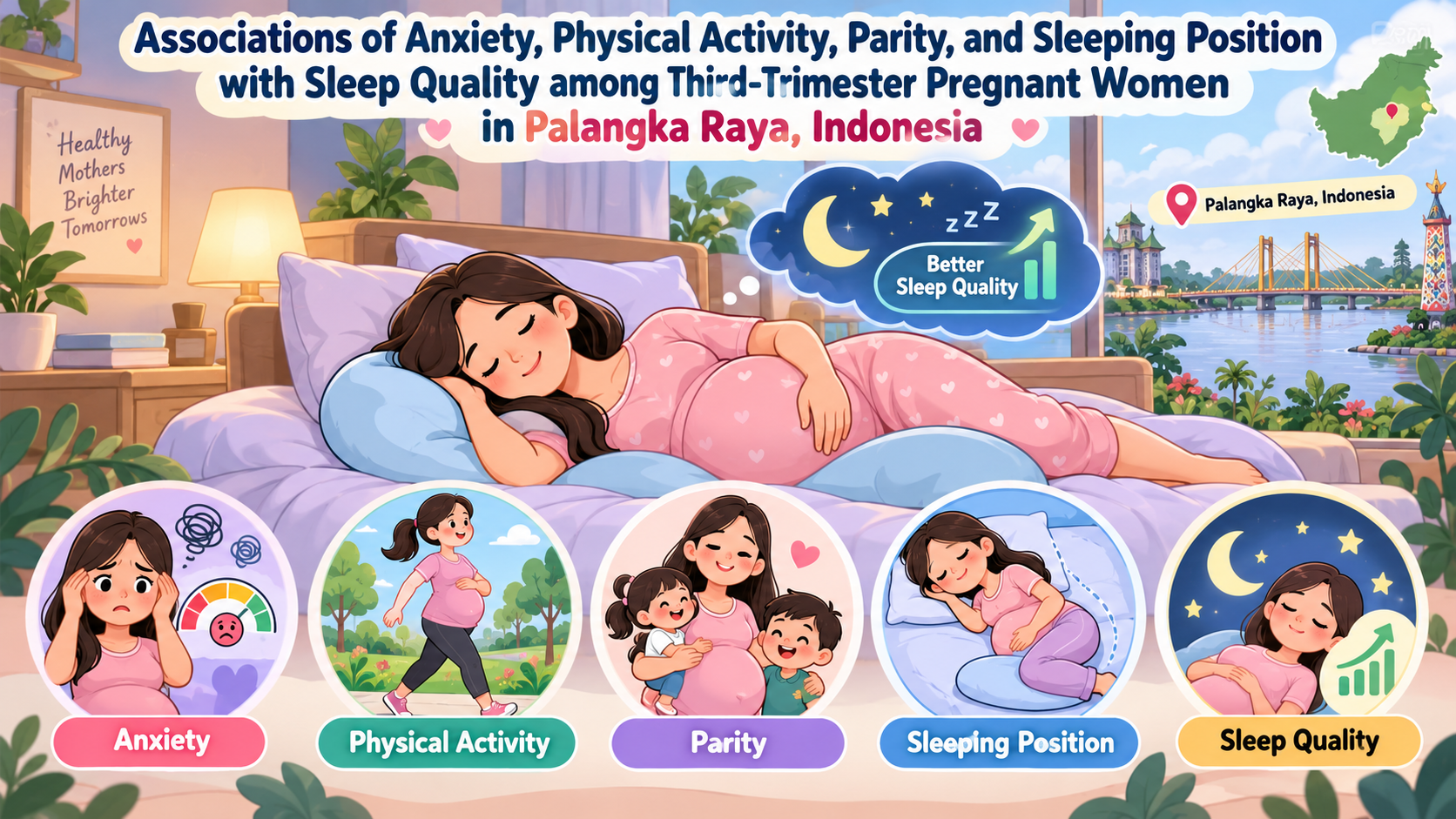
Poor sleep in late gestation has been associated with adverse maternal and neonatal outcomes. Psychological, behavioral, obstetric, and sleep-practice factors have usually been examined separately, leaving their relative contributions within a single population unclear. This study aimed to examine the associations of anxiety, physical activity, parity, and sleeping position with sleep quality among third-trimester pregnant women in Palangka Raya. A cross-sectional study was performed on a sample of 66 third-trimester pregnant women visiting a primary healthcare department in Palangka Raya, Central Kalimantan, Indonesia, who were recruited over a period of four weeks. The quality of sleep was evaluated by the Pittsburgh Sleep Quality Index (PSQI) that generated scores in the form of continuous global score, where higher scores suggest lower sleep quality. The level of anxiety was assessed via Hamilton Anxiety Rating Scale, while physical activity was calculated through Pregnancy Physical Activity Questionnaire as metabolic equivalent-hour per week. Simultaneously, parity and habitual position of sleep were assessed as dichotomous; the key analysis was completed with multiple linear regression model with all four factors put simultaneously with validity of coefficient estimates being examined by means of 5,000 bootstraping and BCa 95% confidence intervals, as well as through two variations as sensitivity analyses. On average, the PSQI score was 7.23±2.26, while 80.3% of the participants showed the score higher than 5. The four-factor model was significant, F (4,61) = 36.496, p<0.001, R²=0.705. Supine sleeping was independently associated with a 4.249-point higher PSQI score than side sleeping (p<0.001; BCa 95% CI 2.929 to 5.846) and remained so when parity was excluded (B=3.324; BCa 95% CI 2.617 to 4.084). Parity reached conventional significance (B=1.140, p=0.040). However, it was not robust to resampling (BCa 95% CI: −0.106 to 2.608), and its coefficient reversed sign when sleeping position was removed, indicating a suppression artifact due to the near-complete overlap between the two variables (Cramer's V=0.817). Anxiety and physical activity were associated with PSQI score bivariately but not after adjustment; excluding sleeping position rendered the anxiety coefficient significant and bootstrap-robust (B=0.086, p=0.009), indicating an association inseparable from sleeping position rather than absent. In this sample, habitual sleeping position was the only correlate robustly associated with sleep quality, supporting attention to sleeping practices in antenatal assessment; the magnitude was unusually large for observational data and requires replication.
Aziz, H. A., Yahya, H. D. B., Ang, W. W., & Lau, Y. (2025). Global prevalence of depression, anxiety, and stress symptoms in different trimesters of pregnancy: A meta-analysis and meta-regression. Journal of psychiatric research, 181, 528–546. https://doi.org/10.1016/j.jpsychires.2024.11.070
Alasmer, Z., Nazzal, M. S., Mohamed, Z., Al-Jaber, A., Ali, R., Alshar, F., Ababneh, E. M., Alshdaifat, E., & Kanaan, S. F. (2025). Sleep Quality and Its Predictors Among Pregnant Women in Jordan: A Cross-Sectional Study. International journal of women's health, 17, 1285–1296. https://doi.org/10.2147/IJWH.S498204
Alomairah, S. A., Knudsen, S. P., Roland, C. B., Molsted, S., Clausen, T. D., Bendix, J. M., Løkkegaard, E., Jensen, A. K., Larsen, J. E., Jennum, P., & Stallknecht, B. (2023). Effects of Two Physical Activity Interventions on Sleep and Sedentary Time in Pregnant Women. International journal of environmental research and public health, 20(7), 5359. https://doi.org/10.3390/ijerph20075359
Awlachew, S., Desalew, A., Jibro, U., & Tura, A. K. (2025). Pregnant women's sleep quality and its associated factors among antenatal care attendants in Bahir Dar City, Northwest Ethiopia. Scientific reports, 15(1), 15613. https://doi.org/10.1038/s41598-025-00288-9
Banaei, M., Alizadeh, S., Roozbeh, N., Ghare-Naz, M. S., Taghvaei, E., Parviz, L., & Ghasemi, V. (2025). Sleep quality during pregnancy: the role of anxiety, fear of childbirth, and obstetric factors - a multicenter cross-sectional study. BMC public health, 25(1), 3797. https://doi.org/10.1186/s12889-025-25142-5
Cannon, S. S., Lastella, M., Evenson, K. R., & Hayman, M. J. (2023). The association between physical activity and sleep during pregnancy: a systematic review. Behavioral sleep medicine, 21(4), 513–528. https://doi.org/10.1080/15402002.2022.2124258
Chen, P., Wang, Y., Yuan, J., Bourjeily, G., Park, C. G., Zhu, B., & Izci-Balserak, B. (2025). Effectiveness of nonpharmacological sleep interventions in pregnancy: a systematic review and meta-analysis. Journal of clinical sleep medicine : JCSM : official publication of the American Academy of Sleep Medicine, 21(8), 1463–1476. https://doi.org/10.5664/jcsm.11696
Christoper, D., Dewi, S., & Suyono, H. (2026). Correlation between sleep quality and anxiety levels among third-trimester pregnant women at Bulak Banteng Community Health Center. Journal of Widya Medika Junior, 8(2). https://doi.org/10.33508/jwmj.v8i2.8138
Jemere, T., Getahun, B., Tadele, F., Kefale, B., & Walle, G. (2021). Poor sleep quality and its associated factors among pregnant women in Northern Ethiopia, 2020: A cross sectional study. PloS one, 16(5), e0250985. https://doi.org/10.1371/journal.pone.0250985
Katz, J., Sanapo, L., Bublitz, M. H., Guillen, M., Avalos, A., Aldana, A., Wilson, D., & Bourjeily, G. (2024). Longitudinally assessed maternal sleep position, measures of breathing during sleep, and fetal growth in high-risk pregnancies. Sleep, 47(2), zsad315. https://doi.org/10.1093/sleep/zsad315
Lee, H., Kim, K. E., Kim, M. Y., & Park, C. G. (2022). Comparison of factor structures of the Pittsburgh sleep quality index between mid- and late pregnancy among Korean women: a cross-sectional study. BMC pregnancy and childbirth, 22(1), 694. https://doi.org/10.1186/s12884-022-05024-z
Mislu, E., Kumsa, H., Tadesse, S., Arage, M. W., Susu, B., Ayele, M., & Chane, F. (2024). Sleep quality disparities in different pregnancy trimesters in low- and middle-income countries: a systematic review and meta-analysis. BMC pregnancy and childbirth, 24(1), 627. https://doi.org/10.1186/s12884-024-06830-3
Mislu, E., & Terefe, A. (2025). Poor quality of sleep and associated factors among pregnant women attending antenatal clinic in Woldia Comprehensive Specialized Hospital, Ethiopia, 2023. BMC pregnancy and childbirth, 25(1), 1013. https://doi.org/10.1186/s12884-025-08023-y
Ojelere, B. O., & Adeoye, I. A. (2024). Sleep pattern and disorders among pregnant women in Ibadan, Southwest Nigeria. BMC women's health, 24(1), 250. https://doi.org/10.1186/s12905-024-03086-z
Rabiah, R., Yuliastuti, E., Rafidah, R., & Isnaniah, I. (2025). Hubungan kualitas tidur dengan kecemasan pada ibu hamil di UPTD Puskesmas Bantuil. Jurnal Penelitian Multidisiplin Bangsa, 2(3), 549-559 https://doi.org/10.59837/jpnmb.v2i3.559
Rossiter, S. K., Aziz, S., Wilson, A. N., Comrie-Thomson, L., Stacey, T., Homer, C. S. E., & Vogel, J. P. (2021). Women's sleep position during pregnancy in low- and middle-income countries: a systematic review. Reproductive health, 18(1), 53. https://doi.org/10.1186/s12978-021-01106-x
Rovcanin, M., Jankovic, S., Mikovic, Z., Sipetic Grujicic, S., Ersk, I. R. B., Lackovic, M., Dimitrijevic, D., Simanic, S., & Vujcic, I. (2022). The Translation and Cross-Cultural Adaptation of the Pregnancy Physical Activity Questionnaire: Validity and Reliability of a Serbian Version (PPAQ-SRB). Healthcare (Basel, Switzerland), 10(8), 1482. https://doi.org/10.3390/healthcare10081482
Salari, N., Darvishi, N., Khaledi-Paveh, B., Vaisi-Raygani, A., Jalali, R., Daneshkhah, A., Bartina, Y., & Mohammadi, M. (2021). A systematic review and meta-analysis of prevalence of insomnia in the third trimester of pregnancy. BMC pregnancy and childbirth, 21(1), 284. https://doi.org/10.1186/s12884-021-03755-z
Setyowati, A., & Chung, M. H. (2021). Validity and reliability of the Indonesian version of the Pittsburgh Sleep Quality Index in adolescents. International journal of nursing practice, 27(5), e12856. https://doi.org/10.1111/ijn.12856
Warland, J., Footner, S., Beaufoy, G., Stocker, J., Agostini, A., & Dorrian, J. (2022). Giving sleep position advice in pregnancy: Will we make women anxious?. The Australian & New Zealand journal of obstetrics & gynaecology, 62(4), 536–541. https://doi.org/10.1111/ajo.13507
Copyright (c) 2026 JURNAL INFO KESEHATAN

This work is licensed under a Creative Commons Attribution-NonCommercial-ShareAlike 4.0 International License.
Copyright notice
Ownership of copyright
The copyright in this website and the material on this website (including without limitation the text, computer code, artwork, photographs, images, music, audio material, video material and audio-visual material on this website) is owned by JURNAL INFO KESEHATAN and its licensors.
Copyright license
JURNAL INFO KESEHATAN grants to you a worldwide non-exclusive royalty-free revocable license to:
- view this website and the material on this website on a computer or mobile device via a web browser;
- copy and store this website and the material on this website in your web browser cache memory; and
- print pages from this website for your use.
- All articles published by JURNAL INFO KESEHATAN are licensed under the Creative Commons Attribution 4.0 International License. This permits anyone to copy, redistribute, remix, transmit and adapt the work provided the original work and source is appropriately cited.
JURNAL INFO KESEHATAN does not grant you any other rights in relation to this website or the material on this website. In other words, all other rights are reserved.
For the avoidance of doubt, you must not adapt, edit, change, transform, publish, republish, distribute, redistribute, broadcast, rebroadcast or show or play in public this website or the material on this website (in any form or media) without appropriately and conspicuously citing the original work and source or JURNAL INFO KESEHATAN prior written permission.
Permissions
You may request permission to use the copyright materials on this website by writing to [email protected].
Enforcement of copyright
JURNAL INFO KESEHATAN takes the protection of its copyright very seriously.
If JURNAL INFO KESEHATAN discovers that you have used its copyright materials in contravention of the license above, JURNAL INFO KESEHATAN may bring legal proceedings against you seeking monetary damages and an injunction to stop you using those materials. You could also be ordered to pay legal costs.
If you become aware of any use of JURNAL INFO KESEHATAN copyright materials that contravenes or may contravene the license above, please report this by email to [email protected]
Infringing material
If you become aware of any material on the website that you believe infringes your or any other person's copyright, please report this by email to [email protected].