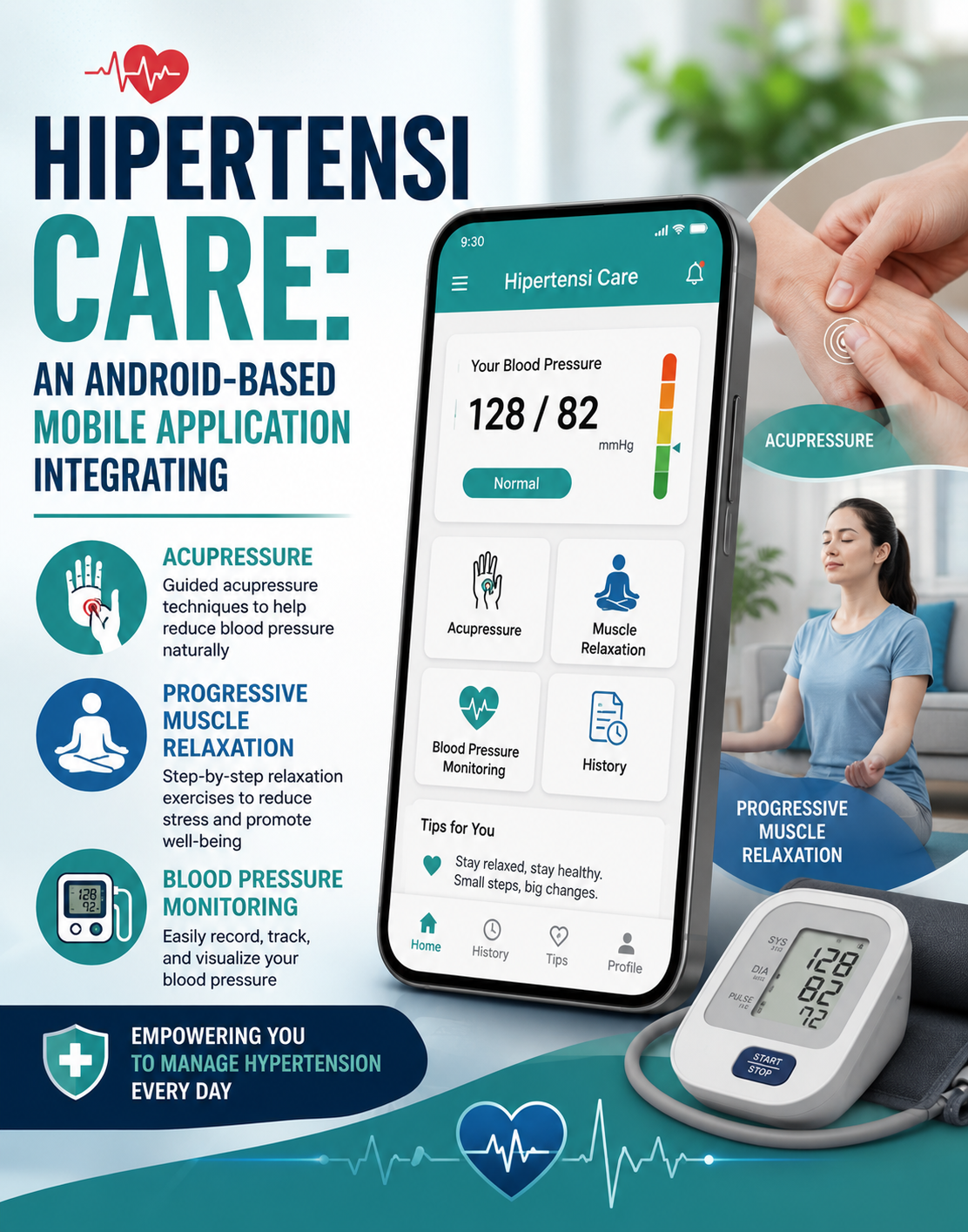
Hipertensi Care: An Android-Based Mobile Application Integrating Acupressure, Progressive Muscle Relaxation, and Blood Pressure Monitoring

Downloads
Hypertension remains a major public health concern, contributing to long-term healthcare costs and complications such as stroke and kidney failure. Although pharmacological therapy is essential, patient adherence to lifestyle-based approaches remains limited. Evidence demonstrates that acupressure and Progressive Muscle Relaxation (PMR) can lower blood pressure. However, no digital platform has integrated both interventions into a single self-management tool. This Research and Development (R&D) study developed an Android-based mobile application, Hipertensi Care, using the ADDIE model (Analysis, Design, Development, Implementation, Evaluation) to support hypertension self- management. The Analysis phase included a literature review, needs assessment, and Focus Group Discussions (FGDs) with 10 participants to identify user requirements. The Design phase involved creating the application workflow, interface, and evidence-based educational content. During Development, the application underwent content validation by 7 experts (three nurses, two acupuncturists, one cardiovascular internist, and one media specialist). A limited trial with 35 individuals with hypertension was conducted in the Implementation phase. Usability and user acceptance were evaluated using the System Usability Scale (SUS) and User Experience Questionnaire (UEQ). The results showed excellent usability, high perceived usefulness and ease of use, and positive user experience across all UEQ dimensions. Overall, Hipertensi Care demonstrated strong alignment with user needs for hypertension self-management and is ready to progress to effectiveness testing to assess its impact on blood pressure and related clinical outcomes.
Adeoye, M. A., Wirawan, K. A. S. I., Pradnyani, M. S. S., & Septiarini, N. I. (2024). Revolutionizing Education: Unleashing the Power of the ADDIE Model for Effective Teaching and Learning. Jurnal Pendidikan Indonesia, 13(1), 202–209. https://doi.org/10.23887/jpiundiksha.v13i1.68624
Alessa, T., S Hawley, M., Alsulamy, N., & de Witte, L. (2021). Using a Commercially Available App for the Self-Management of Hypertension: Acceptance and Usability Study in Saudi Arabia. JMIR mHealth and uHealth, 9(2), e24177. https://doi.org/10.2196/24177
Alfian, S. D., Sukandar, H., Lestari, K., & Abdulah, R. (2016). Medication Adherence Contributes to an Improved Quality of Life in Type 2 Diabetes Mellitus Patients: A Cross-Sectional Study. Diabetes therapy : research, treatment and education of diabetes and related disorders, 7(4), 755–764. https://doi.org/10.1007/s13300-016-0203-x
AM, A., Ishak, R., Putri, A., Wahyudi, T., & Rahmasari, I. (2023). Effectiveness of Progressive Muscle Relaxation as Complementary Therapy in Managing Blood Pressure Among Adult with Hypertension. Proceedings of the International Conference on Nursing and Health Sciences, 4(1), 137-142. https://doi.org/10.37287/picnhs.v4i1.1729
Arikunto, S. (2013). Prosedur penelitian : suatu pendekatan praktik. In Jakarta: Rineka Cipta.
Asyari, H., Rohaedi, S., Marsono, M., Hasni, N. I., & Darmawati, I. (2024). Effect of deep breathing relaxation and progressive muscle relaxation on blood pressure. Jurnal Penelitian Pendidikan IPA, 10(5), 2565-2571. https://doi.org/10.29303/jppipa.v10i5.6896
Badan Kebijakan Pembangunan Kesehatan. (2023). Prevalensi, Dampak, serta Upaya Pengendalian Hipertensi & Diabetes di Indonesia. In Kementerian Kesehatan (pp. 1–2). https://drive.google.com/file/d/1RGiLjySxNy4gvJLWG1gPTXs7QQRnkS--/view
Bangor, A., Kortum, P. T., & Miller, J. T. (2008). An empirical evaluation of the system usability scale. Intl. Journal of Human–Computer Interaction, 24(6), 574-594. https://doi.org/10.1080/10447310802205776
Becker, M. H., Drachman, R. H., & Kirscht, J. P. (1974). A new approach to explaining sick-role behavior in low-income populations. American journal of public health, 64(3), 205–216. https://doi.org/10.2105/ajph.64.3.205
Bozorgi, A., Hosseini, H., Eftekhar, H., Majdzadeh, R., Yoonessi, A., Ramezankhani, A., Mansouri, M., & Ashoorkhani, M. (2021). The effect of the mobile "blood pressure management application" on hypertension self-management enhancement: a randomized controlled trial. Trials, 22(1), 413. https://doi.org/10.1186/s13063-021-05270-0
Chellew, K., Evans, P., Fornes-Vives, J., Pérez, G., & Garcia-Banda, G. (2015). The effect of progressive muscle relaxation on daily cortisol secretion. Stress (Amsterdam, Netherlands), 18(5), 538–544. https://doi.org/10.3109/10253890.2015.1053454
Darma Suyasa, I. G. P., Buntari Agustini, N. L. P. I., & Israfil, I. (2026). Development and Evaluation of SIADIL (Sistem Informasi Aktivitas Dukungan Instrumental Lansia): A Community-Based Digital System to Enhance Older Adults’ Care in Rural Indonesia. Salud, Ciencia Y Tecnología, 6, 2596. https://doi.org/10.56294/saludcyt20262596
Ermayani, M., Prabawati, D., & Susilo, W. H. (2020). The effect of progressive muscle relaxation on anxiety and blood pressure among hypertension patients in east Kalimantan, Indonesia. Enfermería Clínica, 30, 121-125. https://doi.org/10.1016/j.enfcli.2020.07.025
Faul, F., Erdfelder, E., Buchner, A., & Lang, A. G. (2009). Statistical power analyses using G*Power 3.1: tests for correlation and regression analyses. Behavior research methods, 41(4), 1149–1160. https://doi.org/10.3758/BRM.41.4.1149
Grassi G. (2021). The Sympathetic Nervous System in Hypertension: Roadmap Update of a Long Journey. American journal of hypertension, 34(12), 1247–1254. https://doi.org/10.1093/ajh/hpab124
Habibi, H. (2020). Penerapan Relaksasi Otot Progresif dalam Menurunkan Tekanan Darah pada Keluarga dengan Hipertensi: Literature Review. Serambi Saintia: Jurnal Sains Dan Aplikasi, 8(2), 86-93. https://doi.org/10.32672/jss.v8i2.2421
Hach, S., Alder, G., Stavric, V., Taylor, D., & Signal, N. (2024). Usability Assessment Methods for Mobile Apps for Physical Rehabilitation: Umbrella Review. JMIR mHealth and uHealth, 12, e49449. https://doi.org/10.2196/49449
Joho, A. A. (2021). Using the Health Belief Model to Explain the Patient’s Compliance to Anti-hypertensive Treatment in Three District Hospitals - Dar Es Salaam, Tanzania: A Cross Section Study. East African Health Research Journal, 5(1), 50–58. https://doi.org/10.24248/eahrj.v5i1.651
Kang H. (2021). Sample size determination and power analysis using the G*Power software. Journal of educational evaluation for health professions, 18, 17. https://doi.org/10.3352/jeehp.2021.18.17
Kim, B., & Park, H. (2023). The effects of auricular acupressure on blood pressure, stress, and sleep in elders with essential hypertension: a randomized single-blind sham-controlled trial. European journal of cardiovascular nursing, 22(6), 610–619. https://doi.org/10.1093/eurjcn/zvad005
Law, E. L. C., Roto, V., Hassenzahl, M., Vermeeren, A. P., & Kort, J. (2009, April). Understanding, scoping and defining user experience: a survey approach. In Proceedings of the SIGCHI conference on human factors in computing systems (pp. 719-728). https://doi.org/10.1145/1518701.1518813
Lee, E. J., & Frazier, S. K. (2011). The efficacy of acupressure for symptom management: a systematic review. Journal of pain and symptom management, 42(4), 589–603. https://doi.org/10.1016/j.jpainsymman.2011.01.007
Liu, I. S., Liu, F., Zhong, Q., & Ni, S. (2025). A finger on the pulse of cardiovascular health: estimating blood pressure with smartphone photoplethysmography-based pulse waveform analysis. Biomedical engineering online, 24(1), 36. https://doi.org/10.1186/s12938-025-01365-w
Pathan, F. K. M., Pandian, J. S., Shaikh, A. I., Ahsan, M., Nuhmani, S., Iqbal, A., & Alghadir, A. H. (2023). Effect of slow breathing exercise and progressive muscle relaxation technique in the individual with essential hypertension: A randomized controlled trial. Medicine, 102(47), e35792. https://doi.org/10.1097/MD.0000000000035792
Paula, D. De, Sasso, A., Coester, J., & Boettinger, E. (2023). Core Determinants of Quality Criteria for Mhealth for Hypertension: Evidence From Machine Learning Instruments. ArXiv, 20, 1–17. https://doi.org/doi.org/10.48550/arXiv.2311.05434
Rachma, A. F., Iriani, T., & Handoyo, S. S. (2023). Penerapan Model ADDIE Dalam Pengembangan Media Pembelajaran Berbasis Video Simulasi Mengajar Keterampilan Memberikan Reinforcement. (2023). Jurnal Pendidikan West Science, 1(08), 506-516. https://doi.org/10.58812/jpdws.v1i08.554
Rahmawati, I., Magfiroh, F. A., Budiono, B., & Sulastyawati, S. (2024). Effect of Gamelan and progressive muscle relaxation on blood pressure in hypertensive patients. Healthcare in Low-Resource Settings, 12(1). https://doi.org/10.4081/hls.2023.11814
Restawan, I. G., Sjattar, E. L., & Irwan, A. M. (2023). Effectiveness of acupressure therapy in lowering blood pressure in patients with hypertension: A systematic review. Clinical Epidemiology and Global Health, 21, 101292. https://doi.org/10.1016/j.cegh.2023.101292
Sukmadi, A. ., Alifariki, L. O., Arfini Kasman A, I. M. ., & Siagian, H. J. (2021). Terapi Akupresur Menurunkan Tekanan Darah Pasien Hipertensi. Jurnal Kesehatan, 9(2), 109–114. https://doi.org/10.25047/jkes.v9i2.224
Susanto, T. D., & Goodwin, R. (2013). User acceptance of SMS-based e-government services: Differences between adopters and non-adopters. Government Information Quarterly, 30(4), 486-497. https://doi.org/10.1016/j.giq.2013.05.010
Umar, M. A., Ghazali, M., Saedudin, R. R., Ashraf, M., & Kasim, S. (2019). Measuring software product quality using ISO 9126: A systematic review. International Journal of Advanced Trends in Computer Science and Engineering, 8(1.3 S1), 327–336. https://doi.org/10.30534/ijatcse/2019/6081.32019
Unger, T., Borghi, C., Charchar, F., Khan, N. A., Poulter, N. R., Prabhakaran, D., Ramirez, A., Schlaich, M., Stergiou, G. S., Tomaszewski, M., Wainford, R. D., Williams, B., & Schutte, A. E. (2020). 2020 International Society of Hypertension global hypertension practice guidelines. Journal of hypertension, 38(6), 982–1004. https://doi.org/10.1097/HJH.0000000000002453
Wang, H. M., Chen, Y., Shen, Y. H., & Wang, X. M. (2024). Evaluation of the effects of health education interventions for hypertensive patients based on the health belief model. World journal of clinical cases, 12(15), 2578–2585. https://doi.org/10.12998/wjcc.v12.i15.2578
World Health Organization. (2023). Global report on hypertension. In Global report on hypertension: The race against a silent. World Health Organization
Copyright (c) 2026 JURNAL INFO KESEHATAN

This work is licensed under a Creative Commons Attribution-NonCommercial-ShareAlike 4.0 International License.
Copyright notice
Ownership of copyright
The copyright in this website and the material on this website (including without limitation the text, computer code, artwork, photographs, images, music, audio material, video material and audio-visual material on this website) is owned by JURNAL INFO KESEHATAN and its licensors.
Copyright license
JURNAL INFO KESEHATAN grants to you a worldwide non-exclusive royalty-free revocable license to:
- view this website and the material on this website on a computer or mobile device via a web browser;
- copy and store this website and the material on this website in your web browser cache memory; and
- print pages from this website for your use.
- All articles published by JURNAL INFO KESEHATAN are licensed under the Creative Commons Attribution 4.0 International License. This permits anyone to copy, redistribute, remix, transmit and adapt the work provided the original work and source is appropriately cited.
JURNAL INFO KESEHATAN does not grant you any other rights in relation to this website or the material on this website. In other words, all other rights are reserved.
For the avoidance of doubt, you must not adapt, edit, change, transform, publish, republish, distribute, redistribute, broadcast, rebroadcast or show or play in public this website or the material on this website (in any form or media) without appropriately and conspicuously citing the original work and source or JURNAL INFO KESEHATAN prior written permission.
Permissions
You may request permission to use the copyright materials on this website by writing to [email protected].
Enforcement of copyright
JURNAL INFO KESEHATAN takes the protection of its copyright very seriously.
If JURNAL INFO KESEHATAN discovers that you have used its copyright materials in contravention of the license above, JURNAL INFO KESEHATAN may bring legal proceedings against you seeking monetary damages and an injunction to stop you using those materials. You could also be ordered to pay legal costs.
If you become aware of any use of JURNAL INFO KESEHATAN copyright materials that contravenes or may contravene the license above, please report this by email to [email protected]
Infringing material
If you become aware of any material on the website that you believe infringes your or any other person's copyright, please report this by email to [email protected].