Family Perspectives on Risk Factors for Stroke in the Community: A Qualitative Descriptive Study

Downloads
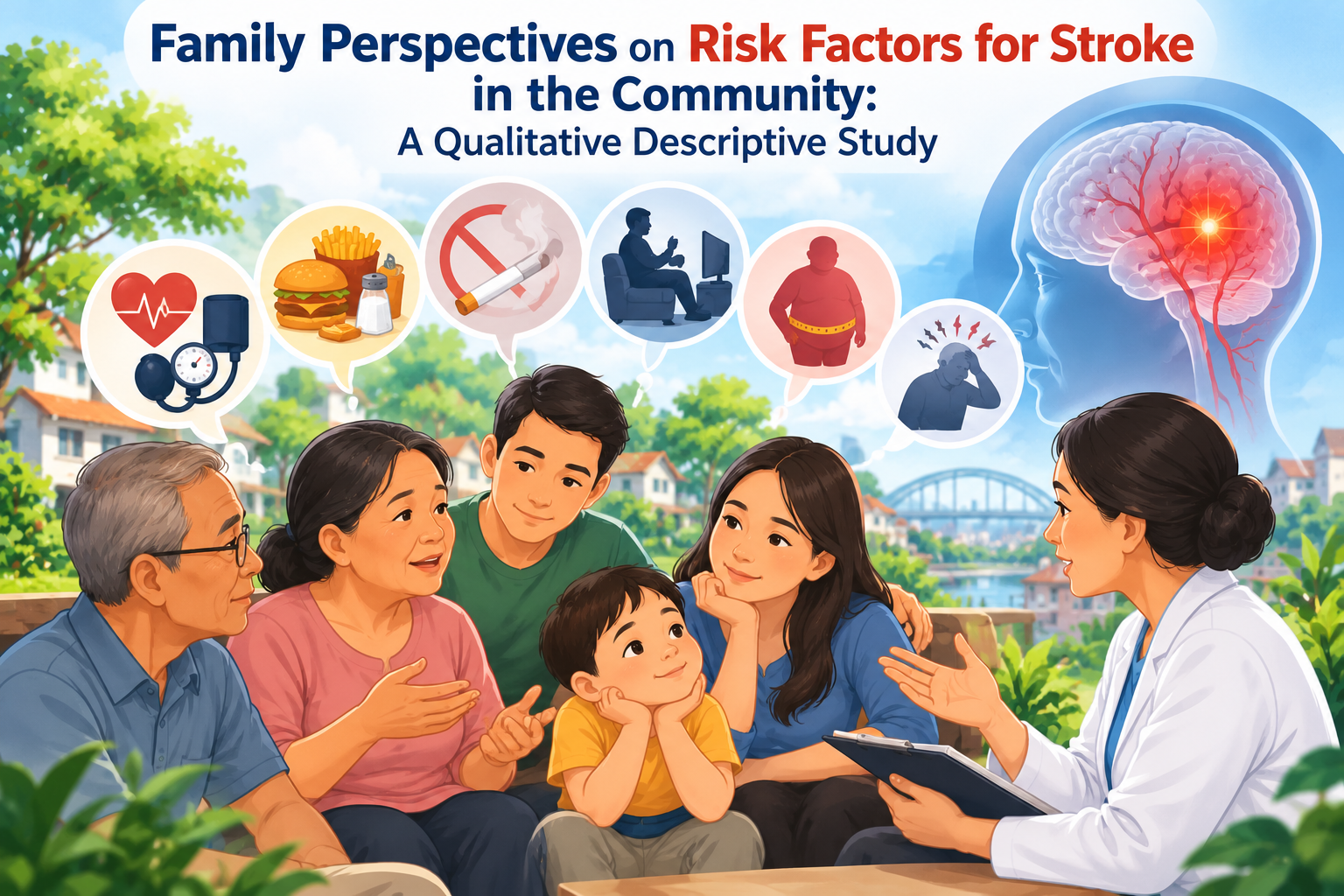
Ischemic stroke is a major cerebrovascular disease that contributes significantly to disability and poses a global public health challenge. Although numerous studies have identified stroke risk factors, few have examined how families perceive the risk factors associated with stroke within their communities. This study aims to explore family perspectives regarding risk factors for stroke in the community. A qualitative descriptive design was employed. Twelve participants comprising ten family members of stroke patients and two stroke survivors included for data triangulation were recruited using convenience sampling. Data were collected through semi-structured interviews and analyzed using thematic analysis. The analysis of family perspectives revealed three main themes and ten sub-themes: 1) history of pre-existing medical conditions, including hypertension, diabetes mellitus with hypertension, and hyperlipidemia with hypertension; 2) inadequate health prevention practices, including delayed medical treatment-seeking, irregular monitoring of blood pressure and cholesterol, and low adherence to prescribed medications; and 3) unhealthy lifestyle behaviors, including frequent consumption of high-fat foods, insufficient rest and sleep, smoking, and a lack of physical activity. This study provides new insights into how families perceive and respond to stroke risk factors, and how these perceptions influence prevention behaviors and decisions to seek healthcare services. Families perceive stroke risk as being closely linked to poorly managed chronic conditions, which are further exacerbated by unhealthy lifestyle behaviors. These findings highlight the strategic role of community nurses in implementing family-centered health promotion through health education, early risk identification, and family empowerment to strengthen stroke prevention efforts within the community.
Boehme, A. K., Esenwa, C., & Elkind, M. S. V. (2018). Stroke: risk factors and prevention. Journal of the Pakistan Medical Association, 60(3), 412. https://doi.org/10.1161/CIRCRESAHA.116.308398.Stroke
Braun, V., & Clarke, V. (2006). Using thematic analysis in psychology. Qualitative Research in Psychology, 3(2), 77–101. https://doi.org/10.1191/1478088706qp063oa
Bukhsh, A., Goh, B. H., Zimbudzi, E., Lo, C., Zoungas, S., Chan, K. G., & Khan, T. M. (2020). Type 2 Diabetes Patients’ Perspectives, Experiences, and Barriers Toward Diabetes-Related Self-Care: A Qualitative Study From Pakistan. Frontiers in Endocrinology, 11(November), 1–13. https://doi.org/10.3389/fendo.2020.534873
Chang, Y., Eom, S., Kim, M., & Song, T. J. (2023). Medical management of dyslipidemia for Secondary stroke prevention: Narrative Review. Medicina (Lithuania), 59(4), 1–19. https://doi.org/10.3390/medicina59040776
Chrismilasari, L. A., Unja, E. E., Chrisnawati, Rachman, & Aulia. (2022). The influence of family support in the management of hypertension patients. Journal Eduhealt, 13(2), 652–662. http://ejournal.seaninstitute.or.id/index.php/healt
Creswell, J. W., & Creswell, J. D. (2018). Research design qualitative, quantitative, and mixed methods Approaches Fifth Edition. In SAGE Publications, Inc.
Dopler, B. (2023). Stroke Prevention. Delaware Journal of Public Health, 9(3). https://doi.org/10.32481/djph.2023.08.003
Farpour, H., Mashhadiagha, A., Edrisi, F., & Farpour, S. (2023). Knowledge, attitude, and practice regarding stroke potential complications among stroke survivors’ family members in Shiraz, Iran. Turkish Journal of Physical Medicine and Rehabilitation, 69(1), 83–88. https://doi.org/10.5606/tftrd.2022.9512
Ge, J., Zhang, Y., Fan, E., Yang, X., Chu, L., Zhou, X., & Yan, Y. (2023). Community nurses are important providers of continuity of care for patients with chronic diseases : A qualitative study. The Journal of Health Care Organization, Provision, and Financing, 60. https://doi.org/10.1177/00469580231160888
Ghozy, S., Zayan, A. H., El-Qushayri, A. E., Parker, K. E., Varney, J., Kallmes, K. M., Morsy, S., Abbas, A. S., Diestro, J. D. B., Dmytriw, A. A., Shah, J., Hassan, A. E., & Islam, S. M. S. (2022). Physical activity level and stroke risk in US population: A matched case–control study of 102,578 individuals. Annals of Clinical and Translational Neurology, 9(3), 264–275. https://doi.org/10.1002/acn3.51511
Govori, V., Budinˇcevi´, H., Morovi´c, S., Ðerke, F., & Demarin, V. (2024). Updated perspectives on lifestyle interventions as secondary stroke prevention measures : A narrative review. Medicina, 60(504). https://doi.org/10.3390/ medicina60030504
Ishak, S. J., Yueniwati, Y., Faculty, M., Brawijaya, U., Faculty, M., & Brawijaya, U. (2020). Factors related about family delay bring stroke patient to emergency departments of Labuha Hospital. International Journal of Science and Society, 2(4), 657–672. https://doi.org/10.54783/ijsoc.v2i4.260
Israfil. (2024). The role of family in stroke patients in the community: A narrative review. Ahmar Metastasis Health Journal, 4(3). https://doi.org/10.53770/amhj.v4i3.412
Kemenkes RI. (2018). Hasil Utama Riset Kesehatan Dasar (RISKEDAS) 2018. Kementerian Kesehatan Badan Penelitian Dan Pengembangan Kesehatan [Main Results of Basic Health Research (RISKESDAS) 2018. Ministry of Health, Health Research and Development Agency]. Https://Www.Litbang.Kemkes.Go.Id/Hasil-Utama-Riskesdas-2018/.
Kernan, W. N., Viera, A. J., Billinger, S. A., Bravata, D. M., Stark, S. L., Kasner, S. E., Kuritzky, L., & Towfighi, A. (2021). Primary care of adult patients after stroke: A scientific statement from the American Heart Association/American Stroke Association. Stroke, 52(9), E558–E571. https://doi.org/10.1161/STR.0000000000000382
Kuriakose, D., & Xiao, Z. (2020). Pathophysiology and treatment of stroke: Present status and future perspectives. International Journal of Molecular Sciences, 21. https://doi.org/10.3390/ijms21207609
Lee, H. J., Jang, S. I., & Park, E. C. (2017). Effect of adherence to antihypertensive medication on stroke incidence in patients with hypertension: A population-based retrospective cohort study. BMJ Open, 7(6), 1–8. https://doi.org/10.1136/bmjopen-2016-014486
Lin, C. (2021). Stroke and diets – A review. Tzu Chi Medical Journal, 33(3), 238–242. https://doi.org/10.4103/tcmj.tcmj
Liu, L., Xie, X., Pan, Y., Wang, A., Wei, Y., Liu, J., Nie, X., Liu, D., Zhao, Z., Wang, P., Shen, S., Zhong, C., Xu, T., Wang, D., Wang, G. C., Song, D., Ma, Y., Zhao, J., Jiang, Y., … He, J. (2023). Early versus delayed antihypertensive treatment in patients with acute ischaemic stroke: multicentre, open label, randomised, controlled trial. Bmj, June 2018, 1–22. https://doi.org/10.1136/bmj-2023-076448
Magwood, G. S., Nichols, M., Jenkins, C., Logan, A., Qunango, S., Zigbuo-Wenzler, E., & Jr, C. E. (2021). Community-based interventions for stroke provided by nurses and community health workers: A review of the literature. Journal of Neuroscience Nursing, 52(August 2018), 152–159. https://doi.org/10.1097/JNN.0000000000000512
Oliveira, A. B. De, Muhith, A., & Zahro, C. (2023). Risk factors of stroke : Literature Review. Journal of Applied Nursing and Health, 5(2), 347–354. https://doi.org/10.55018/janh.v5i2.166
Panwilai, J., Fongkaew, W., Soiwong, P., & Chaiard, J. (2022). Family caregivers’ perceptions regarding stroke prevention for family members at risk. Pacific Rim International Journal of Nursing Research, 26(March), 90–104. https://he02.tci-thaijo.org/index.php/PRIJNR/article/view/255278
Phua, C. S., Jayaram, L., & Wijeratne, T. (2017). Relationship between sleep duration and risk factors for stroke. Frontiers in Neurology, 8(AUG), 1–6. https://doi.org/10.3389/fneur.2017.00392
Rezaei, M., Keyvanloo Shahrestanaki, S., Mohammadzadeh, R., Aghili, M. S., Rajabi, M. R., Abbasi, M., Khachian, A., Momen, R., Khavassi, M., & Aghaei, S. (2024). Caregiving consequences in cancer family caregivers: a narrative review of qualitative studies. Frontiers in Public Health, 12(March). https://doi.org/10.3389/fpubh.2024.1334842
Sarfo, F. S., Mobula, L. M., Plange-Rhule, J., Ansong, D., & Ofori-Adjei, D. (2018). Incident stroke among Ghanaians with hypertension and diabetes: A multicenter, prospective cohort study. Journal of the Neurological Sciences, 395, 17–24. https://doi.org/10.1016/j.jns.2018.09.018
Setyopranoto, I., Bayuangga, H. F., Panggabean, A. S., Alifaningdyah, S., Lazuardi, L., Dewi, F. S. T., & Malueka, R. G. (2019). Prevalence of stroke and associated risk factors in sleman district of Yogyakarta Special Region, Indonesia. Stroke Research and Treatment, 2019. https://doi.org/10.1155/2019/2642458
Silva, E. S. da, Borges, J. W. P., Moreira, T. M. M., Rodrigues, M. T. P., & Souza, A. C. C. de. (2020). Prevalence and risk factors associated with stroke in hypertensive patients: a hierarchical analysis. Revista de Enfermagem Referência, 5(3). http://dx.doi.org/10.12707/RV20014
Wajngarten, M., & Silva, G. S. (2019). Ischaemic heart disease, stroke and risk factors hypertension and stroke : Update on treatment ischaemic heart disease, stroke and risk Factors. Radcliffe Cardiology, 14(2), 111–115. https://doi.org/10.15420/ecr.2019.11.1
WHO. (2024). Stroke, cerebrovascular accident. WHO, 1–2. https://www.emro.who.int/health-topics/stroke-cerebrovascular-accident/index.html
World Stroke Organization. (2019). Stroke risk factors smoking understanding smoking and stroke. http://www.worldstrokecampaign.org
Xing, F., Guo, Y., Xia, N., Zhang, S., Yin, J., Qin, L., Zhu, C., Gao, Q., Jia, J., Zhao, Y., Qi, Y., & Li, W. (2023). Mobile APP-assisted family physician program for improving blood pressure outcome in hypertensive patients. BMC Primary Care, 24(1), 1–11. https://doi.org/10.1186/s12875-023-01965-2
Yusrini, Susanti, H., Wardani, I. Y., & Fitriani, N. (2019). Family experience in providing support and the achieving of post-stroke late adulthood development. Enfermeria Clinica, 29, 900–904. https://doi.org/10.1016/j.enfcli.2019.04.137
Copyright (c) 2026 JURNAL INFO KESEHATAN

This work is licensed under a Creative Commons Attribution-NonCommercial-ShareAlike 4.0 International License.
Copyright notice
Ownership of copyright
The copyright in this website and the material on this website (including without limitation the text, computer code, artwork, photographs, images, music, audio material, video material and audio-visual material on this website) is owned by JURNAL INFO KESEHATAN and its licensors.
Copyright license
JURNAL INFO KESEHATAN grants to you a worldwide non-exclusive royalty-free revocable license to:
- view this website and the material on this website on a computer or mobile device via a web browser;
- copy and store this website and the material on this website in your web browser cache memory; and
- print pages from this website for your use.
- All articles published by JURNAL INFO KESEHATAN are licensed under the Creative Commons Attribution 4.0 International License. This permits anyone to copy, redistribute, remix, transmit and adapt the work provided the original work and source is appropriately cited.
JURNAL INFO KESEHATAN does not grant you any other rights in relation to this website or the material on this website. In other words, all other rights are reserved.
For the avoidance of doubt, you must not adapt, edit, change, transform, publish, republish, distribute, redistribute, broadcast, rebroadcast or show or play in public this website or the material on this website (in any form or media) without appropriately and conspicuously citing the original work and source or JURNAL INFO KESEHATAN prior written permission.
Permissions
You may request permission to use the copyright materials on this website by writing to [email protected].
Enforcement of copyright
JURNAL INFO KESEHATAN takes the protection of its copyright very seriously.
If JURNAL INFO KESEHATAN discovers that you have used its copyright materials in contravention of the license above, JURNAL INFO KESEHATAN may bring legal proceedings against you seeking monetary damages and an injunction to stop you using those materials. You could also be ordered to pay legal costs.
If you become aware of any use of JURNAL INFO KESEHATAN copyright materials that contravenes or may contravene the license above, please report this by email to [email protected]
Infringing material
If you become aware of any material on the website that you believe infringes your or any other person's copyright, please report this by email to [email protected].