Primers for Detecting katG Gene Mutations in Isoniazid-Resistant Mycobacterium Tuberculosis

Downloads
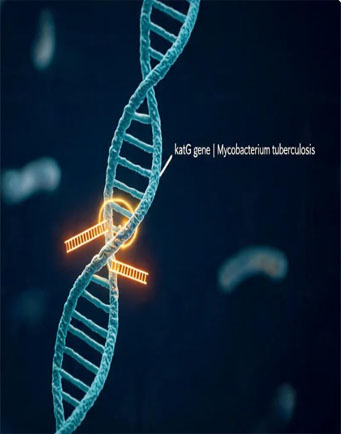
Pulmonary tuberculosis is a disease caused by Mycobacterium tuberculosis infection, which is a health problem in Indonesia. Exploration of the treatment point of anti-tuberculosis drug resistance genes is very important for determining the appropriate gene-target markers of resistance. This study aimed to analyze the role of the katG/Rv1908c gene in Mycobacterium tuberculosis as a marker of isoniazid resistance, and to use mutation analysis data to design specific primers for dominant isoniazid-resistance mutations. We conducted descriptive research using a cross-sectional sampling method. The samples in this study were 10 MDR-TB isolates collected at the Health Laboratory and Calibration Testing Center of Central Java Province (Balapkes and Pak Prov Jateng). The research procedure included denaturing target primer sequencing of Mycobacterium tuberculosis DNA, DNA extraction, and PCR procedures. PCR was performed using BIONEER Exceller 96 with Gotaq Green Master Mix Kit reagents. PCR results were sequenced using the Sanger method at PT. Genetika Science. The Sanger sequencing results were analyzed using the BioEdit program to align the sequences. The spliced Mycobacterium tuberculosis DNA was analyzed using MEGA 10 software to identify mutation sites for comparison with the wild-type H37Rv and to determine the katG gene mutation site within the mapped region. The results of the DNA sequencing analysis using the Sanger sequencing method obtained that the katG gene mutation was dominated by Ser315Thr (80%) which was a single mutation, a double mutation at Ser315Thr+Ala221Asp (10%), a double mutation at Ser315Thr+Arg249Cys (10%), and the results of Primer F > 5'-GATCACCAGCGGCATCGAG-3' Primer R > 5'-CTCTTCGTCAGCTCCCACTC-3' and Primer R >5'-GATCACCACCGGCATCGAG-3' were able to amplify the Ser315Thr gene target as a detection primer. The conclusion is that the dominant mutation conferring isoniazid resistance is Ser315Thr, and the primers used to target the mutation work well.
Banerjee, A., Dubnau, E., Quémard, A., Balasubramanian, V., Um, K. S., Wilson, T., … Jacobs, W. R. (1994). inhA, a gene encoding a target for isoniazid and ethionamide in Mycobacterium tuberculosis. Science, 263(5144), 227–230. https://doi.org/10.1126/science.8284673
de Vos, M., Scott, L., David, A., Trollip, A., Hoffmann, H., Georghiou, S., … Schumacher, S. G. (2021). Comparative analytical evaluation of four centralized platforms for the detection of Mycobacterium tuberculosis complex and resistance to rifampicin and isoniazid. Journal of Clinical Microbiology, 59(3), 1–11. https://doi.org/10.1128/JCM.02168-20
Dheda, K., Perumal, T., Moultrie, H., Perumal, R., Esmail, A., Scott, A. J., … Pai, M. (2022). The intersecting pandemics of tuberculosis and COVID-19: population- and patient-level impacts, clinical presentations, and corrective interventions. The Lancet Respiratory Medicine, 2600(22), 1–20. https://doi.org/10.1016/s2213-2600(22)00092-3
Dlamini, M. T., Lessells, R., Iketleng, T., & de Oliveira, T. (2019). Whole genome sequencing for drug-resistant tuberculosis management in South Africa: What gaps would this address, and what are the challenges to implementation? Journal of Clinical Tuberculosis and Other Mycobacterial Diseases, 16, 100115. https://doi.org/10.1016/j.jctube.2019.100115
Garcia-Vilanova, A., Chan, J., & Torrelles, J. B. (2019). Underestimated Manipulative Roles of Mycobacterium tuberculosis Cell Envelope Glycolipids During Infection. Frontiers in Immunology, 10(December). https://doi.org/10.3389/fimmu.2019.02909
Ghajavand, H., Kargarpour Kamakoli, M., Khanipour, S., Pourazar Dizaji, S., Masoumi, M., Rahimi Jamnani, F., … Vaziri, F. (2019). Scrutinizing the drug resistance mechanism of multi- and extensively-drug resistant Mycobacterium tuberculosis: Mutations versus efflux pumps. Antimicrobial Resistance and Infection Control, 8(1), 1–8. https://doi.org/10.1186/s13756-019-0516-4
Goossens, S. N., Heupink, T. H., De Vos, E., Dippenaar, A., De Vos, M., Warren, R., & Van Rie, A. (2022). Detection of minor variants in Mycobacterium tuberculosis whole genome sequencing data. Briefings in Bioinformatics, 23(1), 1–9. https://doi.org/10.1093/bib/bbab541
Green, E., Obi, L. C., Nchabeleng, M., de Villiers, B. E., Sein, P. P., Letsoalo, T., … Bessong, P. O. (2008). Molecular characterization of resistant Mycobacterium tuberculosis isolates from Dr George Mukhari Hospital, Pretoria, South Africa. Southern African Journal of Epidemiology and Infection, 23(3), 11–14. https://doi.org/10.1080/10158782.2008.11441316
Hatami, H., Sotgiu, G., Bostanghadiri, N., Abadi, S. S. D., Mesgarpour, B., Goudarzi, H., … Nasiri, M. J. (2022). Bedaquiline-containing regimens and multidrug-resistant tuberculosis: a systematic review and meta-analysis. Jornal brasileiro de pneumologia : publicacao oficial da Sociedade Brasileira de Pneumologia e Tisilogia, 48(2), e20210384. https://doi.org/10.36416/1806-3756/e20210384
Jacobs, W. R., Tuckman, M., & Bloom, B. R. (1987). Introduction of foreign DNA into mycobacteria using a shuttle phasmid. Nature, 327(6122), 532–535. https://doi.org/10.1038/327532a0
Khan, A. S., Phelan, J. E., Khan, M. T., Ali, S., Qasim, M., Mohammad, N., … Khan, T. A. (2023). Genetic mutations underlying isoniazid-resistant Mycobacterium tuberculosis in Khyber Pakhtunkhwa, Pakistan. Tuberculosis, 138(November 2022), 102286. https://doi.org/10.1016/j.tube.2022.102286
Lechevallier, M. W. (2004). Control, treatment, and disinfection of Mycobacterium avium complex in drinking water. Pathogenic Mycobacteria in Water : A Guide to Public Health Consequences, Monitoring and Management, 143–168. Diambil dari http://www.who.int/entity/water_sanitation_health/emerging/en/patmycrobact11.pdf
Lempens, P., Meehan, C. J., Vandelannoote, K., Fissette, K., & Rijk, P. De. (2018). Isoniazid resistance levels in Mycobacterium tuberculosis can largely be predicted by high-confidence resistance-conferring mutations. Scientific Reports, (September 2017), 1–9. https://doi.org/10.1038/s41598-018-21378-x
Li ST, Guan WL, Yang H. (2024). Mutation characteristics of inhA and katG genes in isoniazid-resistant Mycobacterium tuberculosis patients in Xinjiang. Journal of Clinical and Nursing Research. 8(1). https://doi.org/10.26689/jcnr.v8i1.5893
Marrakchi, H., Lanéelle, G., & Quémard, A. (2000). InhA, a target of the antituberculous drug isoniazid, is involved in a mycobacterial fatty acid elongation system, FAS-II. Microbiology, 146(2), 289–296. https://doi.org/10.1099/00221287-146-2-289
Mdluli, K., Sherman, D. R., Hickey, M. J., Kreiswirth, B. N., Morris, S., Stover, C. K., & Barry, C. E. (1996). Biochemical and genetic data suggest that InhA is not the primary target for activated isoniazid in Mycobacterium tuberculosis. Journal of Infectious Diseases, 174(5), 1085–1090. https://doi.org/10.1093/infdis/174.5.1085
Ministry of Health. (2023). INDONESIA’S HEALTH PROFILE IN 2023. Indonesia: Ministry of Health, Republic of Indonesia. Retrieved from: https://kemkes.go.id/id/profil-kesehatan-indonesia-2023
Miotto, P., Zhang, Y., Cirillo, D. M., & Yam, W. C. (2018). Drug resistance mechanisms and drug susceptibility testing for tuberculosis. Respirology, 23(12), 1098–1113. https://doi.org/10.1111/resp.13393
Mirzayev, F., Viney, K., Linh, N. N., Gonzalez-Angulo, L., Gegia, M., Jaramillo, E., … Kasaeva, T. (2021). World Health Organization recommendations on the treatment of drug-resistant tuberculosis, 2020 update. European Respiratory Journal, 57(6), 1–19. https://doi.org/10.1183/13993003.03300-2020
Munir, A., Wilson, M. T., Hardwick, S. W., Chirgadze, D. Y., Worrall, J. A. R., Blundell, T. L., & Chaplin, A. K. (2021). Using cryo-EM to understand antimycobacterial resistance in the catalase-peroxidase (KatG) from Mycobacterium tuberculosis. Structure, 29(8), 899-912.e4. https://doi.org/10.1016/j.str.2020.12.008
Mustafa. (2012). The Base “G” in TB86 Primer Frequently Used in the Amplification of katG Isoniazid Resistance Gene of Mycobacterium tuberculosis is an Insertion. Journal of Basic and Applied Sciences, 8(1), 8–10. https://doi.org/10.6000/1927-5129.2012.08.01.28
Parums, D. V. (2021). Editorial: Updates from the World Health Organization (WHO) on global treatment recommendations for drug-susceptible and multidrug-resistant tuberculosis. Medical Science Monitor, 27, 1–3. https://doi.org/10.12659/MSM.934292
Prasad, M. S., Bhole, R. P., Khedekar, P. B., & Chikhale, R. V. (2021). Mycobacterium enoyl acyl carrier protein reductase (InhA): A key target for antitubercular drug discovery. Bioorganic Chemistry, 115(May), 105242. https://doi.org/10.1016/j.bioorg.2021.105242
Quémard, A., Sacchettini, J. C., Dessen, A., Vilcheze, C., Bittman, R., Jacobs, W. R., & Blanchard, J. S. (1995). Enzymatic Characterization of the Target for Isoniazid in Mycobacterium tuberculosis. Biochemistry, 34(26), 8235–8241. https://doi.org/10.1021/bi00026a004
Rozwarski, D. A., Grant, G. A., Barton, D. H. R., Jacobs, W. R., & Sacchettini, J. C. (1998). Modification of the NADH of the isoniazid target (InhA) from Mycobacterium tuberculosis. Science, 279(5347), 98–102. https://doi.org/10.1126/science.279.5347.98
Saroja, D., & Gopinathan, K. P. (1973). Transduction of isoniazid susceptibility-resistance and streptomycin resistance in mycobacteria. Antimicrobial agents and chemotherapy, 4(6), 643–645. https://doi.org/10.1128/AAC.4.6.643
Snapper, S. B., Melton, R. E., Mustafa, S., Kieser, T., & Jr, W. R. J. (1990). Isolation and characterization of efficient plasmid transformation mutants of Mycobacterium smegmatis. Molecular Microbiology, 4(11), 1911–1919. https://doi.org/10.1111/j.1365-2958.1990.tb02040.x
Valafar, S. J. (2021). A systematic review of mutations associated with isoniazid resistance points to ongoing evolution, subsequent evasion of molecular detection, and the potential emergence of multidrug resistance in clinical strains of Mycobacterium tuberculosis. Antimicrobial Agents and Chemotherapy, 65(3). https://doi.org/10.1128/AAC.02091-20
Vigo, A., Solari, L., Santos, D., & Puyén, Z. M. (2019). Mutations conferring resistance to first-line anti-tuberculosis drugs in Peru: A systematic review of the literature. Revista Peruana de Medicina Experimental y Salud Publica, 36(4), 636–645. https://doi.org/10.17843/rpmesp.2019.364.4722
Vilchèze, C., & Jacobs, W. R. (2015). Resistance to isoniazid and ethionamide in Mycobacterium tuberculosis: Genes, mutations, and causalities. Molecular Genetics of Mycobacteria, 431–453. https://doi.org/10.1128/9781555818845.ch22
Vilchèze, C., & Jacobs, W. R. (2019). The Isoniazid Paradigm of Killing, Resistance, and Persistence in Mycobacterium tuberculosis. Journal of Molecular Biology, 431(18), 3450–3461. https://doi.org/10.1016/j.jmb.2019.02.016
Wilming, M., & Johnsson, K. (1999). Spontaneous formation of the bioactive form of the tuberculosis drug isoniazid. Angewandte Chemie - International Edition, 38(17), 2588–2590. https://doi.org/10.1002/(SICI)1521-3773(19990903)38:17<2588::AID-ANIE2588>3.0.CO;2-8
World Health Organization. (2021). Technical Report on critical concentrations for drug susceptibility testing of isoniazid and the rifamycins (rifampicin, rifabutin, and rifapentine). Retrieved from: https://www.who.int/publications/i/item/technical-report-on-critical-concentrations-for-drugsusceptibility-testing-of-isoniazid-and-therifamycins-(rifampicin-rifabutin-and-rifapentine)
Zhang et al. (1992). The Catalase-Peroxidase Gene and Isoniazid Resistance of Myc. Nature, 358, 591–593. https://doi.org/https://doi.org/10.1038/358591a0
Zhang et al. (1993). Transformation with katG restores isoniazid‐sensitivity in Mycobacterium tuberculosis isolates resistant to a range of drug concentrations. Molecular Microbiology, 8(3), 521–524. https://doi.org/10.1111/j.1365-2958.1993.tb01596.x
Zhang, Q., An, X., Liu, H., Wang, S., Xiao, T., & Liu, H. (2019). Uncovering the Resistance Mechanism of Mycobacterium tuberculosis to Rifampicin Due to RNA Polymerase H451D/Y/R Mutations from a Computational Perspective. Frontiers in Chemistry, 7(December), 1–13. https://doi.org/10.3389/fchem.2019.00819
Copyright (c) 2026 JURNAL INFO KESEHATAN

This work is licensed under a Creative Commons Attribution-NonCommercial-ShareAlike 4.0 International License.
Copyright notice
Ownership of copyright
The copyright in this website and the material on this website (including without limitation the text, computer code, artwork, photographs, images, music, audio material, video material and audio-visual material on this website) is owned by JURNAL INFO KESEHATAN and its licensors.
Copyright license
JURNAL INFO KESEHATAN grants to you a worldwide non-exclusive royalty-free revocable license to:
- view this website and the material on this website on a computer or mobile device via a web browser;
- copy and store this website and the material on this website in your web browser cache memory; and
- print pages from this website for your use.
- All articles published by JURNAL INFO KESEHATAN are licensed under the Creative Commons Attribution 4.0 International License. This permits anyone to copy, redistribute, remix, transmit and adapt the work provided the original work and source is appropriately cited.
JURNAL INFO KESEHATAN does not grant you any other rights in relation to this website or the material on this website. In other words, all other rights are reserved.
For the avoidance of doubt, you must not adapt, edit, change, transform, publish, republish, distribute, redistribute, broadcast, rebroadcast or show or play in public this website or the material on this website (in any form or media) without appropriately and conspicuously citing the original work and source or JURNAL INFO KESEHATAN prior written permission.
Permissions
You may request permission to use the copyright materials on this website by writing to [email protected].
Enforcement of copyright
JURNAL INFO KESEHATAN takes the protection of its copyright very seriously.
If JURNAL INFO KESEHATAN discovers that you have used its copyright materials in contravention of the license above, JURNAL INFO KESEHATAN may bring legal proceedings against you seeking monetary damages and an injunction to stop you using those materials. You could also be ordered to pay legal costs.
If you become aware of any use of JURNAL INFO KESEHATAN copyright materials that contravenes or may contravene the license above, please report this by email to [email protected]
Infringing material
If you become aware of any material on the website that you believe infringes your or any other person's copyright, please report this by email to [email protected].