Risk Factors For Tuberculosis Treatment Failure in Five High Tuberculosis Burden Countries: A Scoping Review

Downloads
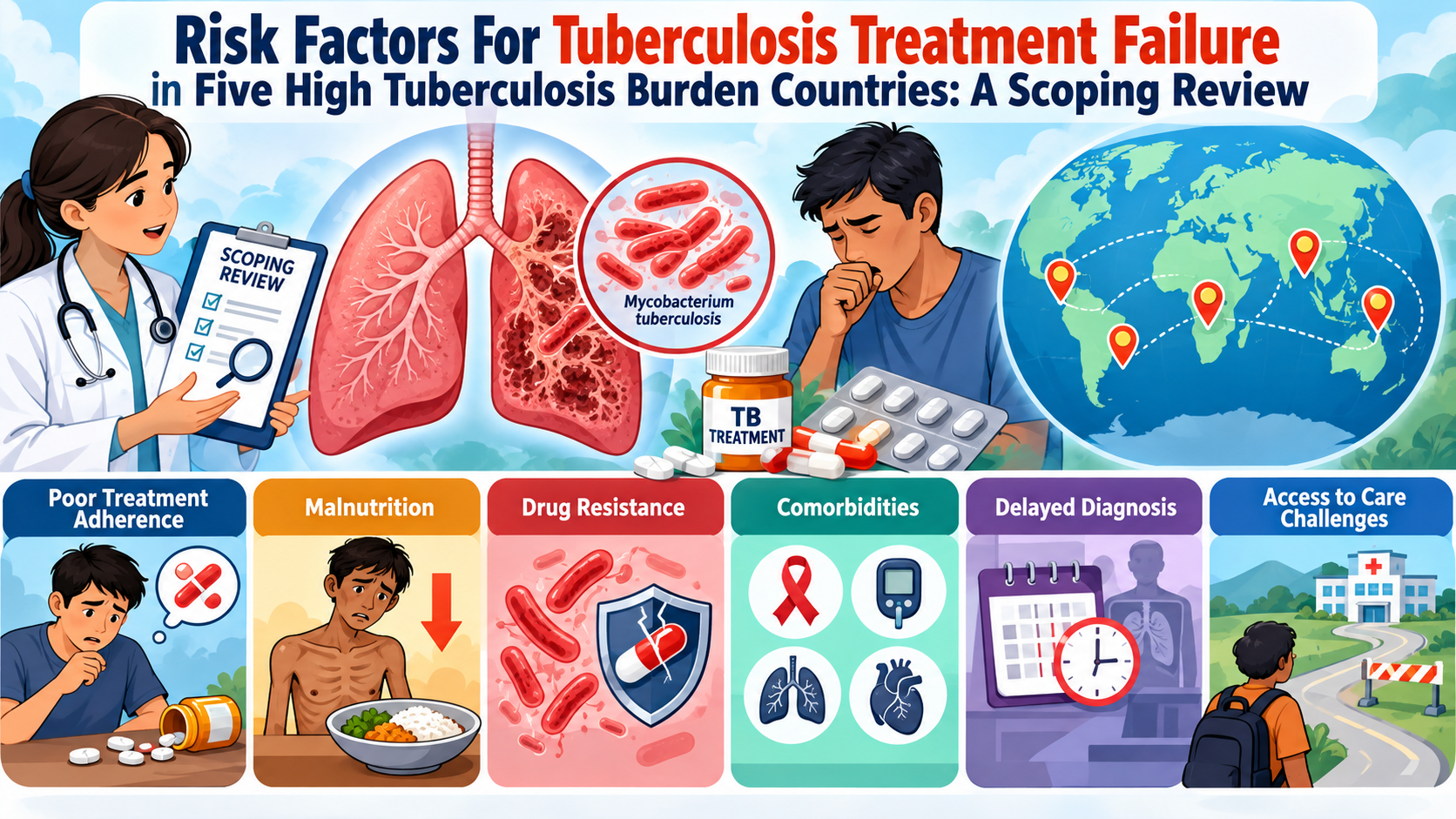
Treatment failure for tuberculosis (TB) remains a serious public health problem, particularly in countries with high TB incidence, since it leads to drug-resistant TB, higher mortality rates, and persistent transmission. This comprehensive research, conducted in five countries with large tuberculosis burdens China, India, Indonesia, Pakistan, and the Philippines aims to identify and define risk factors for treatment failure in adult patients with drug-sensitive tuberculosis (DS-TB) and drug-resistant tuberculosis. The study used a review technique based on the Joanna Briggs Institute (JBI) criteria and the Population-Concept-Context (PCC) framework. The population consisted of adult tuberculosis patients, the concept was on risk variables linked with treatment failure, and the environment was confined to the five high-burden nations. Literature searches were undertaken in PubMed, Scopus, and EBSCOHost for studies published between 2015 and 2025, and study selection followed the PRISMA-ScR standards. The final analysis includes 19 studies that fulfilled the inclusion criteria. Clinical variables accounted for 73.7% of all identified risk factors, followed by demographic factors (68.3%) and microbiological factors (57.9%). Behavioral and social aspects were recorded in 31.6% and 26.3% of studies, respectively. Several risk variables were documented in numerous nations, however the prevailing risk profiles differed by country. Older age and malnutrition were prevalent in China; male sex and underweight status in India; older age, low treatment compliance, and limited tuberculosis-related knowledge in Indonesia; pulmonary cavitation, prior tuberculosis history, and drug resistance in Pakistan; and working-age characteristics, positive sputum smear results, and treatment discontinuation in the Philippines. These data show that, whereas some similar drivers of treatment failure exist in high-burden nations, the relative importance of specific risk variables differs by country. As a result, TB control programs should mix integrated and patient-centered methods with country-specific treatments tailored to the predominant risk profiles observed in each context.
Akhmedullin, R., Algazyeva, G., Rakisheva, А., Mussabekova, G., Zhakhina, G., Tursynbayeva, A., Gaipov, A., Adenov, M., Erimbetov, K., & Ismailov, S. (2025). Treatment outcomes for drug-resistant tuberculosis: a retrospective longitudinal study. BMC infectious diseases, 25(1), 1125. https://doi.org/10.1186/s12879-025-11547-5
Arksey, H., & O’Malley, L. (2005). Scoping studies: Towards a methodological framework. International Journal of Social Research Methodology, 8(1), 19–32. https://doi.org/https://doi.org/10.1080/1364557032000119616
Atif, M., Ahmad, W., Ahmad, N., Malik, I., & Sarwar, S. (2020). Treatment outcomes among multidrug-resistant TB patients in Bahawal Victoria Hospital, Bahawalpur, Pakistan: A retrospective record review. Transactions of the Royal Society of Tropical Medicine and Hygiene, 114(10), 733–741. https://doi.org/10.1093/trstmh/traa040
Baker, M. A., Harries, A. D., Jeon, C. Y., Hart, J. E., Kapur, A., Lönnroth, K., Ottmani, S. E., Goonesekera, S. D., & Murray, M. B. (2011). The impact of diabetes on tuberculosis treatment outcomes: a systematic review. BMC medicine, 9, 81. https://doi.org/10.1186/1741-7015-9-81
Craig, G. M., Daftary, A., Engel, N., O'Driscoll, S., & Ioannaki, A. (2017). Tuberculosis stigma as a social determinant of health: a systematic mapping review of research in low incidence countries. International journal of infectious diseases : IJID : official publication of the International Society for Infectious Diseases, 56, 90–100. https://doi.org/10.1016/j.ijid.2016.10.011
Dheda, K., Gumbo, T., Maartens, G., Dooley, K. E., McNerney, R., Murray, M., Furin, J., Nardell, E. A., London, L., Lessem, E., Theron, G., van Helden, P., Niemann, S., Merker, M., Dowdy, D., Van Rie, A., Siu, G. K., Pasipanodya, J. G., Rodrigues, C., Clark, T. G., … Warren, R. M. (2017). The epidemiology, pathogenesis, transmission, diagnosis, and management of multidrug-resistant, extensively drug-resistant, and incurable tuberculosis. The Lancet. Respiratory medicine, S2213-2600(17)30079-6. Advance online publication. https://doi.org/10.1016/S2213-2600(17)30079-6
Gilmour, B., Xu, Z., Bai, L., Alene, K. A., & Clements, A. C. A. (2022). Risk factors associated with unsuccessful tuberculosis treatment outcomes in Hunan Province, China. Tropical medicine & international health : TM & IH, 27(3), 290–299. https://doi.org/10.1111/tmi.13720
Gupta, A., Mittal, V., Singh, N., & Nadda, A. (2025). Determinants of unsuccessful treatment outcome of pulmonary tuberculosis under the National Tuberculosis Elimination Program in Mohali district, India. Monaldi archives for chest disease = Archivio Monaldi per le malattie del torace, 10.4081/monaldi.2025.3363. Advance online publication. https://doi.org/10.4081/monaldi.2025.3363
Hinay, A. A. J., Mamalintaw, M. A., Damasin, J. M. L., Dilangalen, B. J. S. A., Montinola, B. A. S., Napinas, C. J. S., … Dayaganon, A. J. B. (2025). Sociodemographic and Clinical Predictors of Tuberculosis and Unsuccessful Treatment Outcomes in Davao City, Philippines: A Retrospective Cohort Study. International Journal of Environmental Research and Public Health, 22(7). https://doi.org/10.3390/ijerph22071154
Javaid, A., Ullah, I., Masud, H., Basit, A., Ahmad, W., Butt, Z. A., & Qasim, M. (2018). Predictors of poor treatment outcomes in multidrug-resistant tuberculosis patients: a retrospective cohort study. Clinical microbiology and infection : the official publication of the European Society of Clinical Microbiology and Infectious Diseases, 24(6), 612–617. https://doi.org/10.1016/j.cmi.2017.09.012
Khan, I., Ahmad, N., Khan, S., Muhammad, S., Ahmad Khan, S., Ahmad, I., Khan, A., Gulalai, & Atif, M. (2019). Evaluation of treatment outcomes and factors associated with unsuccessful outcomes in multidrug resistant tuberculosis patients in Baluchistan province of Pakistan. Journal of infection and public health, 12(6), 809–815. https://doi.org/10.1016/j.jiph.2019.04.009
Khan, S., Silsarma, A., Mahajan, R., Khan, S., Davuluri, P., Sutar, N., Iyer, A., Mankar, S., Oswal, V., Puri, V., Shah, D., Chavan, V., Spencer, H., & Isaakidis, P. (2024). Treatment outcomes among patients with isoniazid mono-resistant tuberculosis in Mumbai, India: A retrospective cohort study. Journal of clinical tuberculosis and other mycobacterial diseases, 37, 100481. https://doi.org/10.1016/j.jctube.2024.100481
Lestari, B. W., Nijman, G., Larasmanah, A., Soeroto, A. Y., Santoso, P., Alisjahbana, B., Chaidir, L., Andriyoko, B., van Crevel, R., & Hill, P. C. (2023). Management of drug-resistant tuberculosis in Indonesia: a four-year cascade of care analysis. The Lancet regional health. Southeast Asia, 22, 100294. https://doi.org/10.1016/j.lansea.2023.100294
Ling, Y., Chen, X., Zhou, M., Zhang, M., Luo, D., Wang, W., Chen, B., & Jiang, J. (2023). The effect of diabetes mellitus on tuberculosis in eastern China: A decision-tree analysis based on a real-world study. Journal of diabetes, 15(11), 920–930. https://doi.org/10.1111/1753-0407.13444
Liu, H., Zou, L., Yu, J., Zhu, Q., Yang, S., Kang, W., Ma, J., Chen, Q., Shi, Z., Tang, X., Liang, L., Tang, P., Pan, Q., Guo, C., Du, J., Chang, Z., Guo, Z., Wu, G., & Tang, S. (2025). Treatment outcomes and associated influencing factors among elderly patients with rifampicin-resistant tuberculosis: a multicenter, retrospective, cohort study in China. BMC infectious diseases, 25(1), 1086. https://doi.org/10.1186/s12879-025-11491-4
Macatangay, I. O. D., Liao, S. A. S. P., Dadural, J. J. A., Gagui, F. J. S., Galas, A. J. A., San Antonio, R. D. F. A., & Pinlac, P. A. V. (2020). Factors associated with treatment outcome of patients with pulmonary tuberculosis in the Philippines, 2015 to 2016. Acta Medica Philippina, 54(5), 604–611. https://doi.org/10.47895/AMP.V54I5.2248
Massud, A., Khan, A. H., Syed Sulaiman, S. A., Ahmad, N., Shafqat, M., & Ming, L. C. (2023). Unsuccessful treatment outcome and associated risk factors. A prospective study of DR-TB patients from a high burden country, Pakistan. PloS one, 18(8), e0287966. https://doi.org/10.1371/journal.pone.0287966
Meiyanti, M., Bachtiar, A., Kusumaratna, R. K., Alfiyyah, A., Machrumnizar, M., & Pusparini, P. (2024). Tuberculosis treatment outcomes and associated factors: A retrospective study in West Nusa Tenggara, Indonesia. Narra J, 4(3), e1660. https://doi.org/10.52225/narra.v4i3.1660
Nugrahaeni, D. K., & Rosmalaningrum, L. (2021). Risk factors in pulmonary tuberculosis treatment failure. The Indonesian Journal of Public Health, 16(1), 12. https://doi.org/10.20473/ijph.v16i1.2021.12-22
Oh, A. L., Makmor-Bakry, M., Islahudin, F., & Wong, I. C. (2023). Prevalence and predictive factors of tuberculosis treatment interruption in the Asia region: a systematic review and meta-analysis. BMJ global health, 8(1), e010592. https://doi.org/10.1136/bmjgh-2022-010592
Oxlade, O., & Murray, M. (2012). Tuberculosis and poverty: why are the poor at greater risk in India?. PloS one, 7(11), e47533. https://doi.org/10.1371/journal.pone.0047533
Peters, M. D. J., Marnie, C., Tricco, A. C., Pollock, D., Munn, Z., Alexander, L., McInerney, P., Godfrey, C. M., & Khalil, H. (2020). Updated methodological guidance for the conduct of scoping reviews. JBI evidence synthesis, 18(10), 2119–2126. https://doi.org/10.11124/JBIES-20-00167
Santosa, A., Juniarti, N., Pahria, T., & Susanti, R. D. (2025). Digital adherence technology to improve medication adherence in tuberculosis patients: a systematic review and meta-analysis randomized control trials. NPJ primary care respiratory medicine, 35(1), 52. https://doi.org/10.1038/s41533-025-00457-3
Sinha, P., Ponnuraja, C., Gupte, N., Prakash Babu, S., Cox, S. R., Sarkar, S., Mave, V., Paradkar, M., Cintron, C., Govindarajan, S., Kinikar, A., Priya, N., Gaikwad, S., Thangakunam, B., Devarajan, A., Dhanasekaran, M., Tornheim, J. A., Gupta, A., Salgame, P., Christopher, D. J., … Hochberg, N. S. (2023). Impact of Undernutrition on Tuberculosis Treatment Outcomes in India: A Multicenter, Prospective, Cohort Analysis. Clinical infectious diseases : an official publication of the Infectious Diseases Society of America, 76(8), 1483–1491. https://doi.org/10.1093/cid/ciac915
Soeroto, A. Y., Pratiwi, C., Santoso, P., & Lestari, B. W. (2021). Factors affecting the outcome of longer regimen multidrug-resistant tuberculosis treatment in West Java, Indonesia: A retrospective cohort study. PLOS ONE, 16(2 February), e0246284. https://doi.org/10.1371/journal.pone.0246284
Sureskiarti, E., Mentari, M., Masnina, R., & Milkhatun, M. (2020). The Performance of Nurses to Improve the Responsibility Quality of Nursing Services. Indonesian Journal of Global Health Research, 2(4), 411-418. https://doi.org/10.37287/ijghr.v2i4.250
Velavan, A., Purty, A. J., Shringarpure, K., Sagili, K. D., Mishra, A. K., Selvaraj, K. S., Manikandan, M., & Saravanan, V. (2018). Tuberculosis retreatment outcomes and associated factors: a mixed-methods study from Puducherry, India. Public health action, 8(4), 187–193. https://doi.org/10.5588/pha.18.0038
Wahid, A., Ahmad, N., Ghafoor, A., Latif, A., Saleem, F., Khan, S., ... & Iqbal, Q. (2021). Effectiveness of shorter treatment regimen in multidrug-resistant tuberculosis patients in Pakistan: a multicenter retrospective record review. The American journal of tropical medicine and hygiene, 104(5), 1784. https://doi.org/10.4269/ajtmh.20-1134
World Health Organization. (2024). Global Tuberculosis (TB) Report 2024.
Xiong, K., Wang, J., Zhang, J., Hao, H., Wang, Q., Cai, J., & Ma, A. (2020). Association of Dietary Micronutrient Intake with Pulmonary Tuberculosis Treatment Failure Rate: ACohort Study. Nutrients, 12(9), 2491. https://doi.org/10.3390/nu12092491
Zhou, Y., Dai, Z., Lin, S., Chen, D., Lin, J., Chen, K., Lin, Y., & Deng, Y. (2025). Rifampicin-resistant tuberculosis in Fujian Province, Southeast China: a retrospective analysis of drug resistance screening and treatment outcomes, 2019-2024. Frontiers in public health, 13, 1611459. https://doi.org/10.3389/fpubh.2025.1611459
Zhou, Y., Li, T., Lin, S., Chen, D., Du, Y., Chen, J., Chen, K., & Dai, Z. (2023). Characteristics and treatment outcomes of co-infected tuberculosis patients with human immunodeficiency virus in Southeast China, 2012-2021. BMC infectious diseases, 23(1), 528. https://doi.org/10.1186/s12879-023-08501-8
Copyright (c) 2026 JURNAL INFO KESEHATAN

This work is licensed under a Creative Commons Attribution-NonCommercial-ShareAlike 4.0 International License.
Copyright notice
Ownership of copyright
The copyright in this website and the material on this website (including without limitation the text, computer code, artwork, photographs, images, music, audio material, video material and audio-visual material on this website) is owned by JURNAL INFO KESEHATAN and its licensors.
Copyright license
JURNAL INFO KESEHATAN grants to you a worldwide non-exclusive royalty-free revocable license to:
- view this website and the material on this website on a computer or mobile device via a web browser;
- copy and store this website and the material on this website in your web browser cache memory; and
- print pages from this website for your use.
- All articles published by JURNAL INFO KESEHATAN are licensed under the Creative Commons Attribution 4.0 International License. This permits anyone to copy, redistribute, remix, transmit and adapt the work provided the original work and source is appropriately cited.
JURNAL INFO KESEHATAN does not grant you any other rights in relation to this website or the material on this website. In other words, all other rights are reserved.
For the avoidance of doubt, you must not adapt, edit, change, transform, publish, republish, distribute, redistribute, broadcast, rebroadcast or show or play in public this website or the material on this website (in any form or media) without appropriately and conspicuously citing the original work and source or JURNAL INFO KESEHATAN prior written permission.
Permissions
You may request permission to use the copyright materials on this website by writing to [email protected].
Enforcement of copyright
JURNAL INFO KESEHATAN takes the protection of its copyright very seriously.
If JURNAL INFO KESEHATAN discovers that you have used its copyright materials in contravention of the license above, JURNAL INFO KESEHATAN may bring legal proceedings against you seeking monetary damages and an injunction to stop you using those materials. You could also be ordered to pay legal costs.
If you become aware of any use of JURNAL INFO KESEHATAN copyright materials that contravenes or may contravene the license above, please report this by email to [email protected]
Infringing material
If you become aware of any material on the website that you believe infringes your or any other person's copyright, please report this by email to [email protected].