A Case-Control Study of Environmental Risk Factors for Pulmonary Tuberculosis: Housing Density, Indoor Humidity, and Smoking Habits

Downloads
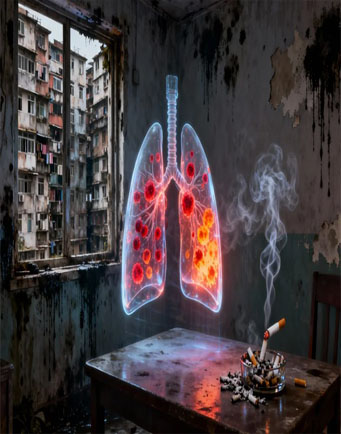
Pulmonary tuberculosis (TB) remains a major public health problem in urban settings and is strongly influenced by environmental and behavioral factors. This study aimed to examine the effects of housing density, indoor humidity, and smoking behavior on the incidence of pulmonary TB in the working area of the Segiri Health Center, Samarinda. An observational analytic study with a case–control design was conducted involving 50 respondents, consisting of 25 TB cases and 25 matched controls. Data were collected through structured interviews, direct observation, and environmental measurements, and were analyzed using chi-square tests and odds ratios. The results indicated that high housing density was significantly associated with an increased risk of TB (OR = 11.16; p = 0.001), while smoking behavior was also significantly related to TB incidence (OR = 5.63; p = 0.010). High indoor humidity showed an increased risk but was not statistically significant. In addition, a large proportion of TB cases were frequently exposed to secondhand smoke in enclosed spaces. In conclusion, high housing density and smoking, including exposure to secondhand smoke, are key determinants of pulmonary TB incidence, whereas indoor humidity demonstrated a weaker association. These findings highlight the importance of improving housing conditions and strengthening tobacco control efforts as part of TB prevention strategies in urban areas.
Alavi-Naini, R., Sharifi-Mood, B., & Metanat, M. (2012). Association Between Tuberculosis and Smoking. International Journal of High Risk Behaviors and Addiction, 1(2), 71–74. https://doi.org/10.5812/ijhrba.5215
Bai, X., Aerts, S. L., Verma, D., Ordway, D. J., & Chan, E. D. (2018). Epidemiologic Evidence of and Potential Mechanisms by Which Second-Hand Smoke Causes Predisposition to Latent and Active Tuberculosis. Immune Network, 18(3), e22. https://doi.org/10.4110/in.2018.18.e22
Clark, M., Riben, P., & Nowgesic, E. (2002). The association of housing density, isolation, and tuberculosis in Canadian First Nations communities. International Journal of Epidemiology, 31(5), 940–945. https://doi.org/10.1093/ije/31.5.940
Coleman, M., Martinez, L., Theron, G., Wood, R., & Marais, B. (2022). Mycobacterium tuberculosis Transmission in High-Incidence Settings—New Paradigms and Insights. Pathogens, 11(11), 1228. https://doi.org/10.3390/pathogens11111228
Dogar, O. F., Pillai, N., Safdar, N., Shah, S. K., Zahid, R., & Siddqi, K. (2015). Second-hand smoke and the risk of tuberculosis: a systematic review and a meta-analysis. Epidemiology and Infection, 143(15), 3158–3172. https://doi.org/10.1017/S0950268815001235
Fahdhienie, F., Mudatsir, M., Abidin, T. F., & Nurjannah, N. (2024). Risk factors of pulmonary tuberculosis in Indonesia: A case-control study in a high disease prevalence region. Narra J, 4(2), e943. https://doi.org/10.52225/narra.v4i2.943
Fakhira, A. D., & Keman, S. (2024). Relationship between healthy house and smoking habits with AFB (+) pulmonary tuberculosis cases at the Singotrunan public health center, Banyuwangi district. Journal of Health Management and Pharmacy Exploration, 2(1), 21-28. https://doi.org/10.52465/johmpe.v2i1.281
Gambhir, H. S., Kaushik, R. M., Kaushik, R., & Sindhwani, G. (2010). Tobacco smoking-associated risk for tuberculosis: a case-control study. International Health, 2(3), 216–222. https://doi.org/10.1016/j.inhe.2010.07.001
Gupta, H., Mahajan, S., Lal, M., Toor, A. K., Deepti, S. S., & Chawla, N. (2022). Prevalence of tobacco consumption and smoking and its effect on outcome among microbiologically confirmed new pulmonary tuberculosis patients on the daily regimen of DOTS in Amritsar city. Journal of Family Medicine and Primary Care, 11(5), 2150–2156. https://doi.org/10.4103/jfmpc.jfmpc_1170_21
Jannah, R. Z., Azizah, R., Jalaludin, J. B., Sulistyorini, L., & Lestari, K. S. (2023). Meta-Analysis Study: Environmental Risk Factors of Tuberculosis (TB). Jurnal Kesehatan Lingkungan, 15(2), 84–91. https://doi.org/10.20473/jkl.v15i2.2023.84-91
Kementerian Kesehatan Republik Indonesia. (2023). Peraturan Menteri Kesehatan Nomor 2 Tahun 2023 tentang Peraturan Pelaksanaan Peraturan Pemerintah Nomor 66 Tahun 2014 tentang Kesehatan Lingkungan. Jakarta: Kementerian Kesehatan Republik Indonesia.
Khan, F. A., Fox, G. J., Lee, R. S., Riva, M., Benedetti, A., Proulx, J.-F., … Menzies, D. (2016). Housing and tuberculosis in an Inuit village in northern Quebec: a case-control study. CMAJ Open, 4(3), E496–E506. https://doi.org/10.9778/cmajo.20160049
Krishnan, R., Thiruvengadam, K., Jayabal, L., Selvaraju, S., Watson, B., Malaisamy, M., … Chandrasekaran, P. (2022). An influence of dew point temperature on the occurrence of Mycobacterium tuberculosis disease in Chennai, India. Scientific Reports, 12(1), 6147. https://doi.org/10.1038/s41598-022-10111-4
Lee, J.-Y., Kwon, N., Goo, G., & Cho, S. (2022). Inadequate housing and pulmonary tuberculosis: a systematic review. BMC Public Health, 22(1), 622. https://doi.org/10.1186/s12889-022-12879-6
Leung, C. C., Li, T., Lam, T. H., Yew, W. W., Law, W. S., Tam, C. M., … Chang, K. C. (2004). Smoking and Tuberculosis among the Elderly in Hong Kong. American Journal of Respiratory and Critical Care Medicine, 170(9), 1027–1033. https://doi.org/10.1164/rccm.200404-512OC
Pratiwi, R. D., Pramono, D., & Junaedi, J. (2020). Socio-Economic and Environmental Risk Factors of Tuberculosis in Wonosobo, Central Java, Indonesia. Jurnal Kesehatan Masyarakat, 16(1), 61–70. https://doi.org/10.15294/kemas.v16i1.12636
Quan, D. H., Kwong, A. J., Hansbro, P. M., & Britton, W. J. (2022). No smoke without fire: the impact of cigarette smoking on the immune control of tuberculosis. European Respiratory Review, 31(164), 210252. https://doi.org/10.1183/16000617.0252-2021
Rangkoratat, M. M., Suhita, B. M., & Anggraini, N. A. (2024). Improving self-efficacy and behavior to prevent transmission in pulmonary tuberculosis patients through health coaching based on social cognitive theory. Journal of Applied Nursing and Health, 6(2), 75–87. https://doi.org/10.55018/janh.v6i2.242
Smith, G. S., Van Den Eeden, S. K., Baxter, R., Shan, J., Van Rie, A., Herring, A. H., … Gammon, M. D. (2015). Cigarette smoking and pulmonary tuberculosis in northern California. Journal of Epidemiology and Community Health, 69(6), 568–573. https://doi.org/10.1136/jech-2014-204292
Sulidah, S., Irwan, M., Elmania, E., Fadlilah, S., Hamdani Rahil, N., & Nugroho, A. (2024). Home environment as a risk factor for increased incidence of tuberculosis: A case-control study. Ciencia y Enfermería, 30(5), 1-9. https://doi.org/10.29393/CE30-5HESA60005
Tesema, C., Tadesse, T., Gebrehiwot, M., Tsegaw, A., & Weldegebreal, F. (2015). Environmental and host-related determinants of tuberculosis in Metema district, north-west Ethiopia. Drug, Healthcare and Patient Safety, 87-95. https://doi.org/10.2147/DHPS.S82070
Tosepu, R., Sani, A., Effendy, D. S., & Ahmad, L. O. A. I. (2024). The association between climate variables and tuberculosis in Kolaka District, Southeast Sulawesi Province, Indonesia, 2013–2020: a Bayesian autoregressive model. F1000Research, 12, 1507. https://doi.org/10.12688/f1000research.138859.2
WHO. (2024). Global tuberculosis report. Geneva: WHO. Retrieved from: https://www.who.int/teams/global-programme-on-tuberculosis-and-lung-health/tb-reports/global-tuberculosis-report-2024
Wolkoff, P. (2018). Indoor air humidity, air quality, and health – An overview. International Journal of Hygiene and Environmental Health, 221(3), 376–390. https://doi.org/10.1016/j.ijheh.2018.01.015
Wulandari, A. A., Nurjazuli, N., & Adi, M. S. (2015). Faktor risiko dan potensi penularan tuberkulosis paru di Kabupaten Kendal, Jawa Tengah. Jurnal Kesehatan Lingkungan Indonesia, 14(1), 7-13. Retrieved from: https://ejournal.undip.ac.id/index.php/jkli/article/view/10031
Copyright (c) 2026 JURNAL INFO KESEHATAN

This work is licensed under a Creative Commons Attribution-NonCommercial-ShareAlike 4.0 International License.
Copyright notice
Ownership of copyright
The copyright in this website and the material on this website (including without limitation the text, computer code, artwork, photographs, images, music, audio material, video material and audio-visual material on this website) is owned by JURNAL INFO KESEHATAN and its licensors.
Copyright license
JURNAL INFO KESEHATAN grants to you a worldwide non-exclusive royalty-free revocable license to:
- view this website and the material on this website on a computer or mobile device via a web browser;
- copy and store this website and the material on this website in your web browser cache memory; and
- print pages from this website for your use.
- All articles published by JURNAL INFO KESEHATAN are licensed under the Creative Commons Attribution 4.0 International License. This permits anyone to copy, redistribute, remix, transmit and adapt the work provided the original work and source is appropriately cited.
JURNAL INFO KESEHATAN does not grant you any other rights in relation to this website or the material on this website. In other words, all other rights are reserved.
For the avoidance of doubt, you must not adapt, edit, change, transform, publish, republish, distribute, redistribute, broadcast, rebroadcast or show or play in public this website or the material on this website (in any form or media) without appropriately and conspicuously citing the original work and source or JURNAL INFO KESEHATAN prior written permission.
Permissions
You may request permission to use the copyright materials on this website by writing to [email protected].
Enforcement of copyright
JURNAL INFO KESEHATAN takes the protection of its copyright very seriously.
If JURNAL INFO KESEHATAN discovers that you have used its copyright materials in contravention of the license above, JURNAL INFO KESEHATAN may bring legal proceedings against you seeking monetary damages and an injunction to stop you using those materials. You could also be ordered to pay legal costs.
If you become aware of any use of JURNAL INFO KESEHATAN copyright materials that contravenes or may contravene the license above, please report this by email to [email protected]
Infringing material
If you become aware of any material on the website that you believe infringes your or any other person's copyright, please report this by email to [email protected].