The Policy Analysis for Implementation of Mass Drug Administration of Filariasis: A Health Policy Triangle Framework

Downloads
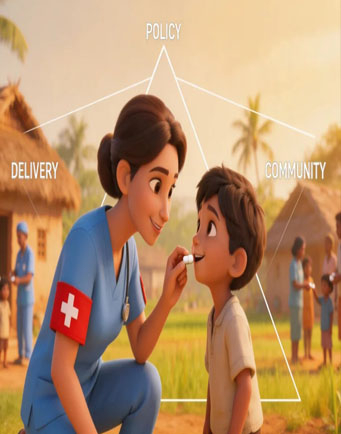
Lymphatic filariasis is a neglected tropical disease targeted for elimination through the World Health Organization’s Global Programme to Eliminate Lymphatic Filariasis (GPELF), primarily via annual Mass Drug Administration (MDA) in endemic areas with microfilaria rates exceeding 1%. This study aims to analyze the implementation of filariasis MDA using the Ivermectin–Diethylcarbamazine–Albendazole (IDA) regimen through the Health Policy Triangle framework, focusing on policy content, context, process, and actors. A qualitative policy analysis was conducted using data from publicly available policy documents, relevant empirical literature, and in-depth interviews with key stakeholders in selected districts/cities implementing extended IDA-based MDA. This study involved 6 participants, including 3 local leaders in community mobilization and health promotion, and 3 residents. The analysis specifically examined the adequacy of Health Operational Assistance (BOK) funding and the effectiveness of community socialization strategies. Findings highlight gaps in funding flexibility and uneven dissemination of information, which contribute to suboptimal treatment coverage. Strengthening financial support mechanisms and implementing more equitable and context-sensitive socialization models are essential to improve the effectiveness of IDA-based MDA and accelerate progress toward filariasis elimination.
Abdul Halim, A. F. N., Ahmad, D., Miaw Yn, J. L., Masdor, N. A., Ramly, N., Othman, R., ... & Dapari, R. (2022). Factors associated with the acceptability of mass drug administration for filariasis: a systematic review. International Journal of Environmental Research and Public Health, 19(19), 12971. https://doi.org/10.3390/ijerph191912971
Azzahra, M. K., Shafwah, D. A., Sondakh, C. S., & Adriyani, R. (2024). A Review Of Bed Nets Usage and Sewerage Conditions as Risk Factors For Lymphatic Filariasis in Developing Countries. Jurnal Kesehatan Lingkungan, 16(1), 89–100. https://doi.org/10.20473/jkl.v16i1.2024.89-100
Bhullar, N., & Maikere, J. (2010). Challenges in mass drug administration for treating lymphatic filariasis in Papua, Indonesia. Parasites & Vectors, 3(1), 70. https://doi.org/10.1186/1756-3305-3-70
Branda, F., Ali, A. Y., Ceccarelli, G., Albanese, M., Binetti, E., Giovanetti, M., ... & Scarpa, F. (2024). Assessing the burden of neglected tropical diseases in low-income communities: challenges and solutions. Viruses, 17(1), 29. https://doi.org/10.3390/v17010029
Chakraborty, S., & Bhattacharya, T. (2022). Coverage and compliance of mass drug administration in lymphatic filariasis amidst the COVID-19 pandemic: A community based epidemiological study. Tropical Parasitology, 12(2), 105–112. https://doi.org/10.4103/tp.tp_32_21
Cocciolo, S., Ghisolfi, S., Ahasan Habib, M., Rashid, S., & Tompsett, A. (2021). Do Community Water Sources Provide Safe Drinking Water? Evidence from a Randomized Experiment in Rural Bangladesh. The World Bank Economic Review, 35(4), 969–998. https://doi.org/10.1093/wber/lhab006
Cromwell, E. A., Schmidt, C. A., Kwong, K. T., Pigott, D. M., Mupfasoni, D., Biswas, G., ... & Negoi, I. (2020). The global distribution of lymphatic filariasis, 2000–18: a geospatial analysis. The Lancet Global Health, 8(9), e1186-e1194. https://doi.org/10.1016/S2214-109X(20)30286-2
Dinas Kesehatan Kota Pekalongan. (2017). Profil Kesehatan Kota Pekalongan Tahun 2017. Pekalongan: Dinas Kesehatan Kota Pekalongan.
Dinas Kesehatan Kota Pekalongan. (2019). Profil Kesehatan Kota Pekalongan Tahun 2019. Pekalongan: Dinas Kesehatan Kota Pekalongan.
Gilson, L., & Walt, G. (2023). Doing Health Policy Analysis: The Enduring Relevance of Simple Models: Comment on" Modelling the Health Policy Process: One Size Fits All or Horses for Courses". International Journal of Health Policy and Management, 12, 8223. https://doi.org/10.34172/ijhpm.2023.8223
Istianah, S., Mulyaningsih, B., Umniyati, S. R., & Arguni, E. (2021). Aedes aegypti as potential vector of filariasis in Pekalongan, Central Java Province, Indonesia. Jurnal Kedokteran Dan Kesehatan Indonesia, 12(1), 44–51. https://doi.org/10.20885/jkki.vol12.iss1.art8
Jacobson, J. (2022). Compressing the Timelines for Development and Delivery: Accelerating Access to Triple-Drug Therapy to Eliminate Lymphatic Filariasis. The American Journal of Tropical Medicine and Hygiene, 106(5), 4–12. https://doi.org/10.4269/ajtmh.21-1174
Kementerian Kesehatan Republik Indonesia. (2021). Profil Kesehatan Indonesia 2021. Jakarta: Kementerian Kesehatan Republik Indonesia.
Keys, H., Gonzales, M., Beau de Rochars, M., Blount, S., & Noland, G. S. (2018). Building Trust through Lymphatic Filariasis Elimination: A Platform to Address Social Exclusion and Human Rights in the Dominican Republic. Health and human rights, 20(1), 41–52. Retrieved from https://pubmed.ncbi.nlm.nih.gov/30008551/
Kibe, L. W., Kimani, B. W., Okoyo, C., Omondi, W. P., Sultani, H. M., & Njomo, D. W. (2022). Towards elimination of Lymphatic Filariasis in Kenya: improving advocacy, communication and social mobilization activities for mass drug administration, a qualitative study. Tropical Diseases, Travel Medicine and Vaccines, 8(1), 16. https://doi.org/10.1186/s40794-022-00172-8
Krentel, A., Basker, N., Beau de Rochars, M., Bogus, J., Dilliott, D., Direny, A. N., ... & Weil, G. J. (2021). A multicenter, community-based, mixed methods assessment of the acceptability of a triple drug regimen for elimination of lymphatic filariasis. PLOS Neglected Tropical Diseases, 15(3), e0009002. https://doi.org/10.1371/journal.pntd.0009002
Kwarteng, A., Kenyon, K. H., Opoku Asiedu, S., Garcia, R., Kini, P., Osei-Poku, P., ... & Amewu, E. K. A. (2023). Knowledge and perceptions of lymphatic filariasis patients in selected hotspot endemic communities in southern Ghana. PLOS Global Public Health, 3(10), e0002476. https://doi.org/10.1371/journal.pgph.0002476
Mandrosovololona, V., Rasoamihanta, P., Djawe, K., Mupfasoni, D., Andriamino, B., Rakotonavalona, R., ... & Musango, L. (2024). Implementation of mass drug administration for lymphatic filariasis in Madagascar: the progress, effectiveness and financial savings of integrating into an existing polio campaign. Research and Reports in Tropical Medicine, 15, 123-147. https://doi.org/10.2147/rrtm.s487163
Niles, R. A., Thickstun, C. R., Cox, H., Dilliott, D., Burgert-Brucker, C. R., Harding-Esch, E. M., ... & Krentel, A. (2021). Assessing factors influencing communities’ acceptability of mass drug administration for the elimination of lymphatic filariasis in Guyana. PLoS neglected tropical diseases, 15(9), e0009596. https://doi.org/10.1371/journal.pntd.0009596
O'Brien, G. L., Sinnott, S. J., Walshe, V., Mulcahy, M., & Byrne, S. (2020). Health policy triangle framework: narrative review of the recent literature. Health Policy Open, 1, 100016. https://doi.org/10.1016/j.hpopen.2020.100016
Ratna, P., Sinha, A., Pati, S., & Sahoo, P. K. (2024). Factors influencing implementation of mass drug administration for lymphatic filariasis elimination: a mixed-method study in Odisha, India. Frontiers in pharmacology, 15, 1297954. https://doi.org/10.3389/fphar.2024.1297954
Rohmana, O., Badriah, B., & Komarudin, K. (2017). Analisis Faktor yang Mempengaruhi Kepatuhan Masyarakat Mengikuti Program POMP Filariasis. Jurnal Media Informasi, 13(1), 80-86. https://doi.org/10.37160/bmi.v13i1.86
Sinha, A., Kumar, S., Dayal, D., Yadav, V., Pramanik, A., Chaubey, K. K., & Kumar, S. (2023). Elimination of lymphatic filariasis: Where do we stand so far? Asian Pacific Journal of Tropical Medicine, 16(9), 385–399. https://doi.org/10.4103/1995-7645.380729
Tarricone, R., Armeni, P., Arsenault, C., & Kruk, M. E. (2026). The relationship between trust and compliance in the Italian NHS: Results of the People’s Voice Survey. Health Policy, 165, 105544. https://doi.org/10.1016/j.healthpol.2025.105544
Taylor, M., Thomas, R., Oliver, S., & Garner, P. (2022). Community views on mass drug administration for filariasis: a qualitative evidence synthesis. Cochrane Database of Systematic Reviews, 2022 (2), CD013638 . https://doi.org/10.1002/14651858.CD013638.pub2
Tripathi, B., Roy, N., & Dhingra, N. (2022). Introduction of Triple-Drug Therapy for Accelerating Lymphatic Filariasis Elimination in India: Lessons Learned. The American Journal of Tropical Medicine and Hygiene, 106(5), 29–38. https://doi.org/10.4269/ajtmh.21-0964
Tyagi, B. K. (2018). Lymphatic filariasis. Prescrire International, 17(93), 36. https://doi.org/10.1201/9781420004946.ch8
WHO. (2020). Indonesia firmly committed to eliminating lymphatic filariasis as a public health problem. Geneva: WHO. Retrieved from https://www.who.int/news/item/29-04-2020-indonesia-firmly-committed-to-eliminating-lymphatic-filariasis-as-a-public-health-problem
WHO. (2024). Lymphatic Filariasis. Geneva: WHO. Retrieved from https://www.who.int/news-room/fact-sheets/detail/lymphatic-filariasis
Widjanarko, B., Saraswati, L. D., & Ginandjar, P. (2018). Perceived threat and benefit toward community compliance of filariasis’ mass drug administration in Pekalongan district, Indonesia. Risk Management and Healthcare Policy, 11, 189–197. https://doi.org/10.2147/RMHP.S172860
Zahidie, A., Asif, S., & Iqbal, M. (2023). Building on the Health Policy Analysis Triangle: Elucidation of the Elements. Pakistan Journal of Medical Sciences, 39(6), 1865–1868. https://doi.org/10.12669/pjms.39.6.7056
Copyright (c) 2026 JURNAL INFO KESEHATAN

This work is licensed under a Creative Commons Attribution-NonCommercial-ShareAlike 4.0 International License.
Copyright notice
Ownership of copyright
The copyright in this website and the material on this website (including without limitation the text, computer code, artwork, photographs, images, music, audio material, video material and audio-visual material on this website) is owned by JURNAL INFO KESEHATAN and its licensors.
Copyright license
JURNAL INFO KESEHATAN grants to you a worldwide non-exclusive royalty-free revocable license to:
- view this website and the material on this website on a computer or mobile device via a web browser;
- copy and store this website and the material on this website in your web browser cache memory; and
- print pages from this website for your use.
- All articles published by JURNAL INFO KESEHATAN are licensed under the Creative Commons Attribution 4.0 International License. This permits anyone to copy, redistribute, remix, transmit and adapt the work provided the original work and source is appropriately cited.
JURNAL INFO KESEHATAN does not grant you any other rights in relation to this website or the material on this website. In other words, all other rights are reserved.
For the avoidance of doubt, you must not adapt, edit, change, transform, publish, republish, distribute, redistribute, broadcast, rebroadcast or show or play in public this website or the material on this website (in any form or media) without appropriately and conspicuously citing the original work and source or JURNAL INFO KESEHATAN prior written permission.
Permissions
You may request permission to use the copyright materials on this website by writing to [email protected].
Enforcement of copyright
JURNAL INFO KESEHATAN takes the protection of its copyright very seriously.
If JURNAL INFO KESEHATAN discovers that you have used its copyright materials in contravention of the license above, JURNAL INFO KESEHATAN may bring legal proceedings against you seeking monetary damages and an injunction to stop you using those materials. You could also be ordered to pay legal costs.
If you become aware of any use of JURNAL INFO KESEHATAN copyright materials that contravenes or may contravene the license above, please report this by email to [email protected]
Infringing material
If you become aware of any material on the website that you believe infringes your or any other person's copyright, please report this by email to [email protected].