Early Detection of Dengue Fever Susceptibility using Climate Parameters and Larval Density

Downloads
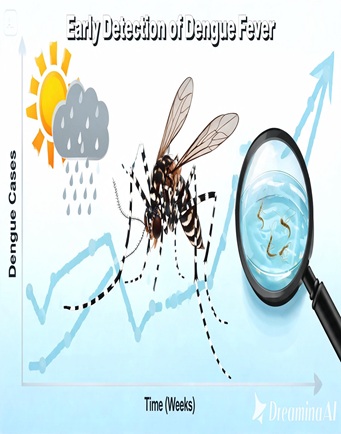
Dengue infection remains a vital public health challenge in Indonesia, especially in Pontianak City, marked by fluctuating case numbers and unpredictable transmission patterns influenced by climate and environmental factors. Current prevention efforts are often hampered by the lack of precise, integrated early warning information about regional vulnerability. This study aims to develop and evaluate a predictive model for dengue infection vulnerability by incorporating climate factors (rainfall intensity, humidity), population density, and larval-free index (LFI) to establish an accurate early warning system. An observational analytic study with a cross-sectional design was carried out using data from 2022 to 2024 in Pontianak. The study examined monthly rainfall intensity, relative humidity, population density, and LFI as predictors for dengue incidence. Data were analyzed using univariate, bivariate, and multivariate logistic regression analysis to assess regional vulnerability. The results show that rainfall intensity (p= 0.025; AOR= 2.097; 1.100 - 3.398) and LFI (p= 0.042; AOR= 1.102; 1.100 - 3.398) were the predictor of dengue risk. The prediction model can support stakeholders and the community in implementing timely and targeted prevention strategies to lessen the burden of dengue infection
Abbasi E. (2025). The impact of climate change on travel-related vector-borne diseases: A case study on dengue virus transmission. Travel medicine and infectious disease, 65, 102841. https://doi.org/10.1016/j.tmaid.2025.102841
Abdullah, N. A. M. H., Dom, N. C., Salleh, S. A., Salim, H., & Precha, N. (2022). The association between dengue case and climate: A systematic review and meta-analysis. One health (Amsterdam, Netherlands), 15, 100452. https://doi.org/10.1016/j.onehlt.2022.100452
Montenegro-Quiñonez, C. A., Louis, V. R., Horstick, O., Velayudhan, R., Dambach, P., & Runge-Ranzinger, S. (2023). Interventions against Aedes/dengue at the household level: a systematic review and meta-analysis. EBioMedicine, 93, 104660. https://doi.org/10.1016/j.ebiom.2023.104660 https://doi.org/https://doi.org/10.1016/j.ebiom.2023.104660
Amelinda, Y. S., Wulandari, R. A., & Asyary, A. (2022). The effects of climate factors, population density, and vector density on the incidence of dengue hemorrhagic fever in South Jakarta Administrative City 2016-2020: an ecological study. Acta bio-medica : Atenei Parmensis, 93(6), e2022323. https://doi.org/10.23750/abm.v93i6.13503
Anas, A. S., Wulandari, N. A., & Anas, H. R. (2025). Faktor Risiko Penyakit Demam Berdarah Dengue. Jurnal Kolaboratif Sains, 8(6), 3169-3176. Retrived : https://www.jurnal.unismuhpalu.ac.id/index.php/JKS/article/view/7913
Andrade Girón, D. C., Marín Rodriguez, W. J., Lioo-Jordan, F. D. M., & Ausejo Sánchez, J. L. (2025, February). Machine learning and deep learning models for dengue diagnosis prediction: A systematic review. In Informatics (Vol. 12, No. 1, p. 15). MDPI. https://doi.org/10.3390/informatics12010015
Aulia, S. S. (2020). Lembar Hasil Penilaian Sejawat Sebidang Atau Peer Review Karya Ilmiah : Jurnal Ilmiah. Repository Universitas Bina Sarana Informatika (RUBSI), 2(April), 1–2.
Benedum, C. M., Seidahmed, O. M. E., Eltahir, E. A. B., & Markuzon, N. (2018). Statistical modeling of the effect of rainfall flushing on dengue transmission in Singapore. PLoS neglected tropical diseases, 12(12), e0006935. https://doi.org/10.1371/journal.pntd.0006935
Caldwell, J. M., LaBeaud, A. D., Lambin, E. F., Stewart-Ibarra, A. M., Ndenga, B. A., Mutuku, F. M., Krystosik, A. R., Ayala, E. B., Anyamba, A., Borbor-Cordova, M. J., Damoah, R., Grossi-Soyster, E. N., Heras, F. H., Ngugi, H. N., Ryan, S. J., Shah, M. M., Sippy, R., & Mordecai, E. A. (2021). Climate predicts geographic and temporal variation in mosquito-borne disease dynamics on two continents. Nature communications, 12(1), 1233. https://doi.org/10.1038/s41467-021-21496-7.
Cheng, Q., Jing, Q., Collender, P. A., Head, J. R., Li, Q., Yu, H., Li, Z., Ju, Y., Chen, T., Wang, P., Cleary, E., & Lai, S. (2023). Prior water availability modifies the effect of heavy rainfall on dengue transmission: a time series analysis of passive surveillance data from southern China. Research square, rs.3.rs-3302421. https://doi.org/10.21203/rs.3.rs-3302421/v1
Cofone, L., Sabato, M., Di Paolo, C., Di Giovanni, S., Donato, M. A., & Paglione, L. (2025). Urban, architectural, and socioeconomic factors contributing to the concentration of potential arbovirus vectors and arbovirosis in urban environments from a one health perspective: A systematic review. Sustainability, 17(9), 4077. https://doi.org/10.3390/su17094077
Costa, A. C., Gomes, T. F., Moreira, R. P., Cavalcante, T. F., & Mamede, G. L. (2022). Influence of hydroclimatic variability on dengue incidence in a tropical dryland area. Acta tropica, 235, 106657. https://doi.org/10.1016/j.actatropica.2022.106657
Dinkes Kalbar, 2024. (2024). Profil Kesehatan Kalbar 2024. Profil Kesehatan 2024, 16(2), 39–55.
Dom, N. C., Abdullah, N. A. M. H., Dapari, R., & Salleh, S. A. (2025). Fine-scale predictive modeling of Aedes mosquito abundance and dengue risk indicators using machine learning algorithms with microclimatic variables. Scientific reports, 15(1), 37017. https://doi.org/10.1038/s41598-025-17191-y
Dutra, H. L. C., Marshall, D. J., Comerford, B., McNulty, B. P., Diaz, A. M., Jones, M. J., Mejia, A. J., Bjornstad, O. N., & McGraw, E. A. (2024). Larval crowding enhances dengue virus loads in Aedes aegypti, a relationship that might increase transmission in urban environments. PLoS neglected tropical diseases, 18(9), e0012482. https://doi.org/10.1371/journal.pntd.0012482
Hertelendy, A. J., Dresser, C., Gorgens, S., Hertelendy, A. P., Biddinger, P. D., & Ciottone, G. (2025). Strengthening healthcare system resilience: a comprehensive framework for tropical cyclone preparedness and response. Lancet regional health. Americas, 48, 101205. https://doi.org/10.1016/j.lana.2025.101205
Hoque, M. A. A., Sardar, M. L., Mukul, S. A., & Pradhan, B. (2025). Mapping dengue susceptibility in Dhaka city: a geospatial multi-criteria approach integrating environmental and demographic factors. Spatial Information Research, 33(4), 33. https://doi.org/10.1007/s41324-025-00635-y
Kolimenakis, A., Heinz, S., Wilson, M. L., Winkler, V., Yakob, L., Michaelakis, A., Papachristos, D., Richardson, C., & Horstick, O. (2021). The role of urbanisation in the spread of Aedes mosquitoes and the diseases they transmit-A systematic review. PLoS neglected tropical diseases, 15(9), e0009631. https://doi.org/10.1371/journal.pntd.0009631
Lahondère, C., Vinauger, C., Liaw, J. E., Tobin, K. K. S., Joiner, J. M., & Riffell, J. A. (2023). Effect of Temperature on Mosquito Olfaction. Integrative and comparative biology, 63(2), 356–367. https://doi.org/10.1093/icb/icad066
Lin, C. H., & Wen, T. H. (2024). Assessing the impact of emergency measures in varied population density areas during a large dengue outbreak. Heliyon, 10(6), e27931. https://doi.org/10.1016/j.heliyon.2024.e27931
Lolo, W. A., & Wiyono, W. I. (2023). Peningkatan Kapasitas Masyarakat Dalam Upaya Pencegahan Demam Berdarah Dengue (DBD) Melalui Pelatihan Pembuatan Bio Spray Anti Nyamuk Di Kelurahan Mapanget Kecamatan Talawaan Kabupaten Minahasa Utara. The Studies of Social Sciences, 5(2), 41-51. https://doi.org/10.35801/tsss.v5i2.51692
Lugten, E., & Hariharan, N. (2022). Strengthening Health Systems for Climate Adaptation and Health Security: Key Considerations for Policy and Programming. Health security, 20(5), 435–439. https://doi.org/10.1089/hs.2022.0050
Mamenun, Koesmaryono, Y., Sopaheluwakan, A., Hidayati, R., Dasanto, B. D., & Aryati, R. (2024). Spatiotemporal Characterization of Dengue Incidence and Its Correlation to Climate Parameters in Indonesia. Insects, 15(5), 366. https://doi.org/10.3390/insects15050366
Maretha, L., Razak, R., & Faisya, A. F. (2022). The Relation between Rainfall and Larval Density of Dengue Hemorrhagic Fever with Spatial Modeling. Media Kesehatan Masyarakat Indonesia, 18(1), 10-17. https://doi.org/10.30597/mkmi.v18i1.18388
Monintja, T. C., Arsin, A. A., Syafar, M., & Amiruddin, R. (2022). Relationship between rainfall and rainy days with dengue hemorrhagic fever incidence in Manado City, North Sulawesi, Indonesia. Open Access Macedonian Journal of Medical Sciences, 10(E), 840-843. https://doi.org/10.3889/oamjms.2022.8897
Nakase, T., Giovanetti, M., Obolski, U., & Lourenço, J. (2024). Population at risk of dengue virus transmission has increased due to coupled climate factors and population growth. Communications Earth & Environment, 5(1), 475. https://doi.org/10.1038/s43247-024-01639-6
Naura Qonita, & Yusva Dwi Saputra. (2023). Relationship between Larva Free Index (LFI) and healthy house with DHF incidence rate in Banyuwangi Regency, 2022. World Journal of Advanced Research and Reviews, 18(2), 1372–1378. https://doi.org/10.30574/wjarr.2023.18.2.0979
Nosrat, C., Altamirano, J., Anyamba, A., Caldwell, J. M., Damoah, R., Mutuku, F., Ndenga, B., & LaBeaud, A. D. (2021). Impact of recent climate extremes on mosquito-borne disease transmission in Kenya. PLoS neglected tropical diseases, 15(3), e0009182. https://doi.org/10.1371/journal.pntd.0009182
Nugraheni, W. P., Nuraini, S., Garjito, T. A., Pawitaningtyas, I., Lestyoningrum, S. D., Putri, L. M., Nursafingi, A., Kusnali, A., Noveyani, A. E., & Dhewantara, P. W. (2026). Assessing the epidemiological and economic impact of dengue from 1990 to 2021 in Indonesia. Clinical Epidemiology and Global Health, 38, 102303. https://doi.org/10.1016/j.cegh.2026.102303
Sureshkumar, S., & Shekhar, S. (2025). Impact of urban heat island effect on dengue incidence: a remote sensing approach using thermal and high-resolution optical imagery. BMC public health, 25(1), 2914. https://doi.org/10.1186/s12889-025-23763-4
Umar, F. (2023). Integrated Public Health Strategies for Vector Control in the Context of Climate Change and Urbanization. Jurnal Riset Kualitatif dan Promosi Kesehatan, 2(1), 15-26. https://doi.org/10.61194/jrkpk.v2i1.660
Xie, Y., Wang, B., Chen, Q., Wei, H., Ke, Y., Xie, F., Guan, X., Rui, J., & Chen, T. (2025). Forecasting high-risk areas for dengue outbreaks in China: A trend analysis of Aedes albopictus and Aedes aegypti distributions from 2014 to 2030. PLOS Neglected Tropical Diseases, 2025-July. https://doi.org/10.1371/journal.pntd.0013237
Yang, Z. S., Baua, A. D., Hemdan, M. S., Assavalapsakul, W., Wang, W. H., Lin, C. Y., Chao, D. Y., Chen, Y. H., & Wang, S. F. (2025). Dengue virus infection: A systematic review of pathogenesis, diagnosis and management. Journal of infection and public health, 18(12), 102982. https://doi.org/10.1016/j.jiph.2025.102982
Zhang, W. X., Zhao, T. Y., Wang, C. C., He, Y., Lu, H. Z., Zhang, H. T., Wang, L. M., Zhang, M., Li, C. X., & Deng, S. Q. (2025). Assessing the global dengue burden: Incidence, mortality, and disability trends over three decades. PLoS neglected tropical diseases, 19(3), e0012932. https://doi.org/10.1371/journal.pntd.0012932
Copyright (c) 2026 JURNAL INFO KESEHATAN

This work is licensed under a Creative Commons Attribution-NonCommercial-ShareAlike 4.0 International License.
Copyright notice
Ownership of copyright
The copyright in this website and the material on this website (including without limitation the text, computer code, artwork, photographs, images, music, audio material, video material and audio-visual material on this website) is owned by JURNAL INFO KESEHATAN and its licensors.
Copyright license
JURNAL INFO KESEHATAN grants to you a worldwide non-exclusive royalty-free revocable license to:
- view this website and the material on this website on a computer or mobile device via a web browser;
- copy and store this website and the material on this website in your web browser cache memory; and
- print pages from this website for your use.
- All articles published by JURNAL INFO KESEHATAN are licensed under the Creative Commons Attribution 4.0 International License. This permits anyone to copy, redistribute, remix, transmit and adapt the work provided the original work and source is appropriately cited.
JURNAL INFO KESEHATAN does not grant you any other rights in relation to this website or the material on this website. In other words, all other rights are reserved.
For the avoidance of doubt, you must not adapt, edit, change, transform, publish, republish, distribute, redistribute, broadcast, rebroadcast or show or play in public this website or the material on this website (in any form or media) without appropriately and conspicuously citing the original work and source or JURNAL INFO KESEHATAN prior written permission.
Permissions
You may request permission to use the copyright materials on this website by writing to [email protected].
Enforcement of copyright
JURNAL INFO KESEHATAN takes the protection of its copyright very seriously.
If JURNAL INFO KESEHATAN discovers that you have used its copyright materials in contravention of the license above, JURNAL INFO KESEHATAN may bring legal proceedings against you seeking monetary damages and an injunction to stop you using those materials. You could also be ordered to pay legal costs.
If you become aware of any use of JURNAL INFO KESEHATAN copyright materials that contravenes or may contravene the license above, please report this by email to [email protected]
Infringing material
If you become aware of any material on the website that you believe infringes your or any other person's copyright, please report this by email to [email protected].