Robotic Glove Therapy in Stroke Rehabilitation: A Scoping Review of Current Evidence and Research Trends

Downloads
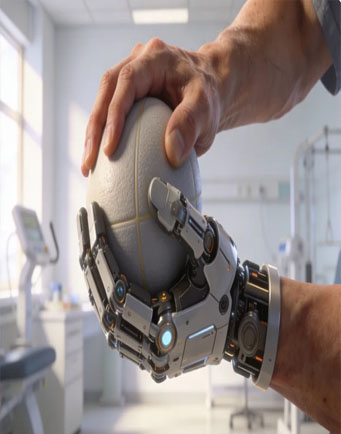
Stroke remains a leading cause of long-term disability worldwide, with persistent upper limb and hand impairments substantially restricting functional independence and quality of life. Robotic glove therapy has emerged as an innovative wearable rehabilitation technology designed to deliver high-intensity, repetitive, and task-specific hand training to stimulate neuroplastic recovery. Despite growing clinical interest, the breadth of current evidence and its translational implications remain insufficiently synthesized. This scoping review aimed to systematically map existing research on robotic glove therapy in stroke rehabilitation, identify methodological gaps, and analyze technological and clinical outcome trends. The review followed the PRISMA-ScR framework. A comprehensive search of PubMed, ScienceDirect, ProQuest, Google Scholar, and national index databases identified 110 records published between 2016 and 2026. After duplicate removal and eligibility screening, eight studies were included in the final synthesis, comprising randomized controlled trials, pilot trials, double-blind studies, and case reports conducted in Europe, Asia, and North America. The findings indicate that robotic glove interventions—including soft robotic gloves, EMG-driven systems, passive mobilization devices, and hand exoskeleton gloves consistently improved upper limb motor outcomes, hand dexterity, grip strength, spasticity, pain, and activities of daily living. Technologies incorporating intention-driven or EMG-triggered control demonstrated superior functional gains, underscoring the importance of active patient engagement in motor relearning. Importantly, robotic glove therapy demonstrates practical feasibility due to its wearable design, adaptability to various impairment levels, and potential for semi-supervised or home-based deployment. By increasing training intensity without proportionally increasing therapist workload, this innovation offers a scalable rehabilitation solution, particularly relevant for healthcare systems facing workforce limitations and growing stroke prevalence. While methodological heterogeneity and limited sample sizes constrain definitive conclusions, current evidence supports robotic glove therapy as a clinically promising and operationally feasible adjunct to conventional stroke rehabilitation, warranting larger standardized trials and contextual implementation studies in emerging healthcare settings.
Abdelraouf, O. R., Ghafar, M. A. A., Mohamed, M. E., Ibrahim, Z. M., Harraz, E. M., Seyam, M. K., ... & El-Bagalaty, A. E. (2025). Soft robotic gloves versus mirror therapy: a long-term comparative study on hand function and motor recovery in post-stroke rehabilitation. Journal of Rehabilitation Medicine, 57, 43482. https://doi.org/10.2340/jrm.v57.43482
Anwer, S., Waris, A., Gilani, S. O., Iqbal, J., Shaikh, N., Pujari, A. N., & Niazi, I. K. (2022). Rehabilitation of Upper Limb Motor Impairment in Stroke: A Narrative Review on the Prevalence, Risk Factors, and Economic Statistics of Stroke and State of the Art Therapies. Healthcare, 10(2), 190. https://doi.org/10.3390/healthcare10020190
Arksey, H., & O'malley, L. (2005). Scoping studies: towards a methodological framework. International journal of social research methodology, 8(1), 19-32. https://doi.org/10.1080/1364557032000119616
Borboni, A., Villafañe, J. H., Mullè, C., Valdes, K., Faglia, R., Taveggia, G., & Negrini, S. (2017). Robot-Assisted Rehabilitation of Hand Paralysis After Stroke Reduces Wrist Edema and Pain: A Prospective Clinical Trial. Journal of manipulative and physiological therapeutics, 40(1), 21–30. https://doi.org/10.1016/j.jmpt.2016.10.003
Boardsworth, K., Rashid, U., Olsen, S., Rodriguez-Ramirez, E., Browne, W., Alder, G., & Signal, N. (2025). Upper limb robotic rehabilitation following stroke: a systematic review and meta-analysis investigating efficacy and the influence of device features and program parameters. Journal of neuroengineering and rehabilitation, 22(1), 164. https://doi.org/10.1186/s12984-025-01662-4
Carpinella, I., Lencioni, T., Bowman, T., Bertoni, R., Turolla, A., Ferrarin, M., & Jonsdottir, J. (2020). Effects of robot therapy on upper body kinematics and arm function in persons post stroke: a pilot randomized controlled trial. Journal of neuroengineering and rehabilitation, 17(1), 10. https://doi.org/10.1186/s12984-020-0646-1
Chen, C. H., Chang, T. Y., Sung, P. S., Su, H. C., Chou, C. H., Tung, H., ... & Jeng, J. S. (2025). An overview of post-stroke disability. Journal of the Formosan Medical Association. https://doi.org/10.1016/j.jfma.2025.10.038
Cisnal, A., Moreno-SanJuan, V., Fraile, J. C., Turiel, J. P., de-la-Fuente, E., & Sánchez-Brizuela, G. (2022). Assessment of the Patient's Emotional Response with the RobHand Rehabilitation Platform: A Case Series Study. Journal of clinical medicine, 11(15), 4442. https://doi.org/10.3390/jcm11154442
Feigin, V. L., Brainin, M., Norrving, B., Martins, S., Sacco, R. L., Hacke, W., Fisher, M., Pandian, J., & Lindsay, P. (2022). World Stroke Organization (WSO): Global Stroke Fact Sheet 2022. International journal of stroke : official journal of the International Stroke Society, 17(1), 18–29. https://doi.org/10.1177/17474930211065917
Franceschini, M., Mazzoleni, S., Goffredo, M., Pournajaf, S., Galafate, D., Criscuolo, S., Agosti, M., & Posteraro, F. (2020). Upper limb robot-assisted rehabilitation versus physical therapy on subacute stroke patients: A follow-up study. Journal of bodywork and movement therapies, 24(1), 194–198. https://doi.org/10.1016/j.jbmt.2019.03.016
GBD 2021 Stroke Risk Factor Collaborators (2024). Global, regional, and national burden of stroke and its risk factors, 1990-2021: a systematic analysis for the Global Burden of Disease Study 2021. The Lancet. Neurology, 23(10), 973–1003. https://doi.org/10.1016/S1474-4422(24)00369-7
Heo, P., Gu, G. M., Lee, S. J., Rhee, K., & Kim, J. (2012). Current hand exoskeleton technologies for rehabilitation and assistive engineering. International Journal of Precision Engineering and Manufacturing, 13(5), 807-824. https://doi.org/10.1007/s12541-012-0107-2
Iqbal, J., Khan, H., Tsagarakis, N. G., & Caldwell, D. G. (2014). A novel exoskeleton robotic system for hand rehabilitation–conceptualization to prototyping. Biocybernetics and biomedical engineering, 34(2), 79-89. https://doi.org/10.1016/j.bbe.2014.01.003
Ko, M. J., Chuang, Y. C., Ou-Yang, L. J., Cheng, Y. Y., Tsai, Y. L., & Lee, Y. C. (2023). The Application of Soft Robotic Gloves in Stroke Patients: A Systematic Review and Meta-Analysis of Randomized Controlled Trials. Brain sciences, 13(6), 900. https://doi.org/10.3390/brainsci13060900
Lim, D. Y., Lai, H. S., & Yeow, R. C. (2023). A bidirectional fabric-based soft robotic glove for hand function assistance in patients with chronic stroke. Journal of neuroengineering and rehabilitation, 20(1), 120. https://doi.org/10.1186/s12984-023-01250-4
Louie, D. R., & Eng, J. J. (2016). Powered robotic exoskeletons in post-stroke rehabilitation of gait: a scoping review. Journal of neuroengineering and rehabilitation, 13(1), 53. https://doi.org/10.1186/s12984-016-0162-5
Mehrholz, J., Pohl, M., Platz, T., Kugler, J., & Elsner, B. (2018). Electromechanical and robot-assisted arm training for improving activities of daily living, arm function, and arm muscle strength after stroke. The Cochrane database of systematic reviews, 9(9), CD006876. https://doi.org/10.1002/14651858.CD006876.pub5
Ministry of Health of the Republic of Indonesia. (2013). Basic Health Research (Riskesdas) 2013. Jakarta: Ministry of Health of the Republic of Indonesia.
Ministry of Health of the Republic of Indonesia. (2018). Basic Health Research (Riskesdas) 2018. Ministry of Health of the Republic of Indonesia.
Polygerinos, P., Wang, Z., Galloway, K. C., Wood, R. J., & Walsh, C. J. (2015). Soft robotic glove for combined assistance and at-home rehabilitation. Robotics and autonomous systems, 73, 135-143. https://doi.org/10.1016/j.robot.2014.08.014
Ranzani, R., Lambercy, O., Metzger, J. C., Califfi, A., Regazzi, S., Dinacci, D., Petrillo, C., Rossi, P., Conti, F. M., & Gassert, R. (2020). Neurocognitive robot-assisted rehabilitation of hand function: a randomized control trial on motor recovery in subacute stroke. Journal of neuroengineering and rehabilitation, 17(1), 115. https://doi.org/10.1186/s12984-020-00746-7
Shi, X. Q., Heung, H. L., Tang, Z. Q., Li, Z., & Tong, K. Y. (2021). Effects of a Soft Robotic Hand for Hand Rehabilitation in Chronic Stroke Survivors. Journal of stroke and cerebrovascular diseases : the official journal of National Stroke Association, 30(7), 105812. https://doi.org/10.1016/j.jstrokecerebrovasdis.2021.105812
Shin, S., Lee, H. J., Chang, W. H., Ko, S. H., Shin, Y. I., & Kim, Y. H. (2022). A Smart Glove Digital System Promotes Restoration of Upper Limb Motor Function and Enhances Cortical Hemodynamic Changes in Subacute Stroke Patients with Mild to Moderate Weakness: A Randomized Controlled Trial. Journal of clinical medicine, 11(24), 7343. https://doi.org/10.3390/jcm11247343
Villafañe, J. H., Taveggia, G., Galeri, S., Bissolotti, L., Mullè, C., Imperio, G., Valdes, K., Borboni, A., & Negrini, S. (2018). Efficacy of Short-Term Robot-Assisted Rehabilitation in Patients with Hand Paralysis After Stroke: A Randomized Clinical Trial. Hand, 13(1), 95–102. https://doi.org/10.1177/1558944717692096
Thimabut, W., Terachinda, P., & Kitisomprayoonkul, W. (2022). Effectiveness of a Soft Robotic Glove to Assist Hand Function in Stroke Patients: A Cross-Sectional Pilot Study. Rehabilitation research and practice, 2022, 3738219. https://doi.org/10.1155/2022/3738219
Wang, T., Liu, Z., Gu, J., Tan, J., & Hu, T. (2023). Effectiveness of soft robotic glove versus repetitive transcranial magnetic stimulation in post-stroke patients with severe upper limb dysfunction: A randomised controlled trial. Frontiers in neurology, 13, 887205. https://doi.org/10.3389/fneur.2022.887205
World Stroke Organization. (2023). Global stroke fact sheet 2023. Geneva: World Stroke Organization
Yurkewich, A., Kozak, I. J., Hebert, D., Wang, R. H., & Mihailidis, A. (2020). Hand Extension Robot Orthosis (HERO) Grip Glove: enabling independence amongst persons with severe hand impairments after stroke. Journal of neuroengineering and rehabilitation, 17(1), 33. https://doi.org/10.1186/s12984-020-00659-5
Zhang, F., Hua, L., Fu, Y., Chen, H., & Wang, S. (2014). Design and development of a hand exoskeleton for rehabilitation of hand injuries. Mechanism and Machine Theory, 73, 103-116. https://doi.org/10.1016/j.mechmachtheory.2013.10.015
Copyright (c) 2026 JURNAL INFO KESEHATAN

This work is licensed under a Creative Commons Attribution-NonCommercial-ShareAlike 4.0 International License.
Copyright notice
Ownership of copyright
The copyright in this website and the material on this website (including without limitation the text, computer code, artwork, photographs, images, music, audio material, video material and audio-visual material on this website) is owned by JURNAL INFO KESEHATAN and its licensors.
Copyright license
JURNAL INFO KESEHATAN grants to you a worldwide non-exclusive royalty-free revocable license to:
- view this website and the material on this website on a computer or mobile device via a web browser;
- copy and store this website and the material on this website in your web browser cache memory; and
- print pages from this website for your use.
- All articles published by JURNAL INFO KESEHATAN are licensed under the Creative Commons Attribution 4.0 International License. This permits anyone to copy, redistribute, remix, transmit and adapt the work provided the original work and source is appropriately cited.
JURNAL INFO KESEHATAN does not grant you any other rights in relation to this website or the material on this website. In other words, all other rights are reserved.
For the avoidance of doubt, you must not adapt, edit, change, transform, publish, republish, distribute, redistribute, broadcast, rebroadcast or show or play in public this website or the material on this website (in any form or media) without appropriately and conspicuously citing the original work and source or JURNAL INFO KESEHATAN prior written permission.
Permissions
You may request permission to use the copyright materials on this website by writing to [email protected].
Enforcement of copyright
JURNAL INFO KESEHATAN takes the protection of its copyright very seriously.
If JURNAL INFO KESEHATAN discovers that you have used its copyright materials in contravention of the license above, JURNAL INFO KESEHATAN may bring legal proceedings against you seeking monetary damages and an injunction to stop you using those materials. You could also be ordered to pay legal costs.
If you become aware of any use of JURNAL INFO KESEHATAN copyright materials that contravenes or may contravene the license above, please report this by email to [email protected]
Infringing material
If you become aware of any material on the website that you believe infringes your or any other person's copyright, please report this by email to [email protected].